


Madhu Rajendran
Members
-
Joined
-
Last visited
Everything posted by Madhu Rajendran
-
Madhu Rajendran replied to Vishwadeep Khatri's topic in We ask and you answer! The best answer wins!The ultimate goal of lean thinking is often defined as the “complete satisfaction of client requirements by producing and delivering, continuously, what the client wants”. This definition helps the Lean followers to realize the importance of the concept of flow, and to constantly work towards identifying, reducing and/or altogether eliminate factors that interrupt the flow (and is typically referred to as “waste”). However, “uninterrupted flow” of products or services to customers, in the way they want is easier said than done. The interrupted flow can be due to many reasons like: · The existence of waste in the process design · The process being non-exclusive (the same equipment used to produce for one client cannot be used for another) · Uneven pace of production for different legs of the work as there may be different cycle times or a need to operate using different batches · The client and the supplier working in different shifts and/or time zones These reasons, typically, contributing to the interruption of the flow results in an increase in lead-times and the levels of work-in-process. To ensure that these interruptions are minimal, the lean organizations can rely on the “Supermarket”. A Supermarket helps the production team to carry extra items that ranges between a minimum and a maximum quantity and is determined by the magnitude of the interruption it is meant to resolve. A supermarket can be associated to a pull system. When the material quantity reaches a low level, the request for replenishing the material will be generated and sent to the supplier, ensuring the required level is maintained. Characteristics of a good Supermarket Supermarkets in a factory floor are similar to the regular supermarkets as they provide access to ta wide range of products within a small vicinity. The history behind the concept of Supermarket is said to be Taiichi Ohno finding his inspiration for regular supermarkets during his visit to America. A good supermarket will have the following characteristics: · All materials including parts and components should be delivered and stored in the Supermarket · All materials including parts and components should be grouped in a logical manner for example by family type, supplier, destination and frequency of use · A designated, unique and well identified location for each component and the address to be called out (Supermarket Address System) · All the containers and boxes should be “Customer or Line” ready meaning the material available should be of 100% quality, of right size and weight · The system to be designed in a way that FIFO is applied and oldest part gets used first To sum up, Supermarket will optimize the flow of Man, Material and Machine Flow o In Material, it can be done by family grouping, defining normal and safety stock, utilization of parts o In Man/Machine, it helps in reducing the walk pattern, reduce transport traffic, management of information flow
-
Madhu Rajendran replied to Vishwadeep Khatri's topic in We ask and you answer! The best answer wins!Visual Management is an important tool in the Lean methodology which helps in informing and involving anybody in the process, even those who are unrelated, and helps them to see, quickly, what is the progress and ensures that everyone understands what is going well and what is not. Obeya, when translated from Japanese means “Big Room”, is a Lean concept, with Visual Management principles. Obeya focuses on creating a physical space wherein the team strategies and plans the projects. It helps in collaborating with management and stakeholders, get and provide an update on the project progress and any impediments. Obeya can also be used to brainstorm to come up with solutions for the impediments. A typical Obeya room is a vital location where everyone part of the value creation meets and brainstorm, ask questions, generate ideas, and debate. Obeyas are distinct as walls pasted with graphs, posters, whiteboards and other visual aids. Obeya rooms aim to spark creativity, break silos and increase collaboration. It can help in shortening the Plan-Do-Check-Act (PDCA) cycle. Obeyas are necessary for large cross functional projects as: It is a very powerful approach to ensure Strategic Alignment as it helps in connecting strategy to execution with visible focus on customer/user experience It acts as a strong pillar for employee engagement as people come together and contribute to resolving real time problems and help in developing high impact improvements It helps in proving a boost to the business performance as it enables tracking and measurement of performance, productivity and the resultant Business Value. It ensures that optimal decisions are taken as a team, even though the team may have presence of some senior leaders.
-
Madhu Rajendran replied to Vishwadeep Khatri's topic in We ask and you answer! The best answer wins!Customer lifetime value (CLV) indicates how much revenue a customer will bring to your brand throughout their entire time as a paying customer. In a glance, the CLV gives an idea of the brand’s overall value and how much a brand is worth. The CLV also helps in segmenting customers into repeating and non-repeating. The CLV calculation formula can be illustrated as follows: For example, for an online store that specializes in cutlery, the average order value is Rs. 150 and the frequency of purchase is twice every year. Also, the average lifetime of the product is three years. Applying the above formula, the CLV is Rs.100.


-
Madhu Rajendran replied to Vishwadeep Khatri's topic in We ask and you answer! The best answer wins!Meaning Quality circle is a concept based on people and focuses on the idea that a team member doing a particular job is the best expert of that process and hence will be in a better position in identifying , analysing and resolving the problems related to work by brining in improvement ideas. A Quality Circle can be ideally defined as a small group of employees in the same process or doing similar work, meeting weekly to identify, analyse and solution process related problems with the objective of improving quality and productivity resulting in enhancement overall performance of the organisation as well as improving the quality of work for the employees. Key Roles 1. Members are the key members of the Circle and participate in the meetings, bring in their ideas and participate in solutioning 2. Non-members work with implementing the recommendations made by the quality circle 3. Leader who is elected by the Circle members and helps in leading in decision making 4. Facilitator facilitates the conversation between Quality circle, steering committee and leadership. The role is also responsible for creation and onboarding of the members of the Circle 5. Steering committee the sponsors who constantly interact with Quality circle and provide guidance and approvals 6. Top Management the key to success of all ideations identified as they help in driving it across all organizations Evolution The Quality Circle was conceptualised in Japan by Dr.Kaoru Ishikawa as part of the realization of Japanese that involving the employees at grass root level in improving the processes will result in better quality standards. However, with the onset of the World War 2, there was a huge set back for the industries in Japan. Post the WW2, in order to bring back the Japanese industries back, Dr.Edward Deming visited the Japan and shared the idea of “Quality Management” and advocated that quality begins at the point of designing and ends with a satisfied customer which synonymic with Ishikawa’s Quality Circle concept. This collaboration resulted in a increased interest in Quality Circles methodology and all industries adopted it in a large scale. The successful adoption and execution resulted in the methodology spreading to other countries. Concepts to make Quality Circle effective Every organisation prefers to improve their productivity at the expense of time wasted, COPQ, but not at the cost of people. For a successful and more effective Quality Circle, the following concepts should be followed: a) Belief by all the parties involved that there is more than one way to solve a problem b) Each team member shows encourages all the members to explain and they build on each other’s ideas c) Leader or members periodically summarize the activities ensuring common understanding d) Avoid high handedness and voting techniques to reach to an agreement e) Encourage constructive disagreements rather than avoiding arguments Objectives of quality circles a) To utilize human resources more effectively by focusing on their development and enhancement b) To improve the productivity and the quality of products/services and reduce cost of per unit of output c) To mollify the employees’ psychological needs for participation, recognition etc., with the intent of motivating them. d) To improve skills like leadership, problem solving and conflict resolution e) To make best use of the knowledge both tacit as well as the skills of the employees f) To develop cordial relations between workers and managers The Concept of quality circle is still very relevant for an organization practising Lean Six Sigma as it is supposed to bring in benefits both tangible and intangible. Quality circles allow employees to participate, make suggestions and be part of solving problems. More specifically, following help in justifying the relevance of quality circles: a) Self-Development: It works as a very good platform for the employees to enhance their knowledge and skills. The key skills that an organization see its employees improving on is problem solving, teaming and agility. b) Job Satisfaction: Employees get a sense of pride and belonging, when they are given opportunities to use their ideas and solutioning abilities. When the ideas provided are considered and executed, the employees get a sense of achievement and satisfaction. This overall ensures that they work with more enthusiasm while performing their jobs. c) Reduction of Waste: By working as a team and helping each other, the team can cut down the waste in time, labour and material. For an organization, there is an ever-increasing trend for Cost and this methodology helps in constantly finding ways to decrease it. d) Improvement of Quality: As improving quality is never ending endeavour, a quality circle helps in constantly questioning the current quality and pushes the organization to improve it by seeking participation. e) Improvement in Productivity: With reduction of Waste and focus on quality, the ideal problem next to tackle is improving productivity which otherwise is expected go reduce. Quality Circle just not focuses on quality but also focuses on how to process faster. The focus on Waste elimination helps to an extent but discussing and designing a better way of executing the process also helps. To surmise, encouraging the adoption and use of Quality Circle will help the organization in improving the overall performance of its employees, ensuring effective and well accepted solutions are implemented faster and with lesser resistance. It also ensures that the communication flow is effective and efficient as the Circle members interact with the Leadership and key decision makers in the organization. Overall, the Quality Circle helps in developing a problem solving and less resistant to change culture within all levels of the organization
-
Madhu Rajendran replied to Vishwadeep Khatri's topic in We ask and you answer! The best answer wins!MOSCOW Method from Prioritization In a project where timelines are fixed, it is important to understand the relative importance of the work to be done for making progress and keep up to deadlines. Prioritisation can be applied to requirements and tasks MoSCoW is a technique used for prioritising and for helping to understand and manage priorities and the letters stand for Must Have Should Have Could Have Won’t Have this time In comparison to simpler prioritisation approaches which are primarily based on relative priorities, the MoSCoW method works betters as the use of a high, medium or low classification is weaker as their operational definitions are incomplete or missing. The specific use of Must Have, Should Have, Could Have or Won’t Have helps in providing a clear indication about the item and the expectations for its completion. MoSCoW Method - Detailed Must Have Must Haves list the Minimum Usable SubseT (MUST) of requirements which the project will deliver. The key question asked is if the requirement is not met, does it cancel the project. If the answer is in affirmation, then it is a Must have requirement. Should Have Should Have requirements are defined as the ones that are important but not vital and can be left out even though the solution is viable which may need a workaround. Could Have Could Have requirements are the ones that are wanted or desired but is less important and has minimal effect if it is left out. These are the contingency items that would have be delivered only in the case of a best case scenario and can be avoided if there is risk to timelines. Won’t Have These are requirements which the team agrees that it will not be delivered during the timeframe. They are kept as part of the Prioritised Requirements List and help in providing clarity on the scope of the project Example: In case of an IT solution requirement for archiving old data, if Must Have requirement is that the solution should be sustained and used for a certain number of months without the basic facility being in place, it is better to categorize the requirement as a Should Have or Could Have for the initial project increment delivery time and ensure that later it becomes Must Have before the end of the project. To concise, the project teams should keep the end product/deliverable in mind while categorizing the requirements and if following Agile methodology the categorisation should be at Timebox level. To summarize, MoSCoW (Must Have, Should Have, Could Have, Won’t Have this time) is used to prioritise requirements, primarily, although it is also useful in many other areas. On a typical project, it is recommended that no more than 60% effort should be put in for Must Have requirements , and around 20% effort for Could Haves.
-
Madhu Rajendran replied to Vishwadeep Khatri's topic in We ask and you answer! The best answer wins!The Change Effectiveness Equation, “Q x A = E” was coined by GE Consultants as part of a tool kit that GE managers could easily implement to manage change known as the Change Acceleration Process (CAP). The tool kit was created at the behest of Jack Welch, the then CEO of GE who recognised the importance of people and wanted to speed up the rate of change as well as improve up take of new initiatives within GE. During the development of the Equation, the team studied ongoing projects and business initiatives and one of the key insights was that application of tools and frameworks is not sufficient to ensure success. Majority of the failed projects had the best technical tools but failed to provide attention to the cultural factors. The Change Effectiveness Equation, “Q x A = E” helps in determining the importance of cultural acceptance of the change. It explains that the Effectiveness (E) of any initiative is equal to the product of Quality of the Change(output) (Q) of the approach and the Cultural Acceptance (A) of that approach. In my experience, being part of some of the successful and few unsuccessful projects where in the change was driven, the key components for successful change management are: · Strong leadership driving the change · Clear goals and objectives which is motivating as well · Communicate the need for adoption of the Change · Listen to the resistance to Change and manage the resistance · Drive the culture change in the organisation and prepare them to be more open As you can observe, none of these components mention the technical tools or frameworks but speaks about people and managing people. A project manager can quantify the key factors in the equation to drive his decisions and ensure that the project is change ready. Working on the equation mentioned, the Project manager will have to rate and score both “Q” (Quality of the Change) and “A” (Acceptance of the Change) in scale of “0 to 10”. For example, PM scores Q as 9 and A as E then the Change Effectiveness Score is 27: In this case, if the PM focuses on improving the quality of the Change and improves to 10 from 9 then the Change effectiveness score will be 30 which 3 more than earlier score. However, if he can work on Change acceptance and improve it by 1 point to 4 keeping the Quality score at 9 there will be a huge jump in the overall Change Effectiveness score to 36: This example also helps in proving how important the acceptance of Change is as well to ensure success of the projects.


-
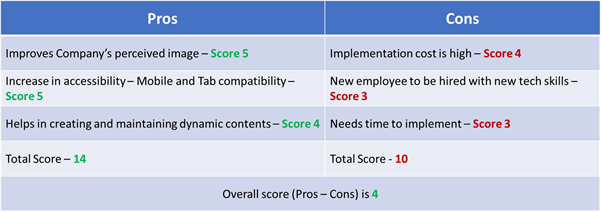
Madhu Rajendran replied to Vishwadeep Khatri's topic in We ask and you answer! The best answer wins!Decision Balance Sheet is the simplest way to decide what to do when you are faced with an important decision and you want to save time looking for the best solution and avoid making wrong decision. It helps the team in making more balanced and confident decisions being a simple and effective decision-making method. It represents the advantages and disadvantages of an idea or a situation, in a tabular form, with the intent of reaching a decision quickly. The situation can be a problem faced or a change to be introduced. The decision balance sheet aids in: · Deciding either to go in favour of or against a problem or change proposed · Helps in improving the understanding of the situation or idea · Speeds up the decision making The tool is particularly useful in a team working environment when you need to encourage team members to consider multiple perspectives to reach a consensus. However, in order to compare different options and to deep dive into those, it is recommended to use other decision-making techniques. In simple word, a decision balance sheet is a table of two columns labelled as Pros and Cons. The table is used to capture all the pros and cons for the given problem/change. A scoring system can be used, by giving numerical weights to the different pros and cons and the resultant score will help in deciding whether to go ahead with the problem/change or not. Another component Interesting can be added if required to capture the elements which are neither Pro or a Con and can be considered as the future implications of the idea. Example: An organization wants to decide on going ahead with moving to a new website The final score here suggests that the organization should go for a new website.
-
Madhu Rajendran replied to Vishwadeep Khatri's topic in We ask and you answer! The best answer wins!What is North Star Metric? The North Star Metric (NSM) is basically the one metric that matters as it best captures the core value your product delivers to customers. Improving NSM by focusing and optimizing organization-wide efforts is the key to ensuring sustainable growth in your company over long term.NSM can be considered as a defining point when measuring how well the problems are solved and the organization’s ability to generate business. NSM usually includes a vision statement along with a metric which is key to measure successTo summarize, an NSM represents your current strategy at its core, measures when the customer gets value from the product and is the leading indicator for future business outcomes which are critical to the organization. Why use North Start Metric (NSM)? NSM holds the organization accountable for the specific outcome. For example, in case of a product-based company NSM provides clarity and helps in focusing on the main goals, ensuring the product team agrees on what features needs to stay, which can be dropped or can be optimised. It helps in ensuring the teams focus and reach easy agreement. Parallelly, the NSM lets you track the progress of your service/product and the goals in a way that the rest of your company can understand. How it generates long term value for customers As NSM should connect to the value that you bring to the customers, it should be a metric that directly connects to the customer value or the “Aaha” moment for the customer and refers the initial interactions the organisation would have had with them which would resulted in their satisfaction making them to come back to use the services/products and also resulted in they recommending you.Primarily the metrics can be either Breadth, Frequency, Depth and Efficiency, explained below with an example from the perspective of an online shopping organization: · Breadth - number of new and returning users · Frequency - number of monthly orders per-user · Depth - number of items per order · Efficiency – the percent of orders delivered on time By focusing on the NSM and monitoring it, the Organization focuses on continuously improving the metric which ultimately ensures that the Customer experience is enhanced considerably and over the long run they benefit by getting better service/product from the organization. For example, if the NSM is efficiency for an online shopping site, then their focus on delivery orders on time result in customers enjoying a trouble-free delivery experience. Conclusion To conclude, the NSM is the most important metric for an organization. It is a priority above all other goals, giving the entire organization a common objective to work towards and helps in reducing disagreements and confusion. NSM ideally focuses on the exact moment of the process which adds value to the customers and that convinces them to continue working with the organization. In the long run, the NSM enables the Organization to perform better and deliver to the customers and for Customer it ensures that there is constant improvement in the user experience and standard of the service/product.
-
Madhu Rajendran replied to Vishwadeep Khatri's topic in We ask and you answer! The best answer wins!Standardized work is one of the key elements of Lean Principles and the most ignored and can be described as a simple description, in writing, of the safest, best quality and the most efficient way of performing a particular process. This description is the only acceptable way to do the process and is expected to improve continuously over the period. The description includes the amount of time taken to perform each task in the process. Standardized work helps in reducing variation and is required for all work areas. “Where there is no standard, there can be no kaizen.”- Taiichi Ohno Standardized work helps in sustaining solutions, continuously improve them and helps in identifying and eliminating previously unseen wastes. To sum up, Standardized Work defines the following essentials for everyone doing the process, resulting in development of a culture of continuous improvement and also in establishing Lean practices: 1. Demand from the Customer 2. The most efficient process routine or process steps 3. Cycle times required to complete the process 4. Process quality checks required to minimize defects/errors 5. The exact amount of effort required in process Steps for Creating Standardized Work · Define the Start and End points of the process which needs standardized work · Determine the extent of standard work requirements · Create all the standard work documents · Train the Employees on the Standard Work based on their roles · Execute the process and monitor the performance · Based on the results make corrections and modifications to the standard work Standardized Work consists of three critical elements: 1. Defining the Standards: Takt Time, helps in achieving the Customer demand, as it is the rate at which an output should be provided to meet the demand. This is the standard to which the process should be performing, ensuring the stakeholder/customer requirements are met. For example, in a Claim processing the Customer expects 100 forms to be processed in the available time of 8 hours, then the Takt time to meet the customer demand is 4.8 min per form 2. Standardize the Process/Method Work Sequencing or Value Stream Mapping helps in sequencing the process steps or tasks in the most efficient order to ensure that the Takt time is achieved. To arrive at the most efficient order, the process needs to be mapped to identify the cycle time for each process step/task which will add up to provide the overall time taken to process. In the above example, the Claim Processing involves four process steps of Indexing, Processing, Quality Check and Approval. Using a Value Stream Mapping, the actual and the ideal cycle time can be identified along with the process steps that add value and the steps that can be eliminated, or time spent can be reduced. 3. Observe the Process and In-process inventory: With one of the key focus of Lean is to reduce inventory, Standardized work helps in defining the standards for the work in progress product as well as the end product ensuring that you have the right product in right quantity
