Sandhya Venu Sanjay
Members
-
Joined
-
Last visited
Everything posted by Sandhya Venu Sanjay
-
Sandhya Venu Sanjay replied to Vishwadeep Khatri's topic in We ask and you answer! The best answer wins!Obeya is "large room" or "war room" refers to a form of project management used in Asian companies (including Toyota) and is a component of lean manufacturing and in particular the Toyota Production System. This is absolutely important in large projects be it any sector where we are working in cross functional team. Either face to face or virtually, iobeya is a digital visual management platform that mimics the obeya room experience, and the benefits are : 1. Aligned to the problem, objective and goals and get to discuss openly 2. To keep the focus on the project 3. Sharing information with the entire team at one stretch, keeping them up to date 4. Enables creative problem solving and innovation 5. Visibility on what each one is working and contributing 6. Team bonding With no walls between the teams it eases out for people to discuss and expedite the execution. Breaks the work in silos which is perennial issue with many organizations. Agility is well demonstrated in such scenarios, devops is one such having a similar approach. A couple of challenges that we need to address could be confidentiality and availability of people at the required time.


-
Sandhya Venu Sanjay replied to Vishwadeep Khatri's topic in We ask and you answer! The best answer wins!A Champion role is as follows: • Own and communicate LSS vision. • Drive the change. • Demand and review progress. • Empower, review, participate, contribute. • Provide resources, eliminate barriers. • Reward and recognize achievers. • Breakdown silos. A Sponsors role is as follows: A sponsor can be at two levels one at the Executive level and the other at the Process level. During project Governance across all the DMAIC phases: Person who reviews & approves the project. Assure business relevance for metrics. Evaluate data collection plan. Review current state Budget and provide resources. Reallocate work to allow team members to participate in projects. Assure multidisciplinary representation if need be. Establish empowerment guidelines. Probe completeness of data. Assess analysis approach. Evaluate and address gaps. Assess practicality of proposed approach. Re-visit the cost benefit analysis. Oversee implementations and deployment plans. Validate improvements. Evaluate financial impacts. Assure disciplined follow through of the proposed approach. Assess BB and GB performances. During change management across DMAIC: Budget and provide resources. Reallocate work to allow team members to participate in projects. Assure multidisciplinary representation if need be. Establish empowerment guidelines. Build organizations consensus to support team’s approach. Influence decision makers to implement change. Facilitate transfer of the implementations and sustenance to process owners. Advocacy and Culture: Retain alignment of Lean Six Sigma culture to strategic mission and vision. Conduct weekly project review meetings. Identify right BB and GB projects. Assure an adequate number of MBB’s, BB’s and GB’s. Make data driven decisions. Act quickly and decisively on issues and obstacles. Model and communicate Lean Six Sigma culture across the board. Take accountability for success and failures alike, lead from the front and demonstrate active involvement. Depending on the organization structure, there can be an overlap on these roles. However, it is important that for the successful deployments of the projects both Sponsors and Leaders/Champions pay a very important role. One of the projects that I was leading would not have found its logical closure and success without the help of the leader/Champion and sponsors, yes there were 3 sponsors to this project. There was a huge pressure being built to complete the project earlier but there were reasons why the deployment had to be pushed due the revised sprints rollouts, both the leader and sponsors heard my submissions, reviewed long with me and confirmed that they will all support the reason for delay with to ensure successful completion. It was encouraging and the entire team took it up as a challenge and completed with the value that we had to deliver on the revised dates. The spirit of project team members was kept alive by being pragmatic to the dynamic situation was considered. Eventually, team members are formed to make the project successful, but it needs enormous understanding of the situations by the leaders and sponsors to support with appropriate decisions to make it work on ground. I feel very honored and a sense of accomplishment for having been part of this project & would like to thank the entire to team to their commitment and consistent support. There can be many more such success stories to quote when each one of us understand one another and play our roles well.

-
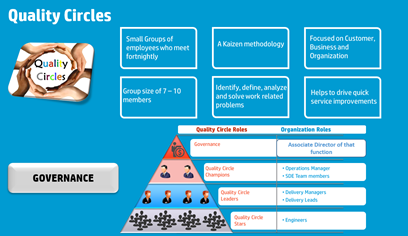
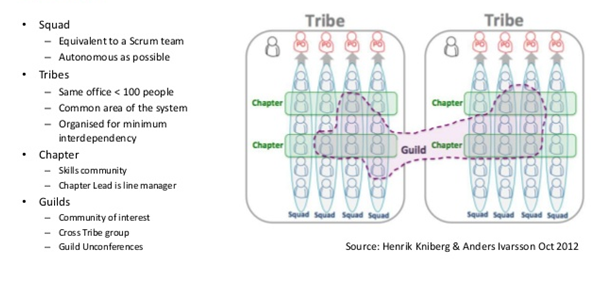
Sandhya Venu Sanjay replied to Vishwadeep Khatri's topic in We ask and you answer! The best answer wins!Quality Circles: A group of team members who do the same or similar kind of work get together and identify few issues/ concerns and deliberate together on the probable improvements and development. This can be adopted across organization, people on job are the one’s knows the techniques to manage and improve the quality and this will build in a philosophy. The one who is on job is the most trained person to bring improvements provided they take sometime out to sit back and understand the day to day issues, identify the concern areas, analyze and find resolution to the problems through simple, innovative and unique ideas. Yes, it is very much relevant even today in the organization: One such framework that was implemented in IT infrastructure services is provided below. We created a governance mechanism to ensure that the ideas are logged, tracked till their completion. We clubbed it with the organization roles to enable the small group employees to work together to identify the related problems and they are arriving at the improvement and where required we have the seniors/supervisors and required support team assistance for the completion. In this framework we came across of self-motivated who were limited number met frequently with their own interest to identify areas of improvement at a periodic interval arrived at action items and reported the status of the same with their supervisor. The status update was presented with and probable solutions which were arrived with detailed analysis such as severity of the problem, urgency of the problem, and frequency of the occurrence. Supervisor would evaluate each of these solutions vs problem and take it up to the management to get the necessary approvals on investments, change management and consensus for implementing the solutions. I remember those days with my colleagues when we implemented this and it was a huge hit because everyone could relate to it as it went well with the organization structure. And it also got the traction as there was rewards and recognition associated with it along with the strong governance model. Since quality circle is more a voluntary activity it can die if it does not get the management support. An Agile organization is very similar to the quality circles in my view. There can be improvements identified with in Chapter, Tribes and squad. Quality circles and agile sprints both work towards coming up with best solution. There is a cross functional team approach for quality circles, and we see the same with mix of roles coming together in sprints to achieve a common objective and bring in improvements sprints after sprints In agile organizations we do see self- motivated individuals and self organized teams who are empowered to come together by their supervisors to solve business problems. There is so much of similarity in the way quality circles relates with Agile. In both the approaches we see the focus is on customer and organization objectives. The concept of quality circle is not time bound, it will be applicable across times, we may use different names to make it relevant as per need. It can be called in various names and adopted in different forms but the spirit of it remains the same.
-
Sandhya Venu Sanjay replied to Vishwadeep Khatri's topic in We ask and you answer! The best answer wins!Managing Stakeholder and delivering the outcome with utmost value with the available resources is one of the interesting and very important skill which will ascertain the future growth of the business. It is very interesting to experience that there are far too many requirements to meet and all of them seem to be important, however, we need to prioritize to deliver those that can reap business benefits early or most immediately. We often hear our managers saying how important a particular action or activity is, and there seems be not one but many coming in our way and with the limited resources it becomes extremely important to prioritize and communicate to our managers internally and the stakeholders to help us to help them better. MOSCOW prioritization technique Frequent conversations with the customer/stakeholder will help us know which is that we need to Must have, which will give us a direction to focus. This is much better technique vs only looking low, medium and high priority. Here is how what must, should, could and won’t have can be understood The Agile framework talks about this and how we arrive at the minimum viable product in every sprint/cycle for the engagement/project. Keeping mind, the time and budget we should be ready to leave out the Won’t have and Could have. Rather look at Must and have and which of those should have can be delivered in a later time box rather than considering everything into on deliverable. This priority technique will also help us to understand the features of the product and judiciously use our time and budget As an example: I would like to bring your attention to the below picture where the focus of the coverage of the solution and effort be. We should drive at looking at the 60% of the effort are focused on the must have and put together around 80% of it to the Should and must while there can be 20% of it considered for could have. This gives us an indication on how we need to cautiously utilize time and effort. Picture credits : Google



-
Sandhya Venu Sanjay replied to Vishwadeep Khatri's topic in We ask and you answer! The best answer wins!Change effectiveness Equation: Bringing in Change has been one of the toughest and challenging irrespective of the change. We all enjoy the status quo which have been very comfortable with and it becomes very difficult to adopt. However, a change should begin with oneself. Being a leader / advocating change in the organization, it is important to bring in a design the change in a methodical way. Let us not forget that we need to bring in changes along with the day to day work and it does take a toll for the leaders to get the people on their side of the change. Many times, the leader and the close members are so engrossed with the change that they do not understand and help the rest of the larger team, organization understand how we help them navigate the change. Not that there is always resistance, but they do not know how to adopt to new change. Hence there will be a need to hand hold and take them along in the journey. Five things that can help us to handle the Change management better is by ensuring there is least resistance, how will we do that as leaders; 1. Engaging the team members at the early stages for them to own the actions and allowing the changes to be embraced by all involved 2. Bringing in clarity on roadblocks that we will collide if we continue with the status quo 3. What is in it for me: Visibility on the Vision and the benefits that it will bring in the long term should be higher than the resistance to change. 4. Start small, incremental changes, reaping small benefits for one to get comfortable and accept it slowly. 5. Consistently monitoring across the change cycle Every person becomes important and can add on to strengthen the change management. A change effectiveness equation is a product of quality of the technical strategy (Q) and acceptance of that strategy (A) Therefore, Change effectiveness equation E = Q X A. The Change Equation, developed by Richard Beckhard and David Gleicher, is a simple change model that shows us how to engage individuals at all stages of the change process in order to achieve successful organizational change. Note : Credits to the respective pictures inserted from the google search.


-
Sandhya Venu Sanjay replied to Vishwadeep Khatri's topic in We ask and you answer! The best answer wins!EMO Index There are different ways on how we intend to take a feedback and arriving at method to make more appropriate to the one who will consume it, be it Kano model, Net promoter score and others. EMO Index, this is one such indicator adopted to gauge emotional state of the stakeholders, clients. There are several ways how we are receiving the feedback primarily through the telephonic interviews that we conduct, survey questions, face to face interactions. Methodology : Here we are trying to fit in a close emotion to the general feelings of each customer which can be extended to product, service and organization. The emotions can give us more clarity as to who are those super excited customers who will get us more through their influence. Those happy will continue to be there but cannot expect them to be promoters etc. Translating by capturing the energy levels of their association will help us to get more insights for business expansion, retaining business and deactivation.
-
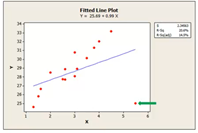
Sandhya Venu Sanjay replied to Vishwadeep Khatri's topic in We ask and you answer! The best answer wins!Influential Observations: The observations that we should not ignore while concluding on the calculation or formula and the deletion /exclusion of those data / observations may noticeably change the result of the formula/ calculations. Many a times we have noticed that the influential are also the outliers hence there is every chance that we miss it. During the regression analysis there can be misses due to not considering the influential observations which will end up with huge impact on the parameter estimation. Let us consider the scatter plot Y vs X in the below example where we intend to estimate through a regression model. In the first equation that we have estimated calculates Y = 25.69+0.99X, however when we exclude the outlier and estimate the equation changes to Y= 22.33 +2.35X. It is clear now that there is a huge influence of the data point in the equation. It also means that influential observation has a disproportionate effect on the least squares model hence it is one such data point which will have a high impact on the slope coefficient and the y intercept. Reference : 20/05/2015 by Cincinnati State Statistics It is not necessary that all the outliers are default influencers and hence always advised to check and confirm if the outlier is an influential observation or not before considering removing it from calculations. When the outlier impacts the slope of the regression it is called an influential observation.

-
Sandhya Venu Sanjay replied to Vishwadeep Khatri's topic in We ask and you answer! The best answer wins!Decisional Balance sheet WHAT is Decisional Balance sheet: It is an important Continuous improvement toolkit. It is a key tool to understand why change is essential and what could be the pros when we implement and cons when we don’t implement the change. WHY: Change to better is a continuous process. It is important that we influence individuals, teams to know how important the change is and what is in it for them to adopt and before that consciously they take a decision. HOW: In a certain circumstance and as and influencer, change manager, you want to convince your team or an individual on the options, choices and help them understand the situation better. It is one of the decision-making techniques. It is also called balance sheet because it gives you the positives, pluses, assets when you adopt to it and negative, minuses, liabilities when you ignore it. I would like to bring the present situation, pandemic and lay out this decisional balance sheet for each one of us. Decisional balance sheet for some of them not wanting to get vaccinated to fight the pandemic Pluses / Pros Minuses / Cons Not getting vaccinated and not following safety rules Infection will not come to me I am physically strong and can deal with it as I could deal with so many other viruses Isolation & mental stress Health problems Financial stress Highly restricted social life and you pass on the infection to others Adding on to the increasing numbers Getting vaccinated Feel secured and mentally strong Equipping myself to fight the virus Supporting the cause of not getting infected and transferring the virus. How will people know whether I am vaccinated or not? Can I lead a normal life, while there are so many restrictions? Getting vaccinated and following safety rules A responsible citizen It makes me less anxious No financial stress and health problems Can you do day to day work with confidence Overprotective Will there be more vaccinations to take? What can be further added to this is a number to score the positives and negatives. Which can help us to weigh the pros Vs cons.
-
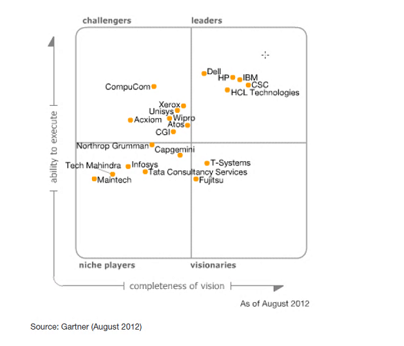
Sandhya Venu Sanjay replied to Vishwadeep Khatri's topic in We ask and you answer! The best answer wins!Product Portfolio Matrix : A portfolio matrix is a representation of products or process in a matrix of 2x2 assisting us to understand , map, prioritize and help us take decisions accordingly. As an example, I want to share below one such analysis which was done in 2012 by Gartner on the completeness of vision an ability to execute. The chart is for growth in the industry either being leaders, challengers, niche players and visionaries. Organization is being analyzed and mapped on the matrix in terms of their Vision and ability to execute in the infrastructure utility services. Identifying the few from the many. I would like to share an other example of the process related as I have not worked on Product matrix. Sharing only a template for the understanding purpose In order to identify which of the process are ready to move into productivity improvement, we at our organization came up with 2x2 Productivity priority matrix where we tried to map in High Business impact process Vs Ease of Measurement. With this prioritization of the process we could get the footprint. With the available resources and time we could clearly identify the few process which are business critical and easy to measure and hence it helped in convincing the leaders to get started with the vital few process. It is important to be aware that this exercise is not one time. It will time bound and hence will have to re-do this every time a decision has to be made. A comparison with references to earlier matrix can also differentiate the changes over a period of time.