


Manoj Kumar Alagesan
Lean Six Sigma Black Belt
-
Joined
-
Last visited
-
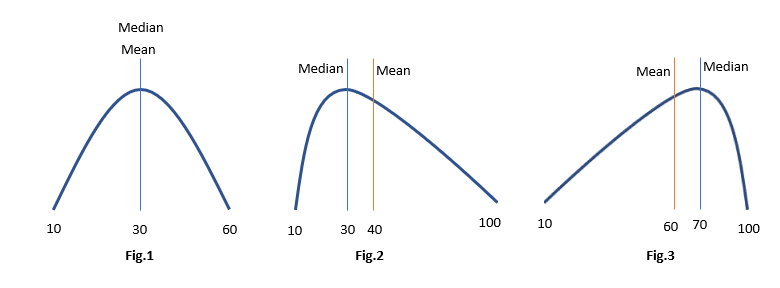
The central limit theorem is used to define the location of data distribution, there are three measures of central tendency Mean, Median and Mode. Mean is simply the arithmetic average of data. Median is a middle number in an ordered dataset. Mode represents the frequently occurred data in a dataset, a dataset can have no mode or bi-mode (two-mode), if the data set has more than 2 modes then we have to consider as the data set has no mode. In Fig.1 the data is normally distributed so all three measures are the same, sometime depends on the data there is a better way to represent the location/middle of the data. In Fig.2&3 the data is skewed mean & mode are same but these are not representing the actual location of distribution, but the median represents the location more accurately, here the difference in mean and median is because of the nature of mean, mean is easily affected by the outlier. When facing the skewed distribution, it is advisable to look for the median to find the location of distribution, for right-skewed distribution mean will always be higher than median whereas in left-skewed distribution median will always be higher than mean.
-
Manoj Kumar Alagesan replied to Vishwadeep Khatri's topic in We ask and you answer! The best answer wins!Of course, it's one of the best and simplest way of achieving process excellence, But there are many reasons for considering it as an optional or less priority one Below are some of the reasons; Documenting Lessons Learnt (LL) required some extra effort and time A set of paradigm developed about processes and standard work procedures, if existing standards or processes have no flaws then why we have to capture those unnecessarily Often Lessons Learnt (LL) is considered as mistakes instead of lessons. No one is willing to admit their mistakes it's a human tendency Not knowing the impact of Lessons Learnt (LL)
-
Manoj Kumar Alagesan replied to Vishwadeep Khatri's topic in We ask and you answer! The best answer wins!When we are looking forward to attaining process excellence there are many ways, in which we can excel in our process, the most commonly used are lean and six sigma Lean(Precision); Lean focuses on improving efficiency (Performing or functioning in the best possible manner with the least waste of time and effort). Lean focuses on identifying and eliminating 3M's, Muda; any activity or process that does not add value (e.g, the 8Wastes) Mura; unevenness in the process and supply chain (e.g, when companies ramp up production to meet targets, even when there is no customer demand) Muri; overburden (e.g, unnecessary stress to our employees and our processes) The strategy of lean is to eliminate the wastes(Muda) caused by Mura(Unevenness) and Muri(Overburden) by using tools like 5S, Kaizen, 8Wastes, Poka-Yoke, Kanban(Pull system), SOP, Visual Standard Simply Lean is doing things right (Inherent process capability_Cp) Six Sigma(Accuracy); Six Sigma focuses on improving effectiveness (Producing the intended or expected result) Six Sigma is a vehicle for strategic change (Both Transformational & Transactional), it provides businesses with tools to improve the capability of their process and ensures the process is aligned with customer requirements by reducing variation in the process Simply SixSigma is doing the right things (Resultant process capbility_Cpk) Lean Six Sigma; Lean Six Sigma is an integrated concept of Lean and Six Sigma, it focuses on reducing the variation by eliminating wastes. Nothing is superior to one another both concepts have their own traits, the need of these concepts may vary depends upon the situation

-
Manoj Kumar Alagesan changed their profile photo
-
How to incorporate six sigma concepts in wiring diagram creation process
