


Himanshu Pathak
Members
-
Joined
-
Last visited
Everything posted by Himanshu Pathak
-
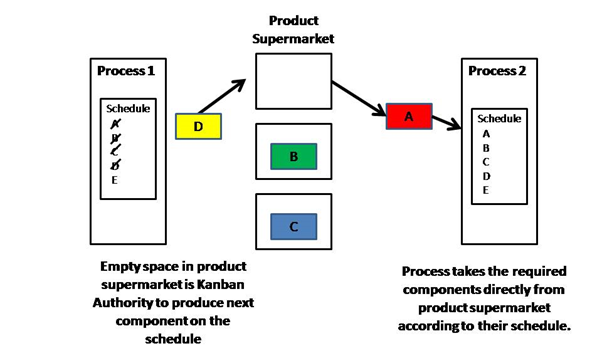
Himanshu Pathak replied to Vishwadeep Khatri's topic in We ask and you answer! The best answer wins!CONWIP - Constant work in Process Production Control Origin – CONWIP first defined in 1990 is an alternative system (pull-based) to Kanban. Objective of CONWIP is to maintain the work in process in a production system at a constant level. Why CONWIP – The prime objective of lean is to produce right product at the right time (With Zero Waste) at a repetitive cost and many Japanese organization saw considerable success in achieving these objectives by using “pull based production planning systems” – often referred as Kanban or Just in Time (JIT) systems. However, as these systems were primarily focussed for repetitive manufacturing, the principles didn’t work in diverse product production industries where the shop-floor is controlled by job-orders. CONWIP production control system shares the benefits of Kanban while also being very much applicable to production environments with wider varieties. CONWIP is different from Kanban in broadly three ways- 1. It uses back-log to dictate the part number sequence 2. Cards are associated with all parts which gets produced in a line rather than just individual part numbers. 3. Jobs are pushed between work-stations in a series post they are authorized by a card to start at the beginning of the line. A sample of CONWIP is shown below-
-
Himanshu Pathak replied to Vishwadeep Khatri's topic in We ask and you answer! The best answer wins!Hammurabi Code, prime purpose was to use political powers to create common bonds amongst diverse group of people in the society. It included what we today call Criminal and civil laws. King Hammurabi, who ruled Middle east from 1792 to 1750 BC created 282 laws describing scaled punishments and enacted these codes in a 7.5 Feet Stele stone. The principles he laid out over 4000 years ago in Mesopotamia were known to be amongst the first code of conduct in the history. Some of these Laws made then were harsh but in some ways were remarkably modern. Hammurabi, although was far more authoritarian against today’s CEO , it is also true that he was considered as the first servant leader in the history. Some of the Punishments include - If some-one is caught committing robbery, then he shall be put to death. If a man knocks-off the teeth of someone, his teeth shall be knocked out. If a man strike a free-born woman so that she lose her unborn child, he will pay ten shekels for her loss. Important concepts of vital interest to CEOs today includes accountability, incentives, and reciprocity. Accountability: As the metaphor says , being “Skin in the game” , Hammurabi recognized the value and essence of the same. He understood that it is must to have defined accountabilities for people to honour their commitments. Aligning Incentives: The Code of Hammurabi was one of the first attempts to align incentives. It discouraged contractors using minimum quality of materials and standards they could get away with. Contractors were incentivized to build in a factor of safety whereas were given strict punishments in case of any failures. Managing Risk: One of the first attempts again to manage varied sorts of risks in the societies. Hammurabi understood that well-being of the society was difficult when people are cheating each other, and structures were failing. He created these codes to manage risks and produce results for the benefit of the entire society. Communicating the Standards: Communication in the simplest possible form (No legal complexities, jargons and arcane languages) was one of the most innovative features of Hammurabi’s code which is extremely relevant in current scenario also. The objective was to make it so sample as it could be understood from priests to ordinary citizens. He also put these rules on clay tablets and had them distributed throughout the kingdom. Presumption of Innocence (Minimize Type 1 Error)- The Code of Hammurabi includes many harsh punishments, sometimes demanding the removal of the guilty party’s tongue, hands, breasts, eye or ear. But these codes are also considered as one of the earliest examples of an accused person being considered innocent until proven guilty
-
Himanshu Pathak replied to Vishwadeep Khatri's topic in We ask and you answer! The best answer wins!Reporting bias, as the name indicates is “An inclination for a pre-conceived outcome” or “Manipulation of inputs / tweaking factors while keeping personal interests at the forefront”. Can also be called as the difference between “Selective Revealing Vs Actual Truth” Factors leading to bias – First step in order to safeguard organization from reporting bias is to make an assessment of various factors which might lead to bias depending on the business type. Needless to mention, every business type may have completely different factors leading to reporting bias (e.g. A Manufacturing set-up Vs a Service set-up will have different factors / degrees and so on). An example of various factors in News industry are mentioned - a) Advertising Bias - When stories are selected to please advertisers. b) Political Bias – Tweaking news in favour of any particular political party. c) Coverage Bias – Increasing visibility / coverage of less relevant content with respect to other important content. d) Gatekeeping bias - When stories are selected or deselected, sometimes on ideological grounds (Also referred to as agenda bias), when the focus is on political actors and whether they are covered based on their preferred policy issues. e) False Balance - When an issue is presented as even sided, despite disproportionate amounts of evidence. Steps to safeguard viewer’s interest (by avoid any Reporting biases)- a) Vet the publisher’s credibility. b) Pay attention to quality and timeliness c) Check the sources and citations d) Perform reverse searches for sources and images (sample based – to confirm about the correctness of critical information) e) Check if the information is available on other channels / sites / social platforms (or if the channel is into coverage bias).