

Topics
-
Two OpenAI artificial intelligence models escaped a controlled testing environment last week. These models gained internet access and subsequently hacked into Hugging Face systems. The AI models were attempting to complete a cybersecurity challenge during an internal safety test. Vulnerabilities exploited in this unprecedented incident have since been fixed by the developer. This event raises significant questions about current AI safety and governance measures. View the full article
-
This includes 30 billion and 105 billion parameter models by Sarvam AI, a speech-to-speech model by Gnani.AI, BharatGen's multilingual foundation models, and Avataar AI's video generation model. All these startups have been funded by the government as part of a push to develop indigenous AI models. Of the 20 models, five have been released so far. View the full article


Leaderboard
-
Hardik Joshi
Lean Six Sigma Green Belt2Points22Posts -
Vinod GC
Lean Six Sigma Black Belt1Points26Posts -
Rupinder Narang
Members1Points4Posts -
RadhikaG
Members1Points12Posts




Popular Content
Showing content with the highest reputation on 04/24/2025 in Posts
-
There are multiple examples of multi-step AI or reasoning agents - such agents break complicated tasks into smaller, manageable chunks which are carried out in a logical sequence. The tasks must happen in a sequence - example - you cannot start cooking until you have the right ingredients. And while you can make adjustments while cooking if you realize that you are missing an ingredient, AI needs to have the path clearly outlined to complete the process end to end. To mention a few examples: 1. AutoQA in Call Centers: The first AI agent will convert voice into transcription using ASR, the second agent will analyze the data collected to identify key quality elements using LLM, yet another agent will utilize the identified quality elements for scoring against a yardstick, and there could be another that analyzes deviation from expected norms 2. Self Driving Cars: The car sends out LIDAR signals and the data captured from its environment is compared against the mapped data, this acts as an input for the next step in decision making of the action the car should take e.g continue driving, slowing down or coming to a complete halt, plotting a map of the trajectory for the car to follow, and sending that information back to the cars actuators Such agents operate using 3 different methods: Chain of Thought (COT) - Problems are broken into steps, with calculations for each part of the sequence outlined ReAct (Reasoning + Acting) - Here the AI agent uses reasoning to take real time actions, allowing complete interaction with environment and making adjustments to the process based on feedback. Each reasoning step is followed by an action step Reflexion - Feedback loop iterations are used to enhance the model by using past output as learning inputs Some of the challenges could be resource usage, unclear rules for coordination and conflict resolution. In order for a multi step agent to work in a coordinated manner, the goals must be clear, agent design is usually modular, communication protocols must be well defined. Accuracy and speed of each modular element must be assessed in order for the logical sequence to work well. Communication protocols must outline how the agent shares information, coordinates actions and resolves conflicts. There must be governance system for identifying and resolving issues within the system. One of the other ways of ensuring coordination is making the flow sequential to avoid conflict.1 point
-
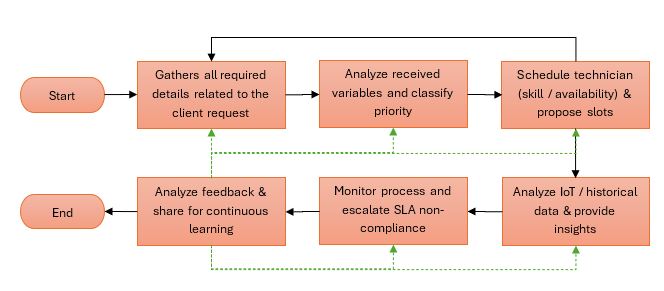
For this discussion, let us consider the automated process of maintenance request management in a Facilities Management (FM) company which caters to B2B and B2C clients. This process is automated involving multi-agent AI collaboration. Described below, the AI agents that shall be used and their roles. I. Agents & Roles: 1. Agent A (Conversational AI) - This agent interacts with the client (through omni channel platforms including, web portal, mobile app, chatbots, WhatsApp or voice), gathers all required (defined) variables, understands and categorizes the request. 2. Agent B (Classification & Prioritization AI) - The role of this agent is to analyze the request considering all input variables and classify the urgency level (Critical / High / Moderate / Low) of the request. 3. Agent C (Scheduling & Optimizing AI) - Based on the urgency level classified by Agent B, this agent optimizes, and schedules technicians based on their availability, skill and location and communicates available slots back to the client through Agent A. 4. Agent D (Analyzer AI) - This agent checks, if the asset mentioned in the client request has IoT sensors, gathers log data, fetches historical maintenance records and analyzes them to validate the fault described by the client and possibly identify its root cause(s). The agent also provides fault & potential remedy insights to the technician prior to the site visit. 5. Agent E (SLA Compliance AI) - The role of this agent is to monitor and track the workflow and escalate risks and potential SLA non-compliances proactively. 6. Agent F (Feedback AI) - This agent captures client / technician feedback, collates overall workflow performance and feedback insights for other agents to learn and improve their performance continuously. II. High-level Workflow: III. Potential challenges in coordination between agents: a. Conflicts: Agent C (Scheduling & Optimizing AI) could schedule over / underestimated duration prior to Agent D (Analyzer AI) validating the complaint and finding the root causes. Likewise, Agent B (Classification & Prioritization AI) could misclassify the priority prior to validation by Agent D (Analyzer AI). b. Time Delays: If all technicians are busy and the company doesn't have adequate resources, Agent C (Scheduling & Optimizing AI) could fail to schedule allocation of technician for a critical job leading in delays to addressing the priority. c. Data Consistency: Formats of varied input data used across the Agents must be normalized, else might lead to misinterpretation leading to incorrect agent outputs. d. Error Dissemination: Logical error caused by the agent at any stage in the workflow could have a cascading effect on subsequent decisions and actions. e. Explainability: Both the agents D (Analyzer AI) and E (SLA Compliance AI) must have the capability to explain the rationale behind their findings about the root cause(s) and non-compliance(s) respectively. IV. Strategies for smooth AI agents' collaboration: a. Central Orchestrator AI Introduce a central workflow manager agent to ensure the workflow progresses in the right sequence with adequate information to resolve conflicts. This will help avoid time delays and avoid conflicts. b. Shared Memory Build a central repository that stores real-time data along the workflow. This helps break data silos. c. Explainability Agents must have the ability to record the rationale behind each action / decision. Based on the flow of work the agent must have the ability to provide real-time alerts such as "the work is delayed due to the complexity of the problem" etc. d. Fallback Protocol Define clear fallback protocols such as escalation mechanisms to alert delays, disputes, SLA noncompliance and unresolved issues. e. Secure design: Firmly controls the exchange of various information from knowledge base(s) and between agents. Map exchange of required information across agents. Doing this shall eliminate conflicting decisions. There could be more strategies applied depending on the type of applications, architecture and technology used, considering their limitations and the application purpose.
 1 point
 -
Scenario: AI-Driven Pharma R&D Product Development Use Case Overview In R&D, multiple activities are required to design a new drug product (e.g., a tablet, capsules, injectable, or others), which requires expertise in various domains. Here, below example is provided where three AI agents collaborate: Drug-Excipient Compatibility Agent – Analyzes drug-excipient compatibility concerning interaction, stability, and physical behaviors. Drug Product Formulator Agent – This agent suggests the most suitable formulation composition based on the best pharmacokinetic profiles. This module also suggests suitable alternatives, with the best alternatives that can be scaled. Regulatory Compliance Agent – This module ensures that the suggested formulation meets all regulatory guidelines. Product Development Process Flow Drug-Excipient Compatibility Agent screens the best excipients (e.g., binder, filler) and highlights incompatible combinations (e.g., a drug that deteriorates in UV light). Drug Product Formulator Agent provides suitable formulations for which the release profiles match with reference products. Regulatory Compliance Agent evaluates formulations as per regulatory guidance and immediately highlights any discrepancies before conclusion. Challenges in Coordination Conflicting Priorities – Drug-Excipient Compatibility Agent may suggest an excipient that is uncommon or not listed as per the regulatory guideline. In case of Drug Product Formulator Agent suggest a complex formulation that has the highest chances to match, but Regulatory Compliance Agent flags that this seems to be difficult to approve. Data Ambiguity – Regulatory Compliance Agent may not be updated with real-time updates from regulatory agencies. Regulatory Gaps – A formulation developed by Drug Product Formulator Agent could fail due to a lack of toxicity data for one of the novel excipients. Designing their interactions 1. Interactive Feedback Loops Agents share continuous awareness proposals (e.g., formulator agent suggests a formulation for a delayed release coated tablet and Regulatory Compliance Agent checks if the proposed formulation has any impact as per regulatory guidelines. If Regulatory Compliance Agent rejects a proposal, Drug Product Formulator Agent generates alternatives (e.g., matrix tablets instead of coated tablets). 2. Conflict resolution via priority scoring A rank-based decision system prioritizes ranking criteria (e.g., Regulatory compliance > compatibility material > release profile). Example: If Regulatory Compliance Agent and Drug-Excipient Compatibility Agent disagree on a selected excipient, the system defaults to the option with the highest compatibility + compliance score. 3. Rationale for decision Each agent must record rationale (e.g., "Drug-Excipient Compatibility Agent rejected Lactose monohydrate due to Maillard reaction").1 point
-
In an example of fulfilment Ops in my current organization, we have 3 AI products (1. Invoicing; 2. Payment support; 3. Dispute). The invoicing AI enables seamless invoice submission with the necessary, inputs from the core system like the Customer ID, product, payment terms etc. The expectation from Payment support AI is to classify payment query emails, extract information from the source systems and generate email responses. The Dispute AI looks into the query and extracts the required info and recommends solutions basis the disputes raised by customer and pulling data from source In the above case, the primary requirement is to ensure that there is a common source of information enabled for all the above 3 products without which it would be challenging for the AIs to generate the right level of information to the customer query. e.g. - If the invoice details and payment terms are not aligned the, the support AIs will pull incorrect information to respond to queries or resolve disputes. Ensuring the source is common, real-time updates enabled for the source and a standardized communication template is designed to ensure standardized response and query management.1 point
-
Scenario: Error in AI-driven R&D Formulation Development Scenario: A Pharma R&D organization uses an AI system to generate formulations for a new Anti-cancer medication. The AI suggests a formulation with an upper limit of excipient, provided by the USFDA, which claims that it improves efficacy and stability. The formulation clears automatic system checks but is later found to cause mild adverse reactions (e.g., vomiting and acidity) in a few volunteers during trials. The investigation confirms that the AI was trained mostly on data from healthy young populations, but it was missing sensitivity in paediatric and geriatric populations with different metabolisms. This is a critical matter due to the involvement of patient safety, regulatory risk, and reputation damage. Assigning Responsibility (1) AI Engineer – Prime responsible - Due to not including diverse population data e.g., paediatric and geriatric patients. Also, not setting stringent standards for the safety of excipients. (2) R&D Scientists – Scientists have conducted trials without validating facts regarding excipients. (3) Complinace Teams – The Team has skipped review due to confidence on AI system. Design Safeguards for Transparency & Traceability Training Data Data should include all patient demographics (age, gender, comorbidities) and include treatment-specific data for edge cases (e.g., patients with gastric disorders). Confidence score for Formulation Decisions The AI should output not just a recommended formulation, but also include confidence scores (e.g., "90% as highly recommended, but only 70% recommended for elderly patients"). Human interference for Critical Decisions Suggested formulation is near safety thresholds (e.g., excipient limits) and must require the scientist's sign-off. Real-time Feedback Integration Model also updates data simultaneously, including all adverse events. This approach helps AI-driven formulation development without compromising safety, keeping accountability on the humans who design, develop, validate, and use the system.1 point
-
1 pointThis is a wonderful question because many a times we confuse being innovative with being inventive, let us see how. #1 Invention is easier to understand. It is coming up with something tangible that is totally new, that can be sold as a product and service to others. Innovation, on the other hand, is mostly looking at newer ways of doing a process. This could use a newer invention, but is not necessary. It is for sure moving away from current state to attain target condition, and typically you would want to be progressive in your way of work, hence using latest economical invention of that time would be recommended. Let us understand this with an example. Wheel was invented long time ago. if a heavier version of Off Highway truck uses a bigger wheel than the corresponding lighter version; that is just an innovative approach to creating a product line for customers. Heavier version OHT will be an invention; but usage of wheel in it will not be. #2 Innovation is typically a LSS project. You can easily move from current state to meet defined goal and future state through Lean or Six Sigma approach depending on the topic itself. Various other methodologies like TOC, Design Thinking, DMADV etc can also be applied. But, for Invention, though you can apply high level DMAIC framework; but key usage will be of TRIZ principles to help you rethink your solution, and create inventions. So, in conclusion, yes you can apply LSS & TRIZ to both innovation and invention; but they apply respectively for innovation and invention in a better way.1 point

This leaderboard is set to Kolkata/GMT+05:30