

Topics
-
Humanoid, a UK robotics firm, secured $152 million in Series A funding. This investment fuels the development of next-generation platforms and proprietary AI software. The company plans beta robot deployments at customer sites later this year. Humanoid has established partnerships with major technology and manufacturing companies. Bosch will serve as the contract-manufacturing partner for the new robots. View the full article
-
German authorities warned Tuesday of the "growing influence" of AI and digital technology on the sexual abuse of children, saying in a report that criminal abusers are increasingly using those tools. Sexual abuse of minors is "increasingly shifting to the digital realm," driving overall statistics "upward", said Holger Muench, the head of Germany's Federal Criminal Police Office (BKA). View the full article



Leaderboard
-
Shubham Chamoli
Members1Points14Posts -
Sanuja Godaarawa
Members1Points10Posts


Popular Content
Showing content with the highest reputation on 11/05/2024 in Posts
-
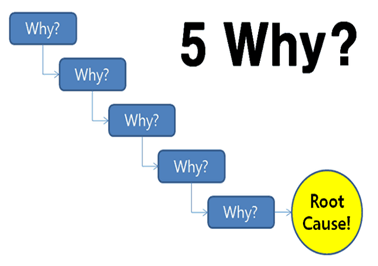
1 point5 Why analysis is a problem-solving technique which used to find the root cause by repeatedly asking the question “why”. Even though it is a powerful and widely used tool for root cause analysis, it is not suitable for every situation and there are better alternatives such as fishbone diagram, FMEA (Failure Mode and Effect Analysis), Tree diagram, C&E matrix (Cause and Effect Matrix), pareto analysis and etc that can be used depending on the complexity of the problem, the level of details needed, the type of industry and the issue at hand. Some situations where 5Why is advisable are as follows, 1. When the problem is simple and clear It is effective when the problem's root cause can be directly identified and followed through a clear sequence of events. Eg: A production line stops because a machine isn't operating. 2. When the problem is not complex If the problem is known and causes are easily identifiable then the 5why analysis can be used effectively Eg: An employee misses deadline to finish a report. A brief investigation could indicate that they were not given clear instructions or were distracted with other tasks. 3. Recurrent and repetitive issues When the same issue happens repeatedly then the 5why analysis can be used effectively to eliminate the issue. Eg: Customer consistently complain about slow service. Asking why it can be revealed that the cause is understaffing and can be addressed by hiring more employees. 4. When time or resources are limited When time or resources are limited, and you need a fast, accessible way to investigate an issue, the 5 Whys can offer insights without requiring extensive data collection or analysis. Eg: In a fast-paced workplace, a team leader might use 5 Whys to quickly understand why a task was delayed and address it immediately. Some situations where 5why is not advisable 1. Complex problems When the problem is complex and has multiple independent causes 5why cannot be used effectively. Eg: A factory is experiencing high defect rates in its products, which could be due to a combination of poor machine calibration, inadequate training, improper materials, and a lack of quality control checks. In such cases, the 5 Whys may miss some of the contributing factors, and a more thorough analysis like a Fishbone Diagram or FMEA would be more appropriate. 2. Lack of experience and knowledge of the team If the team does not have sufficient experience or understanding of the process or system, they might inadvertently stop at the wrong cause or overlook important factors. Eg: In an IT company, a system crashes repeatedly, and a team without enough technical knowledge might assume it’s a hardware failure when the root cause is actually a software bug. In this case, more technical tools (like Log Analysis or Root Cause Tree Analysis) would be necessary to get to the correct conclusion. 3. When the problem is highly subjective If the problem is subjective or related to human perception, emotions, or behavior, the answers may be biased, and it may be difficult to find the root cause using this method. Eg: In a customer service scenario, a customer reports dissatisfaction with a product, but the exact reason for their dissatisfaction is unclear. If the issue is related to subjective factors like expectations or personal preferences, 5 Whys might not be able to uncover the true cause, and other methods like customer feedback analysis or surveys might be more effective. 4. When it is required to quantify the cause 5whys works best with the qualitative data but for problems that require precise measurements or statistical evidence to identify trends and causes, it might need tools like Pareto Analysis, SPC (Statistical Process Control), or Regression Analysis. Eg: A manufacturing process is showing variation in product dimensions, and you need to quantify the degree of variation. In such a case, statistical analysis (like Control Charts or Histograms) would be a more effective approach than 5 Whys.
 1 point
 -
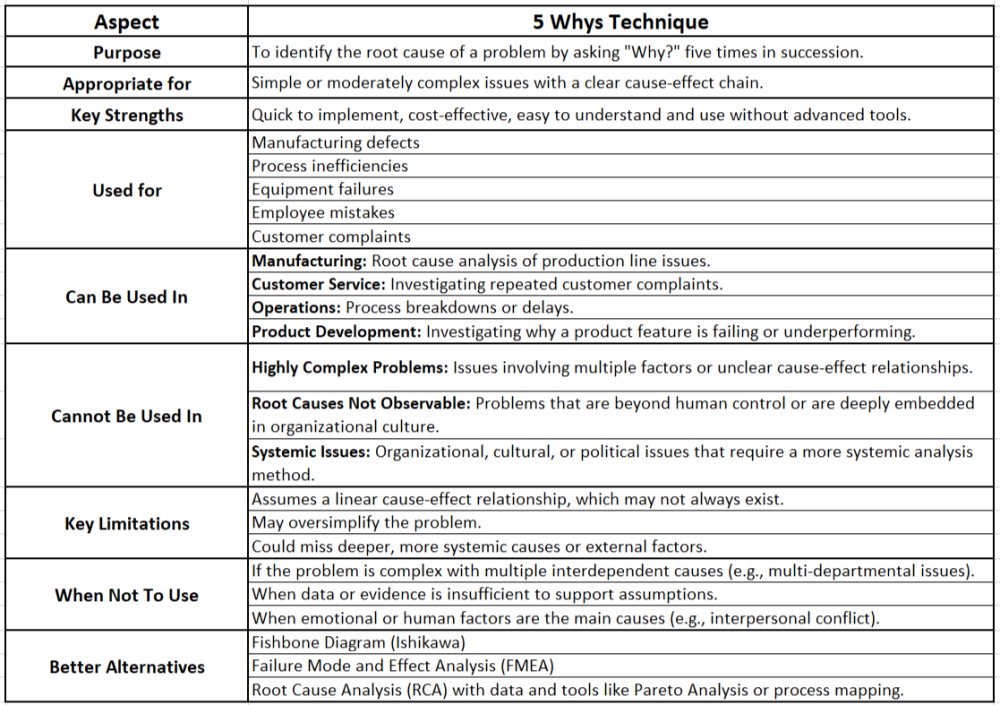
1 point5 WHY TECHNIQUE 5 Why methodology was originated in Toyota by Taiichi Ohno and Toyoda Sakichi. The concept behind this method was to find a permanent solution to the problems that were being faced on production floors. For elimination of the issue/problem permanently, it is necessary to reach to the main cause or root cause of the problem. Japanese always believed in the concept of "Go and See yourself", i.e. to understand the problem, one must go on the floor and witness the problem. So, it is important that we ask these questions from person who are involved in the process. As per the technique 5 Why, it is believed that if we ask 5 whys to the problem, we will reach to the root cause of the problem. It clearly means that the problem that we are facing may seem easy to solve but in spite of implementing the solution, the problem may resurface, reason being that the actions were taken but not on the root cause of the problem. It is important to reach to the root cause to eliminate the issue permanently. By 5 Why, we intend to dig deeper and go deep inside the problem to find out the root cause. The same can be achieved mostly by asking 5 Why's but we may get to the solution even before the fifth why or even after it. 5 Why method is very easy and can be used by everyone. It encourages team member of all levels to participate in problem solving activities. Though it can be used only to solve problem that are less complicated, or we can say that it can be used easily when we have single root cause to a problem. But if we have multiple root causes, we may have to use other advanced techniques like Fish Bone Diagram, Pareto analysis, etc. 5 Why can be used for: 1. Manufacturing defects analysis. 2. Identification of Process inefficiencies. 3. If there are any equipment failures. 4. Employee mistakes identification and correction. 5. Solution of customer complaints As 5 Why assumes a linear relationship between causes and its effect, it cannot be used in: 1. Complex problem with multiple interdependent reasons. 2. Process with insufficient data or evidence to support evidence. 3. Problem arising due to interpersonal conflicts. 4. Problems due to organizational issues/policies. To Summarize: Effective for: Simple, linear, and direct causes. Ineffective for: Complex, multifactorial, or deeply systemic issues that require a more comprehensive and data-driven analysis.
 1 point
This leaderboard is set to Kolkata/GMT+05:30