

Topics
-
Fifty-five women engineering students completed an AI bootcamp focused on rural Karnataka. Participants developed AI-based solutions after visiting villages and conducting field interviews. The She Innovates bootcamp partnered with several organizations to achieve its goals. This initiative aims to boost women's participation in AI and entrepreneurship. It encourages AI applications for rural development and community-focused sectors. View the full article
-
Besi's quarterly orders more than doubled, fueled by AI and hybrid bonding technology. The company saw increased customer adoption of its advanced chip packaging solutions. Demand for AI applications continues to drive growth in data centers. Besi anticipates revenue growth between ten and fifteen percent. This strong performance aligns with other semiconductor sector reports. View the full article



Leaderboard
-
AnshulVaidya
Lean Six Sigma Black Belt1Points17Posts

Popular Content
Showing content with the highest reputation on 05/06/2022 in Posts
-
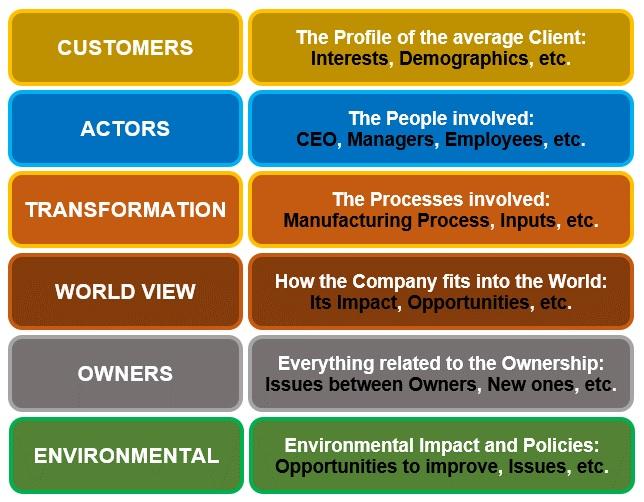
1 pointCATWOE Checklist CATWOE is an acronym for Customers, Actors, Transformation, Weltanschauung or World View, Owners, and Environment given first by David Smyth in 1975, as combination of six elements- problem solving. C – Customers: Customers includes a set of users and stakeholders of a system. Customer benefit from changes within a process & at resolution of the problem impacting system. An early categorization of winners and losers in customer group, wins apostles and prevent future loss to the organization. A – Actors: Actors refers to employees within an organisation. Actors are responsible to create output and implement changes in the system. An activity measuring actor attributes-- abilities, qualities and interests acts as a tool to determine actor’s influence and resistance to change management in the system. T – Transformation Process: Transformation is the change process influencing the system or the change effected as result of process activity. As such transformation may be actively introduced through human design to improve business, by estimating and arranging for volumes of input required; estimating volumes of output generated and planning for the market access, & revaluating production steps. W – World view: World view refers to opinion of different stakeholders and interested parties acting in organization’s market environment. Stakeholders may be opinionated differently about system/process/organization and bring conflicted view to operational desk. CATWOE analysis attempts to shares explicit contract in opinion, while deciding upon best approach for organization to follow. Consideration about the Unique Selling Preposition USP & the bigger industry picture, real market scenarios and likely impact of solution in world-view, need to be considered, while designing success strategies for the business. O – Owners: Owners includes the top management, entrepreneur, investor in a business that hold final say on “GO or NO-GO decisions” related to organization affairs. Key considerations on cost, profit management and ethical consideration for business are decided by these highest decision makers for the organizations. E – Environmental Constraints: Environment includes the actual environmental elements influencing business and may curtail strategic decisions for the organization. Political, Ethical, Social, Technical, Legal, Finance Leverage &funding and Environment factors act as environment constraints for organization and business activities. Due consideration is given to chalk best action plan for organization using CATWOE framework. In a conflicting bear economy, as in low profit market, an investor may be interested in selling investment to close losses, an entrepreneur may declare lay-off to balance losses in account accounts & to optimise process efficiency, employees may favour increasing price of produced goods & services, and community may expect new hiring to improve market sales. The wider contract of perception-based differences among the organization stakeholders, in-effect lowers the effectiveness in decision-making and problem solving. Observed series of conflict of opinion between stakeholders, may bubble into stakeholder conflicts & serious challenges later for the organization. Consequently, CATWOE checklist, may be used to define and analyse business stakeholder’s perspectives, to reach best achievement. CATWOE checklist enables problem identification, reviewing company’s targeted achievements and, designing bouquet of potential solutions to influence stakeholders. The techniques offer resolution to complex business situations, conflict of interests, standpoints & backlog, due contrasting interests of multiple stakeholders. CATWOE checklist, is emphasised as “ROOT DEFINITION CHECKLIST”, implying a list structured— “to enlist stakeholders and represent stakeholder’s positioning” towards segmentation, targeting and promotion of product or service in market. A competitive market scenario would require stepwise intricate analysis of stakeholder contribution, to develop strategic direction for product or service in a niche market. CATWOE Stakeholder Analysis CATWOE allows managers/problem solvers to develop holistic encompassing view approach to review system and its elements in multiple perspectives. CATWOE analysis attunes clarity to feasible outcome to an issue with multiple perceptions. A converged solution document bearing explicit research about feasible targets and likely achievement of each stakeholder, is generated through CATWOE analysis. The varied perceptions of different stakeholders are collated at a common platform, through holistic understanding. Facts are assembled to evaluate authority positions of stakeholders, domain-based assertions, baseline assumptions theorizing integrity of the data and information. The emerging solution is scrutinized to test ethical angle in each stakeholder analysis. The practice forms basis to integration between two or more perspectives, assigning priority to the merits of the respective perspective, and final selection of one perspective while overriding other perspectives. Thus, the business model is studied, stakeholder’s expectations and targets are evaluated at micro and macro levels; to share projected estimate of business projections, valuation about bottlenecks to be eliminated and final review of ethical consideration is held in decision-room. The process culminates into a correct approach to be followed by organization, at different stakeholder levels. C.A.T.W.O.E. In New product Development C – Customers. Real consumers and beneficiaries of transformation--Company customers and marketing executives. A – Actors. Persons responsible for transformation activities--Researchers, engineering executives, marketing executives, HR executives, supplier’s engineers, Customer’s engineers, production executive, P/E executive. T – Transformation Process. Brief about changes in high-level business process -- VOC + tangible + Intangible assets à First time right products and services meeting customer requirement at the lowest cost. W – Weltanschauug or World view. Stakeholder view/World view on Company positioning -- Strategic business positioning in global market where cost effect NPD is must for the survival. O – Owners. Person with authority to direct transformation activities -- Company’s Top-management E – Environmental Constraints. Impact on condition/rules under which the business operates --Manufacturing facility, technological development, budget allocation.
 1 point
This leaderboard is set to Kolkata/GMT+05:30