

Topics
-
Jeff Bezos is pushing Prime Video's overhaul to highlight Amazon's AI. The project, known as Lighthouse, aims to showcase AI for millions of users. This initiative seeks to elevate Amazon's standing in the competitive AI landscape. New features will improve content recommendations and respond to spoken requests. Bezos' personal involvement underscores the strategic importance of this AI integration. View the full article
-
Advanced Micro Devices is launching new artificial intelligence hardware on Thursday. This new hardware aims to compete directly with Nvidia's offerings. AMD is targeting the growing data center inference computing market. The company also announced significant deals with AI labs Anthropic and OpenAI. These agreements position AMD for substantial future revenue in the chip sector. View the full article



Leaderboard
-
krutibas Biswal
Members1Points10Posts -
TUSHAR MARADWAR
Members1Points11Posts


Popular Content
Showing content with the highest reputation on 07/15/2021 in Posts
-
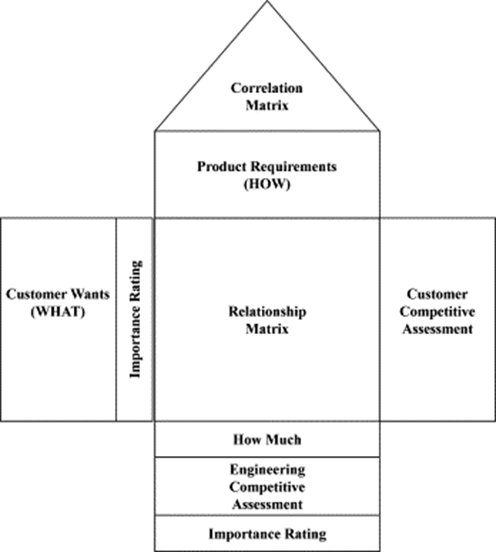
1 pointWhat is QFD?? QFD was first coined by Yoji Akao in the late 1960s ,when he was working for Mitsubishi’s shipyard in Japan. The basic idea behind this method is to take into serious consideration the Voice of customers, so that it can be translated to engineering characteristics of the product and service and after that plans to produce the products that fulfil customer requirements. QFD is used to translate voice of customer into measureable design targets and drive it from start to end of product (e.g. final assembly level to the sub-assembly, component and production process levels) Following fig 1 self explains broad level Block Diagram of QFD, where Customer wants is at left hand side , Product requirement and correlation matrix at Top and Relationship matrix at mid of the area. The main goal of QFD is to maximise the satisfaction of customer by making the required trade offs of several design features of a product or service. What are some of the ways in which QFD has been utilized? QFD is not only for New product development , it can be apply in a wide variety of areas e.g. •Product design, •Manufacturing, •Alternative Transportation System •R&D, •Engineering , •IT (Information Technology) •Regulatory, •Service industry •Business planning •Packaging and Logistics •Sales and Service •Education improvement •Hotel industry •Quality improvement •Quality Management •Military •Consumer Products By below example we can understand how QFD has been utilize in Alternate Transportation system to understand customer wants and successfully fulfilled it. Refer to figure here voice of customer was to implement Alternate Transportation system or Paratransit System to rural areas so they will get pick up from desired location and drop at required place. As this was new system many issues had to be solved, and it would need a new Organisation, Vehicles, Drivers, Offices, a Dispatcher, Electronic Devices, Powerful Computer Systems and Sophisticated Software for the calculations of the optimal routes, good marketing and communication.The above customer “Wants” correlated in the relationship matrix with the Engineering Characteristics “Hows”,which put on the centre top. According to the relative weight of the “Wants”, as shown also in the graph Fig 1 in Appendix 1, the most important ones are to have the solution at the desired point departure and arrival to be collected on time and the system to have an attractive price . According to the Rank of the Engineering characteristics the most serious characteristic is the Application Cost which includes mainly the fixed assets cost and variable costs.
 1 point
 -
1 pointQuality Function Deployment - A method used to translate voice of the customer information into product requirements/CTQs and to continue deployment (for example, cascading) of requirements to parts and process requirements. This is also called as House of Quality. Methods associated with QFD • FAST - Function Analysis System Technique • FMEA - Failure Mode Effects Analysis • FTA - Fault Tree Analysis • DoE - Design of Experiments • VAVE - Value Analysis/Value Engineering • MCA - Measurement Capability Analysis • GDT - Geometric Dimensioning and Tolerancing • CpK - Process Capability Study • DFA - Design for Assembly • DFM - Design for Manufacturing • SPC - Statistical Process Control • CPR - Cost Price Ratio • CPM - Customer Process Matrix QFD Deployment Process Level A - Customer Requirements vs. Design Features • Gather customer requirements for all types of customers. • Specify performance level desired and achieved. • Provide competitive assessment of features and functions. • Relate customer requirements to design features. Level B - Design Features vs. Part Characteristics • Specify how to deliver design features. • Identify critical performance factors. • Link design features to specifications. • Track development of design maturity. Level C - Part Characteristics vs. Process Characteristics • Specify part features. • Set critical parameters. • Fix part tolerances. • Establish control limits. Level D - Process Characteristics vs. Operating System • Identifies supplier control plan. • Identifies special test equipment. • Specifies work instructions. • Identifies operator training requirements.1 point
This leaderboard is set to Kolkata/GMT+05:30