

Topics
-
OpenAI, which is expected to need about 3,200 megawatts (MW) of power for its new facility, has agreed to provide up to 1,000 MW to the Southern Co subsidiary Georgia Power's systems in times of high demand. View the full article
-
The affected startup, Hugging Face, said it had turned to Zhipu AI's open-source GLM-5.2 model last week to analyze data from the hack after leading US AI models declined the task, unable to distinguish between a defender and an attacker. View the full article



Leaderboard
-
Ms._Sharmistha
Lean Six Sigma Green Belt2Points10Posts -
RahulGarg
Members2Points28Posts -
Raja Chairmapandi
Lean Six Sigma Green Belt1Points10Posts


Popular Content
Showing content with the highest reputation on 07/06/2021 in Posts
-
2 pointsSupermarket in lean six sigma refers to a predetermined market inventory/storage. It's the location where a predetermined standard inventory is kept to supply downstream process. When any internal or external customer need any item they can retrieve the requisites from the supermarket . The supermarket basis the usage and demand, restocks the supplies .Supermarkets are located near the supplying process in order to have a quick check on customer's buying pattern, usage & requirements . Before we go into further details of Supermarkets, lets understand what is a Three Pull strategy that is often put in use and how supermarket is one of the derivatives from the Three Pull strategies A Pull Process is one where a unit/ workstation starts to work on its next order only when there is an available free slot on the output section . Which means if the demand of any item is high be it from an internal or external customer it would trigger the production of that item . Here the customer pulls order rather than the Push production where items are prepared no matter whats the demand is . The output section is not considered in Push production . In Pull Process the inventories between workstations are managed & it directly influences and maximises the Lead time. The 3 forms of Pull connections are 1. Continuous flow : Products are worked on one by one with maximum inventory of one between workstations 2. Sequential Pull :A fixed quantity is determined & the sequence of product is defined, however a buffer with a defined maximum is allowed between workstations for variance. 3. Replenishment pull: Maximum number of products waiting where which type of product to be used is unknown Supermarket is also known as a replenishment pull system where it manages inventory where variation of parts can be kept without knowing in what order the parts can be taken from the inventory/storage. A customer can take out parts randomly from the supermarket and the supplier replenishes the taken parts after a certain interval. Supermarket can be implemented as connection between process steps when designing a Future state VSM Following are the characteristics of a good Supermarket Supermarkets must have access to wide range of products, which is why they need to be arranged in shelves. A FIFO approach can be followed here where everyone involved can immediately see the state of things.FIFO lanes be implemented when a particular workstation uses different colours and is not aware how many colours they need in a particular day.A Supermarket should contain a FIFO is each lane to help guide which colour used in what quantity for a particular day which in terms will help forecast & strategise production Market location serves an important factor. It is important to help gauge on unit consumption & back it up with demand. Market Locator can be used as a sort of isolator between batch demand spikes & upstream supply .If a market is positioned at loading bay it will automatically receive indications of spikes of demand whenever a truck reaches for loading . So its known in advance when the trucks arrive there is a demand spike over a certain period of time. Thereby designating a location or a marked floor area to be the virtual truck area of moving items from virtual truck smoothly for a chosen period is required in supermarket Products to be placed in plastic boxes , whose size would depend on the size of the material & each box is to be identified with a tag that shows the item details, the supermarket where it is located, supplier & quantity Supermarkets should be located in loops.The sequential operations need to have a similar production pace (Cycle time, Downtime, Changeover time etc.),Have similar requirement of workers ( multi-skilling & multitasking) & hence to be located close to each other The boxes become an indication of Cycle flow & Buffer stock depending on the demand. Each box leaving the supermarket triggers signal for the supplier in multiple forms like Same box needs to be placed . A Kanban card can be put in use to identify when the material goes out and becomes a replenished order and instead of taking out label the whole box can be put in use Thereby supermarket is important as it manages material flow and eliminates waste , it also carries extra items in quantity from a range of a minimum and maximum without interrupting the flow and that results in increase in lead time & associated levels of WIP2 points
-
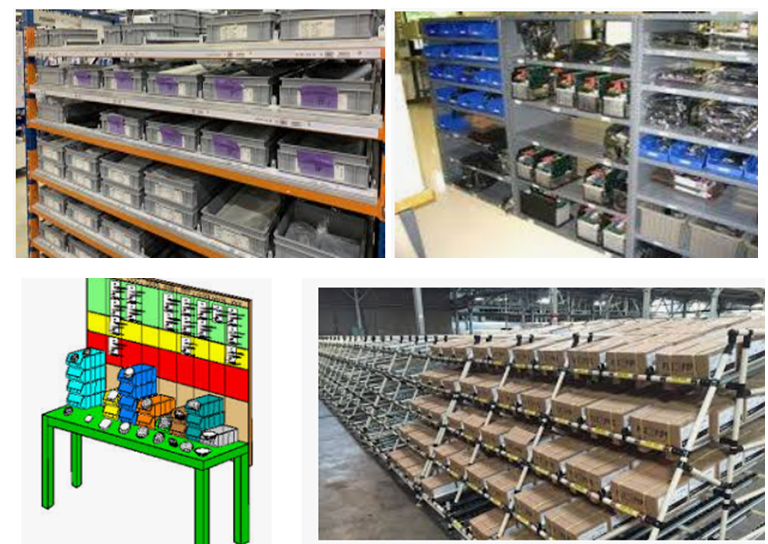
2 pointsThe term supermarket in lean six sigma refers to a predetermined market or space to be used for storage / inventory. The supermarket carries the necessary "supplies" for a work area that is close to it. When a customer (internal / external) needs an item they can take the same from the supermarket. The supermarket then replenishes their supplies based on the downstream demand. Supermarkets prevent overstocking and help to lower the inventory levels. Supermarkets normally are located near the supplying process to help that process see customer usage and requirements. Each item in a supermarket has a designated location from where a material handler take out the products in amounts needed by the downstream process. As an item is removed, a signal to make more or to replenish (such as a kanban card or an empty bin) is taken by the material handler to the supplying process. Toyota implemented first supermarket in year 1953 in machine shop of main plant. Toyota executive Taiichi Ohno got the idea of the supermarket from photos of American supermarkets showing goods arrayed on shelves by specific location for withdrawal by customers. A supermarket is nothing but a series of parallel FIFO (First in First Out) lanes sorted by product. This term in manufacturing originated from the normal retail supermarket. The key of a supermarket (both retail and manufacturing) is that taking out any part or product gives a signal to replenish this part (via Kanban). Therefore, a supermarket also aims to keep all the required parts in stock, while at the same time avoiding overproduction. Diagram of a Process with Supermarket (ꓱ) : Diagram of a Process with Supermarket at 3 different locations i.e. close to Supplier, close to Customer and between the processes : How Supermarkets Look like in real? When to use Supermarkets? i) Use Supermarkets when there is difference in lot sizes at different processes ii) Use Supermarket if Material Flow Splits Up into Different Directions iii) A supermarket is also strongly recommended if two processes have very different cycle times. iv) Use Supermarket when there are different shift patterns v) Use Supermarket when next process creates different variants of the product vi) Use Supermarket if there is merging of the material flows vii) Use Supermarket when there is large distance between the processes viii) Use Supermarkets in case of very high demand on flexibility and Reaction time ix) Use Supermarket whenever there is change in responsibility Characteristics of a Good Supermarket: i) Supermarkets must aim at reducing the overproduction and inventory in the process where it’s not possible to eliminate the inventory completely or deployment of the one piece or continuous flow ii) Supermarket must work on a pull system i.e. as and when signal is received to replenish the supply at process or by customer via a Kanban, it should be able to supply that demand and at the same time supplier also shall be able to replenish the goods consumed in supermarket. iii) A good supermarket must be able to supply the right quantity of goods at the right time and there shall be sufficient stock of material / goods to meet the customer’s demand iv) Supermarkets should be close to close to Supplier / Supply Source so that immediate process / processes can take the material or supplies needed for doing the operations at that process OR Supermarkets can also be close to Customer as well so that customer may take up the finished goods as required from the supermarket. v) A good supermarket must aim to develop a continuous kind of flow and shall not allow any disruption in the operations / production by maintaining the adequate quantity of products / materials / parts for the downstream process vi) A good supermarket shall be sensitive to customer demand / process demand and shall be able to replenish the stock as per stakeholders / process requirement by usage of technology say RFID at Amazon / Kanban in manufacturing vii) A good supermarket shall have place for everything and everything at its place i.e. it must follow the principles of 5S, Lean, JIT etc. viii) Visual Controls / ANDON / Signage / Labels can be used in a supermarket to make it more structured / easy to refer


 2 points
 -
1 pointSupermarkets: Independently on the type of production (custom job shops or repetitive manufacture) the work flow can benefit from using a supermarket. In fact, the secret for an effective manufacturing operation is to align production capacity to customers’ demand. A zero inventory strategy would be ideal but the concept is utopic since the supplier’s deliveries are not always regular, quality control is inevitable and batch size is variable in each production line. A right size inventory strategy is crucial. It employs the use of supermarkets located at specific points of the production process. Supermarkets are incredibly helpful in businesses with wide variations in customers demand and when the production lead time is longer than the takt time. There are two questions to answer when establishing supermarkets where should it be located and how large should it be? To answer the first one the following should be considered: If there are shared resources that can cause bottlenecks, a supermarket should be placed immediately before the processes that can cause such bottlenecks. Another supermarket right after each of these processes should also be considered in order to provide a small number of parts that can be used until the machine is once again available to run that item. The last supermarket should be placed in a location where its downstream lead time is smaller than the established delivery time to the next client. For example, if the established delivery time is 5 days, the last supermarket has to be somewhere in the production line where it’s possible to make its products arrive to the customer in 5 days. It should also be as upstream as possible in the production line. This will allow a lower product differentiation and therefore least references to stock, which contributes to the reduction of supermarkets dimensions and costs of stocking due to lower transformation of the product. For the second question the reorder point, average stock and maximum stock should be measured.1 point
This leaderboard is set to Kolkata/GMT+05:30