

Topics
-
Jeff Bezos is pushing Prime Video's overhaul to highlight Amazon's AI. The project, known as Lighthouse, aims to showcase AI for millions of users. This initiative seeks to elevate Amazon's standing in the competitive AI landscape. New features will improve content recommendations and respond to spoken requests. Bezos' personal involvement underscores the strategic importance of this AI integration. View the full article
-
Advanced Micro Devices is launching new artificial intelligence hardware on Thursday. This new hardware aims to compete directly with Nvidia's offerings. AMD is targeting the growing data center inference computing market. The company also announced significant deals with AI labs Anthropic and OpenAI. These agreements position AMD for substantial future revenue in the chip sector. View the full article


Leaderboard
-
Rajesh Chakrabarty
Members1Points87Posts

Popular Content
Showing content with the highest reputation on 04/09/2021 in Posts
-
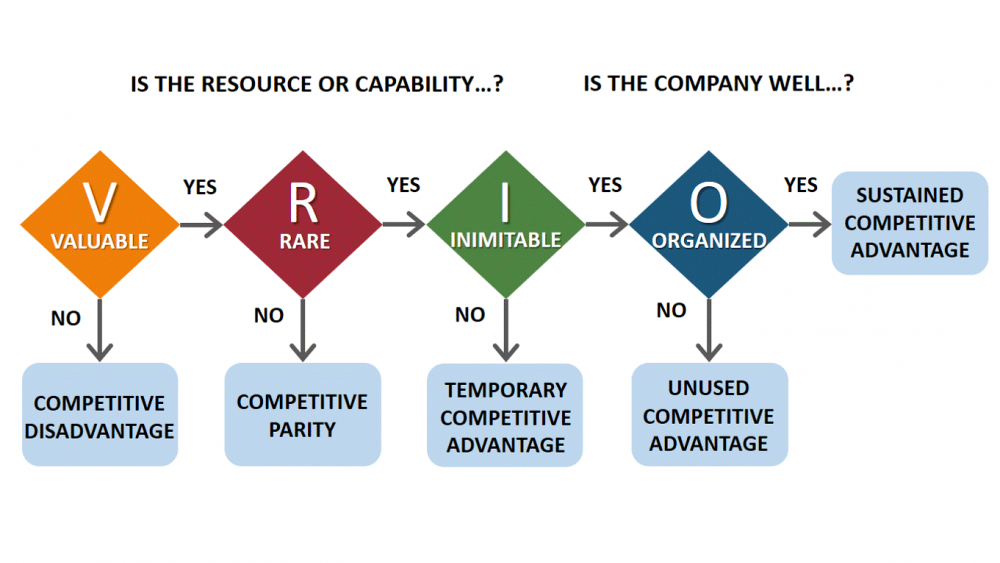
1 pointVRIO stands for Value , Rarity, Imitability and Organization. A Question Framework of the 4 mentioned matrix is created to analyze and uncover ‘Sustained Competitive advantage”. Since it is a tool that helps to plan for achievement of long term goals and create an edge over the competitors, VRIO framework forms a part of the Organization’s strategic Scheme. Unlike SWOT, which is carried out on the organization as a whole, VRIO analysis is conducted on each individual resource or competency that needs to be reviewed. The abovementioned four components of VRIO Analysis are arranged in a framework in a style of a decision tree with branches that lead to decisive strategies and then action points. <Diagram1> The said decision tree structure with branches or nodes are developed with some fundamental question that lead to decisive strategies and then action points. The most fundamental Question to put forth relevant to any resource/Competency is “Does the said Resource and/Competency add value to the customer?? It is pertinent that only resources/capabilities/competencies that add value, can lead to competitive advantage, else, any non-value adding resource may lead to competitive disadvantage only. After that the next relevant steps are taken in the defined course of the Framework – Refer to <Diagram 1> Steps for VRIO Analysis; Objective: To determine whether the Resource /Competence under review has a Competitive advantage or a competitive Parity or does it have only a temporary competitive advantage or an unused Competitive advantage or at the best it has a sustainable competitive advantage. 1) Select and Define the Resource/ Competency that needs to be reviewed 2) Ask questions to arrive at the Decision Nodes and verify the competitive edge of the resource/Competency in review. 3) Use the 4 categories of Value, Rarity, Imitability & whether the organization is able to capture the complete possible value. 4) In the first Category we need to understand if the Resource is adding value to the Customer. If a resource is established as being not valuable to customers then it is only draining time, effort & money and there is definitely a Competitive disadvantage. Action points can be taken to either eliminate or improve the said resource /Competency 5) If the Resource /competency has value but has less or no demand or is Easy to come by at the competitor’s as well- not rare; then it would fail, the rarity category test and will be said to bring in Competitive Parity. This would mean that the said resource is on equal footing with the Competitors in the market. Action Points to be decided to bring in that “Difference” to beat the competition and create a need /aspiration & demand in the market 6) A resource with Value and Rarity is then tested for it’s Imitability. If the analysis through relevant questions and research data leads us to conclude that the resource is easily replicable and can also be attained by any competitor then there is a Temporary Competitive advantage, as there is always a chance that the similar product will be available in the market from other competitors. The action points need to focus on what can be done with the resource to remain ahead of the curve. 7) If the resource in review is analysed to be Valuable, Rare and also inimitable then the said resource has still got the potential to be used to maximum. This resource probably has an Unused Competitive Advantage that the organization has to capture. The action points need to ensure that the organization puts in place the right systems, processes and procedures to utilize the unused advantage. A Sustained Competitive Advantage is the best possible outcome of the analysis as it would imply that the resource/competency under review is bringing in multifaceted advantages to the business and the organization has robust systems, processes and procedures to take acquire due benefits of the competitive advantages that resource is providing- Then, the focus needs to be on marketing the resource/product/ competency. The above concept can be used to the benefit of the organization- The benefits or advantages of the VRIO Framework concept are; - It is very Simple and Clear concept and gives decisive output - It shows where the business is doing well and where it is not doing well- Resource specific. This makes it easier to take focussed corrective & preventive and creative actions for continuous improvement - It is broad – any resource/competency can be analysed very quickly - The process can be repeated multiple times for review due to the less time it takes and the reliability of the output - It can be used to analyse competitors as well and then take action on edging them out- A possible and justifiable business objective. - Can be used to compare the organizations business advantages with that of the competitor. This ,combined with the need and demand analysis of the market can help to take major strategic decisions. Almost every matured organization uses VRIO analysis in combination with other analytical techniques to help evaluate not only business resources and competencies, but also the products. For example let us take the Burger giants in the country. Each one of us will agree that there is not much to a burger than the bun, the dressing and the patty in between. However, you will see that each of the Burger brands are competing to create value through competitive pricing, Rare type of patties; I know of a brand which has started Raw Banana Patty to attract certain segments with religious practices, in the market. You will see these players investing to develop in-house (proprietary) sauces to make them inimitable and yes the organization is fully committed to utilize any unused advantage that any product, / resource/ competency that can help to do better business. Notwithstanding, this is a continuous business evaluation process.
 1 point

This leaderboard is set to Kolkata/GMT+05:30