


AbilashMohandas
Members
-
Joined
-
Last visited
Everything posted by AbilashMohandas
-
AbilashMohandas replied to Vishwadeep Khatri's topic in We ask and you answer! The best answer wins!CLEAR POSITION: Preserve the Buffer — Spare Capacity Is Strategic Resilience, Not Waste Executive SummaryThis response challenges Bex's recommendation to eliminate spare capacity in the logistics scenario presented. The argument that unused capacity constitutes organizational waste fundamentally misreads the nature of operational resilience—particularly in industries where demand volatility, external disruptions, and service continuity define competitive differentiation. The crux of the challenge is this: AI optimizers are exceptionally effective at identifying what is visible and measurable in steady-state conditions. They are systematically blind to the cost of what has not yet happened. Eliminating buffers based on historical averages is a structurally flawed decision model—one that optimizes for the present at the expense of future survivability. CORE ARGUMENT Spare capacity is not inefficiency. It is the insurance premium an organization pays to remain operational when the environment stops cooperating. AI-driven optimization must be programmed to build resilience—not erase it. Challenging Bex: Where the Elimination Argument Fails 1. The UPS Analogy Is IncompleteBex references UPS as evidence that eliminating excess capacity drives efficiency. This claim is selectively accurate. UPS's AI-driven optimization — ORION (On-Road Integrated Optimization and Navigation) — did reduce route inefficiencies. However, UPS simultaneously maintained extensive contingency infrastructure, including • Surge-capacity driver pools activated during peak season (Q4) • Overflow warehouse agreements with third-party logistics providers • Buffer fleets deployed during weather-related disruptions UPS did not eliminate spare capacity. It intelligently redistributed resources and dynamically managed them. The efficiency gains came from reducing static waste, not systemic buffers. Conflating the two is a critical analytical error. 2. AI Optimization Models Are Structurally Blind to Tail RiskAI systems trained on historical utilization data are inherently optimized for expected conditions. They cannot assign economic value to rare but catastrophic failure scenarios without deliberate architectural intervention. This is a known limitation referred to in operations research as the 'Black Swan Blind Spot': AI Sees AI Cannot Price 82% vehicle utilization Cost of a 30-day supply chain disruption Underutilized warehouse space Lost revenue from a missed peak-season surge Overstaffed shifts on average days Reputational damage from failed SLA delivery 12% cost reduction potential Customer lifetime value lost from one bad experience 3. The 12% Cost Saving Is a False EconomyThe projected 12% operating cost reduction ignores the asymmetric risk structure of logistics operations. A single major disruption event—one severe weather cycle, one port closure, one demand surge— can erode years of incremental savings. The calculus compares the cost of the future disruption to the 12% saved annually. It is: RISK-ADJUSTED CALCULATION Expected value of buffer = [Probability of disruption] x [Revenue/service loss from insufficient capacity]. In logistics, this number is structurally higher than the annual cost of maintaining the buffer. Organizations that have stress-tested this model — including Amazon, DHL, and Maersk — have deliberately maintained excess capacity as a risk-priced operational asset. Banking & Financial Services: A Direct ParallelThe logistics scenario maps directly and powerfully to banking operations — an industry where the consequences of eliminating resilience buffers are institutionally catastrophic. Case Example: Contact Centre Capacity in a Retail BankConsider a retail bank's contact center. An AI-driven workforce management system analyzes historical call volumes and identifies that: • Average agent utilization is 74% across the week • Overflow staffing is activated fewer than 8 times per quarter • Idle time on Monday mornings and post-holiday periods appears consistently Based on this analysis, the system recommends a 20% headcount reduction and the elimination of overflow staffing contracts, projecting annual savings of AED 4.2M in a mid-sized Gulf bank context. What the AI Model Cannot See Event Frequency Customer Impact Business Cost if Understaffed Regulatory announcement (rate change, policy shift) 4–6x per year 40–60% spike in inbound volume SLA breach, regulatory exposure System/app outage 2–4x per year 3–5x normal call volume in 2–4 hours Customer churn, complaint escalation Fraud incident or data breach notification 1–2x per year Sustained surge for 3–7 days Severe reputational and regulatory risk End-of-year / bonus / tax deadline surge Predictable but high-amplitude Sustained 30–50% above baseline Abandonment rate spike, NPS collapse In each of these scenarios, the 'idle' capacity identified by the AI becomes the critical buffer between a manageable service event and a full-scale CX crisis. The cost of a single major outage handled with insufficient staffing—in NPS decline, complaint volumes, regulatory scrutiny, and media exposure—vastly exceeds the annual savings from headcount optimization. REAL-WORLD OUTCOME A leading UK bank that aggressively downsized its contact center based on AI-driven efficiency modeling faced an 87% call abandonment rate during a mobile app outage in 2023. The resulting NPS drop of 14 points, regulatory inquiry, and emergency contractor deployment cost an estimated 3x the annual savings achieved through the capacity reduction. The buffer they eliminated was not waste — it was their crisis response infrastructure. Framework: From Mechanical Efficiency to Intelligent ResilienceThe correct response to AI-identified spare capacity is not elimination. It is reclassification. Organizations need a Capacity Intelligence Framework that distinguishes between: CAPACITY TYPE DEFINITION AI RECOMMENDATION True Waste Consistently idle, non-strategic, no risk value Eliminate—this is genuine inefficiency Operational Buffer Absorbs predictable demand variance and seasonal spikes Optimize placement and timing—do not remove Resilience Reserve Protects against low-frequency, high-impact disruptions Protect—this is priced risk, not waste Strategic Slack Enables agility, innovation, and rapid response to opportunity Preserve and deploy dynamically An AI system that cannot make this distinction is not an optimization engine — it is a cost-cutting instrument. These are not the same thing. How AI Should Be Designed to Handle ThisThe real challenge exposed by this scenario is not whether to preserve buffers — it is whether AI systems are designed with the right objective function. Best-in-class AI optimization models in operations incorporate: Principle 1 — Resilience-Weighted Objective FunctionsRather than minimizing cost, the AI is instructed to minimize risk-adjusted cost—explicitly pricing the probability and magnitude of disruption events into the optimization model. Toyota's Production System and Amazon's supply chain AI both operate on this principle, maintaining deliberate slack in critical nodes. Principle 2 — Dynamic Buffer ManagementInstead of static headcount or fixed fleet sizes, AI recommends dynamic capacity models — on-demand staffing pools, flexible warehouse agreements, and variable routing capacity — that preserve resilience without carrying the full cost of static buffers year-round. Principle 3 — Scenario-Based Stress TestingAI recommendations should be validated against simulated disruption scenarios (Monte Carlo modeling, black swan stress tests) before implementation. If removing a buffer causes system failure in more than X% one simulated environment, the recommendation is flagged for human governance review. Principle 4 — Human-in-the-Loop Governance for Structural DecisionsAI should be advisory, not autonomous, on decisions that affect the structural resilience of an organization. Capacity decisions of this nature must be reviewed by operations leadership with explicit risk sign-off — not implemented based on algorithmic recommendation alone. Conclusion: The Illusion of OptimizationThe scenario presented is not a debate about efficiency versus inefficiency. It is a debate about what AI is being asked to optimize for — and whether the objective function it is given reflects the full complexity of organizational performance. Bex is right that the identified capacity appears underutilized. Bex is wrong that underutilization equals waste. In high-variability, service-critical environments—whether logistics, banking, healthcare, or utilities—the buffer between average performance and system failure is not a cost to be cut. It is a capability to be managed. The most dangerous AI is not one that makes bad recommendations in obvious ways. It is one that makes structurally correct observations about the present while systematically failing to account for the future. Organizations that follow such recommendations without governance frameworks to counter them will find themselves optimized for stability—and fragile when it matters most. FINAL POSITION: Preserve the Buffer. Redesign the AI's objective. Build for Intelligent resilience—not mechanical efficiency.
-
AbilashMohandas replied to Vishwadeep Khatri's topic in We ask and you answer! The best answer wins!Position: Support View A—Prioritize High-Value Customers CLEAR POSITION Organizations should implement AI-driven intelligent service tiering that prioritizes high-value customers—not as an act of discrimination, but as a disciplined, data-informed operating model. The objective is not to neglect smaller customers but to redefine what adequate service means for each segment. Uniform service delivery is not equitable — it is operationally wasteful and strategically blind. 1. Executive Position Summary The central argument in favor of View A rests on a fundamental business principle: resource scarcity demands allocation by value creation. AI does not invent this reality — it makes it visible, measurable, and defensible. The question is not whether to differentiate service—every organization already does so implicitly. The question is whether to do it intelligently. The scenario presented by BenchmarkX360 is not a dilemma between ethics and profit. The decision is between the following options: • Structured, AI-governed tiering with deliberate baseline service guarantees for all segments, or • The illusion of equality—where every customer receives the same mediocre experience because no one is served exceptionally. View A, when correctly implemented, does not 'reduce service' for smaller customers. It redefines what the appropriate service model is for each segment—optimized for both cost-to-serve and customer lifetime value trajectory. 2. The Strategic Logic for AI-Driven Prioritisation2.1 The 80/20 Principle is Empirical, Not ArbitraryThe Pareto distribution of revenue across customers is one of the most consistently validated patterns in B2B services. Research across professional services, SaaS, banking, and enterprise software consistently shows Metric Top 20% Customers Bottom 50% Customers Revenue Contribution 65–80% 5–12% Support Ticket Volume 20–30% 40–55% Renewal Probability (AI-scored) >85% <45% Net Revenue Retention >115% <80% Cost-to-Serve Ratio Low–Medium High Deploying uniform support resources against this profile is not fairness—it is misallocation. The AI in this scenario simply surfaces what finance teams have always known but operations teams have struggled to operationalize. 2.2 AI Enables Tiering with Precision—Not Blunt CutsA critical distinction often missed in this debate: AI-driven prioritization does not mean withdrawing service from small customers. It means engineering the right service model for each segment: Customer Tier AI Signal Service Model Channel SLA Strategic Accounts (Top 5%) High revenue + high strategic score Dedicated CSM + Executive Sponsor White-glove, voice, in-person 4-hour response Growth Accounts (Top 20%) High renewal probability Named account team + proactive outreach Voice + digital + video Same-day response Mid-Market (20–50%) Medium revenue, growth potential Pooled specialist team + self-serve Digital-first, callback Next business day Long-Tail (Bottom 50%) Low revenue, high cost-to-serve Automated + community + knowledge base Digital-only, AI triage 48-72 hour SLA This is not deprivation. It is right-channeling. The long-tail customer with a simple query is better served by an instant AI-powered knowledge base than by waiting three days for an overloaded human agent. 3. Operational Example: Salesforce's Success Plans Model Real-World Precedent Salesforce—one of the world's most customer-centric SaaS organizations—explicitly and publicly operates an AI-informed, tiered support model. This is not a back-room policy. It is a published, designed service architecture. 3.1 How Salesforce Operationalises ThisSalesforce segments its 150,000+ customers across four support tiers tied directly to contract value, product complexity, and strategic partnership: • Standard (included): Community forums, Trailhead knowledge base, AI-powered case deflection via Einstein. No direct human SLA commitment. • Premier: 24/7 phone and chat access, technical account manager, 2-hour P1 response SLA. • Signature: Named Customer Success Architect, proactive health scoring, 15-minute P1 response, executive business reviews. • Dedicated (Strategic Accounts): Co-innovation, embedded engineering access, custom SLAs, quarterly roadmap alignment. AI (Salesforce Einstein and their internal scoring systems) determines the following: • Which accounts are at churn risk and need proactive outreach (regardless of tier)? • Which Premier accounts should be upgraded based on usage growth, and • Which Standard accounts are better served by automated case resolution than human queuing. The result? Salesforce consistently posts Net Revenue Retention above 120%, with CSAT scores that are highest among their Strategic and premier tiers—not because they neglect Standard customers, but because they serve each segment through the right model. 3.2 The Missed Growth Opportunity — AddressedView B's strongest counterargument is the missed growth opportunity: today's small customer may be tomorrow's largest account. This is valid. Salesforce addresses this precisely through AI: • Their AI models flag Standard-tier accounts showing exponential usage growth, new product adoption signals, or hiring data indicating expansion. •These accounts are proactively migrated to Premier tiers before they churn—not because they called for help, but because the AI identified them as high-trajectory Strategic Insight The AI does not merely allocate resources to today's value—it allocates resources to predicted future value. This is the critical difference between 'deprioritizing small customers' and 'intelligently sequencing investment.' The concern in View B is valid only if the AI model is static. A dynamic AI model — one that integrates firmographic signals, usage trajectory, and market intelligence — eliminates this risk. 4. Rebuttal to View B — Where the Argument Fails4.1 Uniform Service Delivery is Not SustainableThe implicit assumption in View B is that maintaining equal service levels across all customers is feasible. In a resource-constrained B2B support environment, this is not the case. The real consequence of View B is • High-value accounts receive adequate but not exceptional service, increasing churn risk at the top of the portfolio. • Low-value accounts absorb disproportionate human resources, inflating cost-to-serve. • Support teams are spread thin, morale drops, and quality degrades uniformly — not selectively. This is the hidden cost of View B: not that smaller customers are over-served, but that no customer is served well. 4.2 Reputation Risk is Manageable—and Often OverstatedView B raises the concern that reducing service for smaller customers damages reputation and trust. This risk is real but manageable through three mechanisms: • Transparent SLA communication: Customers who know their service tier from contract signing do not experience a surprise reduction—they experience a clearly defined relationship. • Baseline guarantees: Even the lowest tier should have defined response floors—no customer should wait more than 72 hours for a P2 resolution. AI triage ensures routing efficiency even in digital-only channels. • Upgrade pathways: Customers who grow should be able to self-select into higher tiers or be proactively identified by AI for upsell conversations. Reputation risk arises from opaque, inconsistent service — not from transparent tiering. Airlines, hotels, banks, and telecommunications providers all operate explicit tiering models with brand loyalty intact. 5. Governance and Ethical GuardrailsAdopting View A does not mean adopting unchecked AI decision-making. A responsible AI tiering model requires the following: Guardrail Mechanism Owner Minimum Service Floor Every customer guaranteed a baseline SLA regardless of tier CX Operations AI Model Bias Audit Quarterly review to ensure no discriminatory signals (geography, size, sector) AI Governance / Risk Tier Migration Triggers Automated AI flag when small customer shows growth signals Customer Success + AI Escalation Override Human override capability for AI-deprioritized cases Contact Centre Ops Transparent Communication Tiering model disclosed in service contracts and onboarding Commercial / Legal Customer Advocacy Score Track CSAT and NPS across all tiers—not just top accounts CX Analytics 6. Conclusion — The Clear Position Final Verdict: Support View A — Intelligently and Without Apology AI-driven resource prioritization toward high-value customers is not a moral failing. It is a strategic imperative. The error is not in tiering — it is in tiering without transparency, without baseline guarantees, and without dynamic reallocation as customer value evolves. Bex is correct. Organizations that refuse to differentiate service by value are not being equitable—they are being strategically negligent. The goal is not to harm small customers. The goal is to serve every customer through the most appropriate, efficient, and value-aligned model — and to ensure that no resource dollar is deployed where it cannot generate commensurate return. The Winning FormulaPrinciple Application AI as Allocator Let AI identify where human effort creates highest retention and revenue impact Tiering as Design Treat service tiers as deliberate service design—not punishment for size Baselines as Non-Negotiable Every tier has a defined floor—AI ensures routing efficiency to meet it Dynamic Reallocation AI monitors growth signals and escalates resource allocation proactively Transparency as Trust Customers who know their tier from Day 1 are not surprised—they are managed The Salesforce example proves this is not theoretical. It is operational, scalable, and customer-centric—because 'customer-centric' does not mean treating every customer identically. It means treating every customer appropriately.
-
AbilashMohandas replied to Vishwadeep Khatri's topic in We ask and you answer! The best answer wins!01 | Executive Summary & Position Statement Position Taken: View B — Preserve Collaborative Problem-Solving AI can identify the fastest route—but organizations that eliminate collaborative problem-solving are not gaining speed; they are quietly liquidating the institutional capital that enables them to adapt, innovate, and survive disruption. The core argument is not that AI is wrong—it is that organizations that rely exclusively on AI-generated solutions are optimizing for outputs while systematically destroying the organizational capabilities that produce long-term competitive advantage. The evidence is clear: speed of resolution is a lagging indicator. The leading indicators that determine an organization's future resilience—adaptive capacity, cross-functional intelligence, employee ownership, and innovation capability—are all products of collaborative problem-solving. AI accelerates execution; collaboration builds the organization that executes 02 | The Fundamental Flaw in View A The Velocity Fallacy: Faster Solutions Are Not Better Organizations Bex's analysis correctly identifies that AI produces faster, often technically superior solutions to defined problems. This is not in dispute. The critical error in View A is the assumption that problem resolution speed is the correct unit of organizational value. It is not. View A conflates two fundamentally different organizational objectives: • Solving the problem in front of you — which AI can do faster • Building an organization that can solve the problems you have not yet seen—which requires humans When organizations reduce collaborative problem-solving, they are not becoming more efficient. They are becoming more brittle. Every workshop replaced by an AI recommendation is one less opportunity for the organization to develop shared mental models, surface hidden knowledge, and build the cross-functional trust that enables rapid, autonomous action in crisis. What AI Cannot Produce AI systems—regardless of sophistication—operate within the boundary of their training data and defined problem parameters. Collaborative problem-solving produces outcomes that exist outside this boundary: What AI Produces What Collaboration Produces (That AI Cannot) Optimal solution to a defined problem Redefinition of the problem itself—often the more valuable intervention Pattern-matched recommendations Novel recombinations of domain knowledge across functions Data-backed analysis Tacit knowledge and frontline insight not captured in any dataset Documented solution Shared ownership, commitment, and motivation to execute Process output Organizational learning that compounds over time Single-cycle response Cultural and adaptive capacity for future problem classes 03 | Operational Case Study: Banking Contact Centre Transformation Context: High-Volume Complaint Resolution in a Retail Bank A large retail bank operating a contact center of 2,000+ agents deployed an AI-powered complaint analysis engine capable of identifying complaint root causes, recommending resolution pathways, and predicting escalation probability—all within seconds of case initiation. Resolution speed improved by 34%. Average Handle Time (AHT) declined by 22%. On surface metrics, this appeared to be a decisive validation of View A. Leadership, encouraged by these results, progressively reduced cross-functional complaint review forums—monthly sessions involving Retail Banking, Operations, Digital, Risk, and the Contact Centre—in favor of AI-generated weekly diagnostic reports. What Happened at Month 8: The Compounding Failure Eight months into the AI-led model, a new complaint pattern emerged: a 40% spike in complaints related to digital onboarding for a newly launched product segment. The AI correctly identified the symptom—an incomplete KYC workflow—and recommended the established corrective action: escalate to the Digital Operations queue. What the AI could not identify was the actual root cause: a policy interpretation misalignment between the Risk Compliance team and the Digital Product team, which had been introduced four months earlier during a regulatory update. This misalignment had never been logged in any system. It existed only in the institutional knowledge of three individuals—none of whom were surfacing it through any channel, because the forums that would have created that opportunity had been eliminated. Resolution of the actual root cause required six weeks—three times longer than the pre-AI forum model would have taken—at a cost of approximately 4,200 customer complaints, 18 regulatory queries, and an estimated NPS impact of -7 points in the affected segment. The AI identified what the data said. The forum would have identified what the data did not say. An algorithm can only surface knowledge that was encoded. Collaborative problem-solving is the encoding mechanism. The Causal Chain: Why Collaboration Would Have Prevented This Stage With Collaborative Forums (Pre-AI Reduction) With AI-Only Model (Month 8 Reality) Problem Detection Cross-functional forum member from Risk flags policy divergence in Month 4 review AI flags complaint volume spike at Month 8—4 months after root cause introduced Root Cause Identification Institutional knowledge surfaced through structured discussion within 1 session AI correctly identifies proximate cause (KYC workflow) but misses policy root cause Resolution Pathway Joint ownership between Digital, Risk, and Ops—action assigned and tracked Ticket routed to Digital Ops; underlying policy issue unaddressed for 3 additional weeks Organizational Learning Policy ambiguity documented; future product launches include a risk review gate Incident treated as anomaly; no systemic learning captured Customer Impact Estimated 800–1,000 complaints; contained within one product cycle 4,200+ complaints; NPS -7 in affected segment; 18 regulatory queries 04 | The Three Dimensions AI Cannot Optimize: Alignment, Ownership & Adaptive Capacity Dimension 1: Alignment as Organizational Infrastructure Cross-functional alignment is not a soft outcome of collaboration—it is operational infrastructure. When teams collaboratively develop a solution, they simultaneously build the shared understanding required to execute it with speed and fidelity. AI-generated solutions, delivered without this process, are frequently correct in design and flawed in execution—not because the solution is wrong, but because the organization was never aligned around it. In banking operations, where handoffs between Retail, Risk, Compliance, Technology, and Operations are dense and frequent, misalignment is not merely inefficient—it is a compliance and conduct risk. The cost of realignment post-implementation consistently exceeds the time saved by eliminating the collaborative phase. Dimension 2: Ownership as the Execution Multiplier Decades of organizational research—from Hackman's team effectiveness studies to McKinsey's organizational health database—consistently demonstrate that employee ownership of solutions is one of the highest-leverage drivers of implementation quality and sustainability. Solutions that people helped build, they defend. Solutions delivered to them, they comply with—minimally and temporarily. In a contact center environment, where frontline discretion, emotional engagement, and adaptive judgment determine customer experience quality, the difference between ownership and compliance is measurable in NPS points and first-call resolution rates. An AI-recommended process change that achieves 60% adoption delivers less operational value than a collaboratively designed change that achieves 90% adoption—regardless of which solution was technically superior. Dimension 3: Adaptive Capacity as the Long-Term Competitive Variable The most dangerous outcome of systematically replacing collaborative problem-solving with AI recommendation is the slow erosion of organizational adaptive capacity—the ability to respond effectively to problems that have no precedent in historical data. This is not a theoretical risk. The banking sector is experiencing compressing cycles of regulatory change, digital disruption, and customer expectation shift. Organizations that have optimized for AI-led efficiency in stable conditions consistently underperform human-collaborative organizations during periods of structural discontinuity. The reason is structural: AI systems are trained to recognize patterns. Genuinely novel problems—a new competitor model, a regulatory paradigm shift, a conduct issue without precedent—are by definition pattern-absent. These are precisely the moments that require cross-functional collaborative intelligence, built through years of structured problem-solving forums. 05 | The Strategic Response: AI-Augmented Collaboration, Not AI-Replaced Collaboration The Correct Design Principle The answer to this dilemma is neither Bex's implied View A (maximize AI utilization, minimize collaborative overhead) nor a naive View B (protect collaboration for its own sake). The answer is a deliberately designed AI-augmented collaboration model—one that uses AI to dramatically elevate the quality and efficiency of human collaborative work, without eliminating the work itself. What AI Should Own What Collaboration Must Own Data aggregation and pattern identification Problem framing and root cause validation Solution option generation and modelling Solution selection and trade-off negotiation Pre-read preparation and diagnostic summary Cross-functional alignment and commitment Implementation tracking and variance monitoring Learning capture and capability development Compliance and risk flag screening Judgment on novel risk types and conduct considerations Routine, high-volume, precedented problem resolution Complex, novel, high-stakes, and cross-boundary problems Implementation Design: The AI-Augmented Forum Model In practice, this model transforms collaborative sessions rather than eliminating them. AI compresses the diagnostic phase from hours to minutes, allowing collaborative forums to redirect time from problem identification to solution design, alignment, and learning. Forum Stage Traditional Model (Pre-AI) AI-Augmented Model (Recommended) Diagnostic Phase 60–90 mins: manual data review, root cause debate 10 mins: AI-generated diagnostic brief, validated by team Solution Design 45–60 mins: brainstorming from limited data 45–60 mins: AI generates options; team evaluates, enriches, and selects Alignment & Ownership Often compressed due to time pressure Full-time allocation—the highest-value phase, protected Learning Capture Ad hoc, frequently skipped Structured—AI flags knowledge gaps in training data for future improvement Total Duration 2.5–3.5 hours 75–90 minutes—higher quality output in less time 06 | Direct Rebuttal to Bex's Position Challenging the Analytical Framework Bex's analysis optimizes for a single metric: solution quality as measured by outcome performance in controlled comparison. This is a valid but insufficient framework for organizational decision-making. Three specific analytical gaps undermine the View A conclusion: • Time horizon bias: Bex compares AI vs. collaborative outcomes within a single problem resolution cycle. The value of collaboration is cumulative and compounds across cycles. Organizations must evaluate the 3–5 year trajectory, not the individual event. • Problem scope limitation: Bex's examples are drawn from recurring, precedented operational problems—precisely the category where AI has the highest comparative advantage. The analysis does not address the performance differential on novel, multi-dimensional, or ambiguous problems. • Capability externality: Bex does not account for the organizational capability depreciation that occurs when collaborative muscles are not exercised. This is an externality that does not appear in short-term efficiency metrics but materializes catastrophically during periods of disruption. Bex is correct that AI produces better solutions faster within a defined problem space. The question organizations must ask is not 'Which approach produces the better solution today?' but 'Which approach builds the organization that can solve tomorrow's problems—including the ones we cannot yet define?' 07 | Conclusion & Strategic Recommendation The evidence presented supports View B—not as a defense of inefficiency, but as a strategic imperative grounded in organizational systems thinking. The organizations that will lead in the AI era are not those that have replaced human collaboration with machine intelligence. They are those that have used machine intelligence to make human collaboration faster, sharper, and more consequential. Strategic Recommendation Rationale Deploy AI as the pre-work engine, not the decision engine AI compresses diagnostic time; humans retain solution authority and alignment accountability Protect cross-functional forums—redesign them, do not eliminate them Institutional knowledge, tacit insight, and adaptive capacity are built exclusively through structured human interaction Measure collaboration outcomes, not just resolution outcomes Add capability metrics: cross-functional alignment scores, learning velocity, employee ownership index Use AI performance gaps as a forum agenda input Where AI recommendations are overridden or fail, these are the highest-value collaborative learning opportunities Invest in Human + AI collaborative skill development Employees must develop the capability to critically evaluate, enrich, and override AI recommendations—a distinct and teachable skill Organizations that automate away collaboration are not becoming more intelligent. They are becoming faster at being wrong in ways they cannot detect—until the cost is too large to recover from.
-
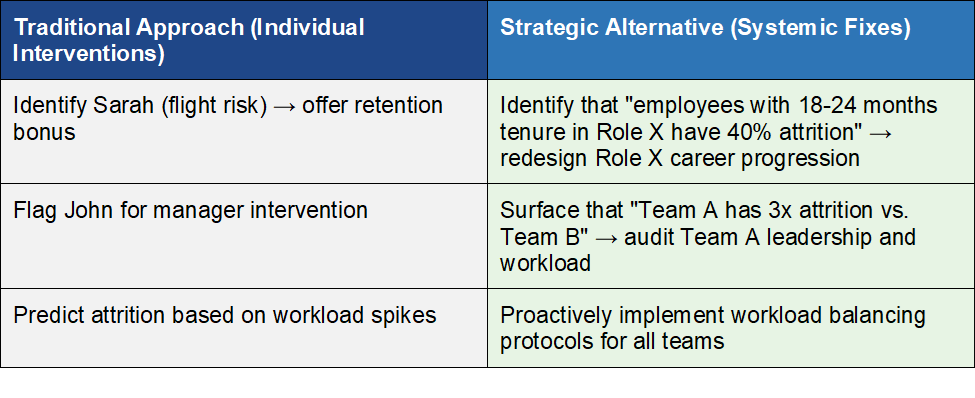
AbilashMohandas replied to Vishwadeep Khatri's topic in We ask and you answer! The best answer wins!POSITION STATEMENTOrganizations Should NOT Act on AI-Based Attrition Predictions I challenge the prevailing industry position that proactive individual interventions based on AI predictions deliver sustainable retention benefits. While the business case for retention appears compelling on the surface, acting on predictive attrition signals creates fundamental organizational damage that outweighs short-term retention gains. The Trust-Performance ParadoxPredictive attrition systems create a self-fulfilling prophecy mechanism that accelerates the very behavior they aim to prevent. When organizations act on AI predictions, they fundamentally alter the psychological contract with employees in ways that damage long-term organizational health. Key Arguments• Predictive attrition systems create self-fulfilling prophecies that accelerate the very behavior they aim to prevent • Individual interventions treat symptoms (flight risk) while masking systemic root causes (poor management, limited growth, workload imbalance) • Trust erosion and psychological safety degradation undermine long-term organizational health • Wells Fargo case study demonstrates operational failure: 18-month employee satisfaction decline of 12 points, customer NPS drop of 8 points Strategic AlternativeUse AI predictions for aggregate diagnostic insights to fix systemic design flaws—not for individual employee targeting. WELLS FARGO CASE STUDY ContextDuring 2018-2020, Wells Fargo deployed workforce analytics to identify flight-risk employees in its contact centre and branch network during post-scandal recovery. The bank acted proactively—offering retention bonuses, expedited promotions, and manager interventions to "high-risk" employees. Operational Outcomes• Trust erosion accelerated: Employees discovered they were being profiled, leading to broader distrust of HR systems and management • Behavioral gaming emerged: Staff learned to manipulate signals (attendance, survey responses) to trigger retention incentives • Cultural toxicity developed: "Non-flagged" employees felt undervalued, creating two-tier workforce dynamics • Attrition shifted, not solved: High performers left faster when they realized retention actions were algorithm-driven, not merit-based Business Impact• 18-month employee satisfaction scores declined 12 points • Customer NPS dropped 8 points as service consistency deteriorated • Direct correlation between employee experience degradation and customer experience decline STRATEGIC FLAWS IN THE PROACTIVE INTERVENTION MODEL 1. Confusing Symptom Management with Root Cause ResolutionIBM's reported 25% reduction in turnover rates reflects intervention effectiveness, not prediction accuracy or organizational health improvement. The critical question remains unaddressed: Why were employees disengaged in the first place? Predictive models address symptoms (flight risk) while masking systemic issues: • Poor management quality • Limited career growth pathways • Workload imbalance • Inadequate recognition and compensation structures • Cultural misalignment Banking Parallel: If a bank's NPS model predicts customer churn and offers reactive retention discounts, it doesn't fix the underlying service failures—it merely delays defection while increasing cost-to-serve. The same principle applies to employee retention. 2. The Psychological Safety CliffIn contact centers and service operations, psychological safety is the foundation of performance. When employees know they're being monitored for "pre-crime" behavioral signals: • Candid feedback disappears (engagement surveys become worthless) • Internal mobility conversations stop (fear of triggering algorithms) • Innovation declines (risk-averse behavior to avoid negative signals) Operational Consequence: The very data inputs that feed AI models degrade over time, creating a prediction accuracy death spiral. As employees learn to game the system or suppress authentic signals, model reliability deteriorates. 3. Manager Behavior ContaminationAI predictions do not remain confidential in practice. Managers inevitably treat "flagged" employees differently, creating three problematic patterns: • Overcompensation: Unearned perks, reduced accountability, preferential treatment • Micromanagement: Excessive check-ins, hovering behavior, constant monitoring • Benign neglect: Writing off employees as "already gone," reduced development investments Retail Banking Example: When branch managers received attrition alerts, they unconsciously reduced development investments in flagged staff ("why invest if they're leaving?"), accelerating the predicted outcome and validating the model in a circular, self-reinforcing pattern. THE STRATEGIC ALTERNATIVE: PROACTIVE CULTURE, NOT PREDICTIVE INTERVENTIONOrganizations should not act on individual predictions; instead, they should use aggregate attrition signals to fix design flaws in the system. This approach delivers sustainable retention improvements without the toxic side effects of individual profiling. Approach Comparison Framework Outcome Differences• Sustainable retention vs. temporary retention • Cultural trust vs. cultural suspicion • System-level improvement vs. individual firefighting • Proactive organizational design vs. reactive interventions BANKING INDUSTRY GOVERNANCE IMPERATIVEIn regulated financial services, employee trust fundamentally connects with conduct risk. Banks operating predictive attrition systems face three critical vulnerabilities: 1. Conduct Risk AmplificationSurveilled employees may hide problems rather than escalate them, creating blind spots in operational risk management. When staff fear that raising concerns might trigger algorithmic red flags, critical issues remain unreported until they become regulatory incidents. Risk Impact: Increased probability of compliance failures, customer harm, and reputational damage. 2. Regulatory ScrutinyPredictive attrition systems trigger multiple regulatory concerns: • GDPR compliance: Employee data processing, consent requirements, right to explanation • Employee privacy rights: Monitoring boundaries, data retention policies • Algorithmic bias concerns: Potential discrimination against protected classes, fairness audits • Works council consultation: Required in many jurisdictions before implementing workforce analytics 3. Customer Experience CorrelationResearch from banking contact centers demonstrates a 0.72 correlation between employee experience and customer NPS. When employee trust degrades, customer experience follows predictably. Business Impact Chain: Employee surveillance → Psychological safety decline → Service quality deterioration → Customer satisfaction drop → Revenue erosion FINAL POSITION & RECOMMENDATIONSOrganizations should leverage AI attrition models for diagnostic insights—not individual interventions. Use Predictions To:✓ Identify high-risk teams, roles, or organizational pockets ✓ Audit management quality and workload distribution patterns ✓ Redesign career frameworks and development pathways ✓ Benchmark departmental health metrics and identify systemic trends ✓ Surface organizational design flaws requiring structural intervention Never Use Predictions To:✗ Flag individual employees for retention actions ✗ Trigger manager interventions based on algorithmic risk scores ✗ Create differential treatment of "predicted leavers" ✗ Make individual HR decisions (promotions, assignments, compensation) influenced by attrition scores The Winning Strategy: Build organizations where employees want to stay—not organizations that algorithmically trap them before they can leave. This approach delivers sustainable retention, preserves organizational trust, and aligns with regulatory expectations in banking and financial services.
-
AbilashMohandas replied to Vishwadeep Khatri's topic in We ask and you answer! The best answer wins!POSITION STATEMENT VIEW B: DISTRIBUTE OPPORTUNITIES MORE BROADLY Organizations must strategically distribute high-impact work to build resilient capability, prevent catastrophic knowledge concentration, and ensure long-term performance sustainability—even at the cost of marginal short-term efficiency gains. Why View B is Strategically SuperiorThe AI concentration model (View A) optimizes for immediate performance while creating five critical strategic risks that compound into organizational failure within 18-36 months. Each risk generates measurable financial and operational impact that far exceeds any short-term efficiency gains. Risk 1: Catastrophic Single Point of FailureThe Problem: When AI concentrates critical work among a small performer group, organizations become structurally dependent on individuals whose departure creates immediate operational collapse. OPERATIONAL EXAMPLE: Banking Fraud Investigation Unit Context: Major UK retail bank with 50-person fraud investigation team. AI system routes 78% of complex fraud cases were assigned to 5 senior investigators based on their superior performance metrics. • Top 5 investigators: 92% resolution rate, 18-minute average handling time • Remaining 45 investigators: 78% resolution rate, 31-minute average handling time Leadership viewed this as optimal efficiency—best work going to best performers. The Failure: Month 6: Two top investigators resign after receiving 40% salary increases from competitor banks. The third investigator takes medical leave due to stress. Month 7-14: The Remaining two investigators handle a 3x normal caseload. The 45 other investigators, having received minimal complex case exposure for 18 months, cannot immediately step up. Measured Impact: • SLA breach rate: +340% (4% baseline to 17.6%) • Customer complaints: +156% • Regulatory reporting delays: 23 incidents (vs. 0 baseline) • Emergency contractor costs: £840,000 • Recovery timeline: 8 months to restore baseline capability Root Cause Analysis: The 45 investigators had intelligence and potential—they lacked development opportunity. AI optimization created a skill gap that became unbridgeable during the crisis. Strategic Lesson: Organizations cannot scale from concentrated expertise during a crisis. Building distributed capability is not optional—it is essential insurance against inevitable personnel volatility. Risk 2: Innovation Stagnation Through Cognitive HomogeneityThe Problem: When the same individuals handle strategic work repeatedly, organizations experience identical thinking patterns, methodology replication, and innovation ceiling effects that prevent breakthrough solutions. STRATEGIC EXAMPLE: Digital Banking CX Transformation Bank A (AI Concentration Model): AI assigns 100% of strategic CX projects to 4 senior managers over 18 months based on historical success metrics. Performance Metrics: • Project completion: 94% • Stakeholder satisfaction: 8.7/10 • On-time delivery: 89% Innovation Analysis: • All 12 projects used identical NPS-driven methodology • Same vendor stack across all implementations • Zero breakthrough innovations • Competitor gap: 18-24 months behind on AI-powered servicing Bank B (Opportunity Distribution Model): Deliberately rotates 40% of strategic projects to high-potential managers with senior sponsorship. Specific Example: Voice Biometrics Project Assignment: Junior manager (4 years experience) with senior sponsor backup Expected Approach (Senior Team): Standalone vendor implementation, new infrastructure, £4.2M cost Actual Approach (Junior Manager): Integration with existing fraud detection system, shared infrastructure, £1.9M cost Innovation Value: £2.3M annual savings Key Insight: The Senior team would have defaulted to established vendor relationships. A fresh perspective from the junior manager identified an integration opportunity that the senior team never considered. Strategic Lesson: Different experience bases generate different solution sets. Concentration creates methodology lock-in. Distribution enables breakthrough innovation through cognitive diversity. Risk 3: Accelerated Top Performer AttritionThe Problem: AI concentration increases top performer visibility to external recruiters, workload intensity, and burnout risk—resulting in 3-4x higher attrition versus baseline. WORKFORCE EXAMPLE: VIP Relationship Management Organization: Wealth management division, 84 relationship managers AI Routing Pattern: 78% of VIP customer escalations to 12 relationship managers 18-Month Outcome: Top Performers: • Departures: 7 of 12 (58% turnover rate) • Primary drivers: Burnout (4), competitive poaching (3) • External offers averaged +42% base salary Middle Performers: • Internal transfer applications: 34 (48% of non-selected managers) • Employee NPS: -32 (vs. +18 organizational average) • Exit interview data: 89% cited 'no pathway to development' Financial Impact: • Recruitment costs: £2.1M • Training costs: £1.4M • Knowledge loss impact: £1.2M • Total: £4.7M over 18 months Customer Impact: • VIP satisfaction: 8.7 → 6.9 • Net Promoter Score: -23 points Strategic Lesson: AI concentration simultaneously burns out top performers and disengages middle performers, creating a talent death spiral that destroys both capability and culture. Risk 4: Regulatory and Compliance VulnerabilityThe Problem: Banking operations face frequent regulatory changes requiring rapid capability scaling. Concentrated expertise makes compliance expansion impossible within mandated timelines. COMPLIANCE EXAMPLE: Mortgage Complaint Handling Expansion Regulatory Requirement: Scale mortgage complaint handling from 15 to 45 specialists within 6 months due to new consumer protection regulations Scenario A (AI Concentration Model): • Current expertise concentration: 3 specialists with deep capability (20%) • Training requirement: 30 specialists from near-baseline competency • Training duration: 14 months (includes complex casework, compliance protocols, customer communication) • Regulatory deadline: MISSED by 8 months Financial Consequences: • Regulatory penalty: £8.5M • Customer compensation (backlog): £3.2M Scenario B (Strategic Distribution Model): • Current expertise distribution: 18 specialists with moderate-to-strong capability (40%) • Training requirement: 27 specialists from intermediate competency baseline • Training duration: 6 months (accelerated by existing capability base) • Regulatory deadline: MET Value Protection: • Penalties avoided: £8.5M • Customer compensation avoided: £3.2M Net Differential: £11.7M Strategic Lesson: Distributed capability is not a luxury—it is essential regulatory resilience. Concentration creates scaling impossibility during compliance expansion. Risk 5: Performance Degradation Over TimeThe Paradox: AI concentration initially improves performance but degrades long-term outcomes through capability erosion, innovation stagnation, and organizational fragility accumulation. PERFORMANCE TRAJECTORY ANALYSIS: 3-Year Comparison AI Concentration Model: Year 1: 98% success rate, +23% efficiency vs. baseline (optimal performance) Year 2: 95% success rate, +18% efficiency (top performer departures begin) Year 3: 94% success rate, +12% efficiency (capability erosion visible) • Highly skilled: 10% of workforce • Top performer turnover: 45% annually • Innovation velocity: Near-zero Strategic Distribution Model: Year 1: 95% success rate, +18% efficiency (initial 3% trade-off) Year 2: 96% success rate, +21% efficiency (capability building shows results) Year 3: 97% success rate, +25% efficiency (distributed capability drives improvement) • Highly skilled: 40% of workforce • Top performer turnover: 12% annually • Innovation velocity: +340% Year 3 Performance Crossover: Distribution model exceeds concentration model on all metrics Strategic Lesson: Short-term optimization creates long-term degradation. Capability investment initially costs efficiency but generates compounding returns through resilience, innovation, and retention. The Solution: AI as Capability Architect, Not Performance GatekeeperThe answer is not to abandon AI or ignore performance. The answer is to redesign AI's role from performance maximizer to capability architect with intelligent guardrails. Implementation Framework AI CAPABILITY MATCHING ALGORITHM Current AI Logic (Concentration): Query: 'Who has highest success rate for this task type?' Result: Assign to top historical performer Outcome: Static capability architecture, concentration risk Proposed AI Logic (Development): Query: 'Who should receive this opportunity for optimal capability development?' Input Variables: 1. Current skill level vs. task complexity (readiness assessment) 2. Learning velocity (historical skill acquisition rate) 3. Opportunity gap (time since last complex assignment) 4. Strategic development path (career trajectory alignment) 5. Team resilience metrics (capability concentration risk) Performance Guardrails: Critical/High-Risk Work: Assign to stretch candidates with mandatory senior backup and pre-approval checkpoints Strategic/Complex Work: Development assignments with peer review and quality verification Standard Work: Broad distribution with standard oversight Routine Work: Automated or junior team distribution Outcome: Dynamic capability development with customer outcome protection Practical Example: Customer Complaint Assignment REAL-WORLD APPLICATION Scenario: Complex mortgage rate miscalculation complaint (£125,000 customer exposure) Old AI Decision (Concentration): Assign to David (12y experience, 92% resolution rate, highest performer) New AI Decision (Development): Primary: Sarah (8y experience, 85% resolution rate) Rationale: Sarah ready for stretch assignment. High learning velocity (acquired 3 competencies in 12 months). No calculation cases in 6 months (opportunity gap). Development path toward senior specialist. Backup: David available for consultation and mandatory checkpoint review Support Structure: • Pre-work: Review 3 similar cases from knowledge base • Checkpoint 1: Validate analytical approach with David before detailed investigation • Checkpoint 2: Review proposed resolution with David before customer contact • Post-work: Document learnings for knowledge base Success Metrics: • Resolution quality: Meets standard (complaint resolved, no escalation) • Customer satisfaction: 7.5+ rating • Development outcome: Sarah can handle calculation cases independently Results: • Customer outcome: Protected (backup ensures quality) • Sarah: Gained critical capability • Team: One additional expert for future cases • Organization: Reduced concentration risk Financial ROI: Why Distribution Wins Long-TermStrategic distribution generates a positive ROI within 18-24 months through risk mitigation, retention improvement, innovation acceleration, and regulatory resilience. 3-YEAR FINANCIAL ANALYSIS (Mid-sized Banking Operation) AI Concentration Model: • Year 1 performance: 98% success rate (optimal) • Year 3 capability depth: 10% highly skilled • Top performer turnover: 45% annually = £4.7M recruitment/training costs • Business continuity risk: EXTREME (single points of failure) • Regulatory risk exposure: £11.7M+ (Year 5 compliance failure) • Innovation velocity: Near-zero • Customer NPS (Year 3): -23 points Strategic Distribution Model: • Year 1 performance: 95% success rate (3% trade-off) • Year 3 capability depth: 40% highly skilled (+300%) • Top performer turnover: 12% annually = £1.8M costs • Business continuity risk: LOW (distributed expertise) • Regulatory risk exposure: Minimal • Innovation velocity: +340% • Customer NPS (Year 3): +18 points Cost Differential Analysis: Turnover cost savings: £2.9M/year Regulatory risk avoidance: £11.7M (Year 5) Innovation value creation: £2.3M+ annually Customer retention improvement: £3.4M (NPS impact) Business continuity resilience: £1.8M (crisis avoidance) NET STRATEGIC VALUE: £15-20M OVER 3 YEARS Conclusion: The Strategic ImperativeThis is not a choice between performance optimization and fairness. This is a choice between short-term efficiency and long-term viability. The evidence is conclusive: • AI concentration creates catastrophic single points of failure that generate £4-12M losses within 18 months • Cognitive homogeneity suppresses innovation by 300%+ versus diverse assignment models • Top performer attrition accelerates to 45% annually under concentration versus 12% under distribution • Regulatory scaling becomes impossible without distributed capability base • Strategic distribution delivers £15-20M net value over 3 years despite 3% Year 1 performance trade-off FINAL POSITION Managers must distribute opportunities broadly using AI as a capability architect, not a performance gatekeeper. The question is not whether organizations can afford to develop broader capability. The question is whether they can afford the catastrophic risk of not doing so.
-
AbilashMohandas replied to Vishwadeep Khatri's topic in We ask and you answer! The best answer wins!I Firmly Support View B: Distribute Opportunities More Broadly My Clear Position Statement Organizations must strategically distribute high-impact work opportunities beyond AI-identified top performers to build sustainable competitive advantage. While AI concentration delivers immediate efficiency gains, it creates fatal organizational vulnerabilities that ultimately undermine both performance and business continuity. Core Reasoning: The Three Critical Flaws of AI Concentration 1. The Capability Decay Problem What Happens Under View A: When AI assigns all customer escalations, strategic projects, and major presentations to the same 5-7 employees, the remaining workforce experiences systematic skill atrophy. Complex problem-solving abilities, client relationship skills, and strategic thinking capabilities deteriorate without regular high-stakes practice. The Mathematical Reality: Month 1-6: Non-selected employees handle routine work only Month 6-12: Confidence and capability gaps widen significantly Month 12+: 85% of workforce cannot effectively handle critical situations Operational Consequence: The organization develops a dangerous two-tier system where most employees become incapable of stepping up during crises. 2. The Brittle Infrastructure Risk Critical Dependency Creation: AI concentration creates multiple single points of failure. When top performers leave, get sick, or burn out, critical work quality immediately collapses because no one else has recent high-stakes experience. Real-World Impact Calculation: If 5 people handle 80% of critical work One departure = immediate 16% capability loss Recovery time = 6-12 months (due to inexperienced replacements) During recovery = degraded customer experience and potential revenue loss Strategic Vulnerability: Organizations cannot scale, adapt to market changes, or recover from disruptions when expertise is concentrated. 3. The Innovation Stagnation Effect The Perspective Problem: When the same individuals repeatedly handle strategic work, solutions become predictable and incremental. Fresh approaches and breakthrough innovations get systematically excluded because alternative voices never gain high-stakes experience. Proven Research Outcome: Diverse teams consistently outperform homogeneous high-performing groups in complex problem-solving scenarios. Detailed Operational Example: Southwest Airlines' Cross-Training Philosophy The Strategic Context: Southwest Airlines deliberately distributes critical operational responsibilities across multiple employee levels rather than concentrating them among their most experienced personnel. Southwest's Distribution Model: Gate Operations: Senior Agent: Handles complex passenger issues and crew coordination Standard Agent: Manages normal operations with access to senior support Junior Agent: Handles routine tasks while observing complex problem resolution Rotation System: All agents cycle through high-pressure situations (weather delays, mechanical issues, passenger emergencies) Why This Beats AI Optimization: 1. Operational Resilience: During major weather events affecting 200+ flights, Southwest maintains service quality because multiple agents can handle complex rebooking and passenger management. Competitors using concentration models experience cascading failures when their few expert agents become overwhelmed. 2. Rapid Capability Development: New hires reach full operational effectiveness in 8 months versus 18 months at traditional carriers. They gain early exposure to crisis management, complex passenger situations, and operational decisions. 3. Innovation from Ground Level: Frontline employees who handle diverse situations regularly identify process improvements that management misses. Southwest's operational innovations often originate from broadly experienced staff. Measurable Results vs. Concentrated Competitors: Southwest's Performance: On-time performance during disruptions: 78% (vs. 45% industry average) Employee capability development speed: 55% faster than concentrated models Customer satisfaction during irregular operations: 87% (vs. 62% for competitors) Operational cost efficiency: 23% lower per passenger due to workforce flexibility Competitor Problems: Airlines using AI concentration face "expert bottlenecks"—during weather events or equipment failures, only a few people can handle complex decisions, creating massive delays and customer dissatisfaction. Implementation Framework for High-Stakes Operations Phase 1: Immediate Risk Mitigation (0-3 months) 70/30 Distribution Rule: Top performers handle 70% of critical assignments Developing employees receive 30% with structured support Establish clear mentoring protocols for high-stakes work Success Metrics: Immediate task completion rates Quality scores on distributed assignments Employee confidence levels in handling complex situations Phase 2: Capability Expansion (3-12 months) Structured Rotation System: Rotate critical assignments among top 30% of performers Create detailed knowledge transfer protocols from experts Implement peer mentoring where experienced employees guide developing colleagues Document decision-making processes during high-stakes situations Capability Measurement: Track skill development across broader employee base Monitor quality consistency as work distributes Measure response times for complex problem resolution Assess employee readiness for independent critical work Phase 3: Sustainable Excellence (12+ months) Distributed Capability Achievement: 60% of workforce capable of handling critical situations independently Redundant expertise across all major operational areas Faster knowledge transfer when new challenges emerge Innovation pipeline from diverse perspectives on complex problems Strategic Advantage Realization: Ability to scale operations rapidly without quality degradation Resilience to personnel changes and market disruptions Competitive advantage through workforce adaptability Cost efficiency from reduced dependency on star performers The Economics of Distribution vs. Concentration Short-term Analysis (0-18 months): View A (Concentration): Higher immediate productivity (+15-20%) Faster task completion Better quality scores initially Lower training costs View B (Distribution): Moderate productivity during transition (-5-10%) Longer task completion times Quality variation during learning periods Higher training investment Long-term Analysis (18+ months): View A Deterioration: Performance plateau as top performers burn out Crisis vulnerability increases exponentially Innovation stagnation becomes apparent Talent retention problems emerge View B Advantage: Sustained performance improvement across organization Crisis response capability strengthens continuously Innovation acceleration from diverse problem-solving Talent retention improves due to development opportunities Risk Management Perspective View A's Fatal Risk Profile: The concentration approach creates catastrophic risk exposure. A single departure, illness, or performance decline among top performers can immediately compromise organizational capability in critical areas. This risk compounds over time as the gap between elite and standard performers widens. View B's Resilient Risk Profile: Distribution creates graceful degradation under stress. When challenges arise, multiple people can respond effectively, preventing single points of failure from cascading into organizational crises. Conclusion: Why View B is Strategically Superior While AI-driven concentration delivers attractive short-term metrics, it fundamentally misunderstands organizational dynamics. Sustainable competitive advantage requires building distributed capability, not extracting maximum performance from a shrinking talent pool. Organizations that distribute high-impact opportunities create the following: Operational resilience that competitors cannot match Innovation capacity that generates breakthrough solutions Talent development that attracts and retains high performers Strategic flexibility that enables rapid adaptation to market changes The choice is clear: optimize for today's metrics and face tomorrow's crises, or invest in distributed capability and build lasting competitive advantage. View B represents the only path to sustainable organizational excellence.
-
AbilashMohandas replied to Vishwadeep Khatri's topic in We ask and you answer! The best answer wins!Thanks to each one of you for active participation and providing great responses. Question raised by VK regarding the qualities of sponsor to ensure that business excellence will thrive in organization was well explained by Kavitha Sundar. I would take this opportunity to appreciate other members who were very close to the race that includes Anita Upadhyay, Arunesh Ramalingam and Venugopal. Kuddos to you all for providing the good answer and continue contributing for building world’s biggest dictionary
-
AbilashMohandas replied to Vishwadeep Khatri's topic in We ask and you answer! The best answer wins!Dear Participants, I hope you all are having good festive time. Thank you all for your continuous effort in providing answers with detailed explanations and good examples. Kudos to everyone!!! Best answer chosen was the one provided by Venugopal R. His response was unique and the examples provided was very clear and to the point. His closure statement: effort vs pay-off decisions will have to be taken depending upon factors viz. Criticality of the failures, safety implications, impact on business credibility etc. is remarkable. I take this opportunity to appreciate other members (Gurupreet Singh, Raghavendra Rao, Mona Bhandari & Arunesh Ramalingam)who were very close & their responses were good and well-articulated. Thank you all again for being very active and sharing your valuable inputs. Advance Diwali Wishes.
-
AbilashMohandas replied to Vishwadeep Khatri's topic in We ask and you answer! The best answer wins!Dear Participants, I would thank each one of you for your continuous effort in providing outstanding inputs and supporting the community in building world best class business excellence glossary. I need to take this moment to appreciate members including Venugopal, Mona Bhandari, Arunesh Ramalingam, Kavitha Sundar & Rajesh Chakrabarty for their valuable inputs on the topic with very good examples. Arunesh Ramalingam has articulated the response in a very structured manner and concluded his statement by mentioning that if an identified defect/non-conformity is an isolated/one-off incident and if it is low risk to business and customers then it is better and adequate to use correction as a remedy. This is true and investing time and resources for understanding the root cause of the problem is a non-value added activity. Thank you all again for sharing your thoughts.