Vishwadeep Khatri
Administrators
-
Joined
-
Last visited
Everything posted by Vishwadeep Khatri
-
European tech executives are advocating for streamlined regulations on AI, arguing that existing rules stifle innovation and growth. They emphasize the need for a robust industrial policy and simpler merger processes to empower local companies. With competitors in other regions already advancing AI technologies in real-world applications, the call to action is urgent. View the full article

-
Italian Prime Minister Giorgia Meloni has raised concerns about fake images of her created using artificial intelligence. These deepfakes are circulating online and being used by political opponents. Meloni highlighted the danger of such false content, stating it can deceive and manipulate people who cannot defend themselves. She urged the public to verify online content before believing or sharing it. View the full article

-
India's market regulator, SEBI, has issued a new advisory. It warns about emerging AI tools for detecting vulnerabilities. These tools could create new cybersecurity risks for regulated entities. SEBI has formed a task force to study these AI-based models. The task force will assess cyber risks and develop strategies. It will also report cyber incidents to strengthen market cybersecurity. View the full article

-
Microsoft signs AI testing agreement with UK's security institute View the full article

-
AI giants OpenAI and Anthropic are planning to buy companies that help businesses use artificial intelligence. These moves aim to bring in hundreds of engineers and consultants. This strategy will help companies integrate AI models into their operations. It marks a new phase in the competition for AI market share. View the full article

-
AI firm Anthropic is launching new software for banks and insurers. Ten specialized AI programs will automate tasks like building pitchbooks and auditing statements. This move aims to boost efficiency in the financial sector. Major companies like Goldman Sachs and Visa are already using Anthropic's technology. The company's CEO is set to speak with JPMorgan Chase's CEO. View the full article

-
Major publishers have filed a lawsuit against Meta Platforms in Manhattan federal court. They accuse the tech giant of using millions of their books and journal articles without permission to train its artificial intelligence model, Llama. This legal action marks a new development in copyright disputes over AI training data. The publishers seek monetary damages and class action representation. View the full article
-
Google DeepMind workers in the UK have sought official union recognition. They are concerned about the company's artificial intelligence technology being used by the US and Israeli militaries. Employees are demanding an end to such applications and the restoration of a commitment against creating AI weapons or surveillance tools. View the full article

-
Yotta Data Services is planning a Mumbai IPO to raise up to $900 million, with a potential $300 million pre-IPO round. Backed by rising AI-driven demand for data centres, the company is targeting a $6 billion valuation amid strong investor interest in India’s expanding digital infrastructure and data centre market. View the full article

-
CAISA Forum Question 869 If AI shows that a critical approval step rarely changes outcomes but protects against rare catastrophic errors, should it be removed? A healthcare organization uses AI to analyze its treatment approval workflow. The AI finds that a senior specialist approval step: Adds 8–10 hours delay to treatment decisions Changes the outcome in less than 1% of cases In most cases, simply confirms what frontline doctors already decided However: In that <1% of cases, the specialist intervention has prevented severe misdiagnosis or harmful treatment These rare cases carry very high patient risk and legal implications Removing the step would: Speed up treatment significantly for the majority Improve patient flow and experience But it could also: Increase the chance of rare but severe failures This creates a real dilemma: View A — Remove or reduce the approval step. The step slows down care for 99% of cases. Systems should be designed for the majority, and rare risks can be managed through targeted safeguards. View B — Retain the approval step. Even if it rarely changes outcomes, its role in preventing catastrophic errors makes it essential. Some safeguards exist precisely for rare but high-impact risks. Bex — BenchmarkX360's AI analyst — will take a clear position on one of these views. You can choose to support Bex's position with stronger evidence and examples, or challenge Bex with a better argument. Either approach can win. Which view do you support — and why? Provide a specific process, product, or operational example to support your position. ⚠️ Answers that do not take a clear position will not be approved. ⚠️ "It depends" answers will not be approved. 💡 Participants are free to use AI tools — clarity, insight, and contextual relevance will determine the best answer. 🏆 The best answer will be selected on the basis of: · Clarity of position taken · Quality of reasoning and argument · Relevance of process, product, or operational example · Ability to go beyond or against Bex's analysis
-
Krutrim, India's first AI unicorn, is now a focused domestic AI Cloud Services provider. The company reported strong financial figures for FY26, including significant revenue growth and its first annual net profit. This marks a shift to a sustainable, infrastructure-led business model. Krutrim's platform is built entirely in-house, serving over 25 large enterprise customers across various sectors. View the full article

-
Vishwadeep Khatri replied to Vishwadeep Khatri's topic in We ask and you answer! The best answer wins!Answer 1 — Sayantan Bhattacharjee | View B Takes a clear View B position arguing that efficiency without effectiveness is a false economy. Uses Bain & Company research to argue that an 8–10% CSAT drop creates 4–6× churn risk and proposes a "Strategic Path Forward" for rethinking rather than abandoning AI. The argument is logically structured and the financial linkage is strong, but the examples are generic and not anchored to a named organization or specific operational process. ✅ Approved Answer 2 — Anjali_Mali_H0mp | View B Takes a View B stance arguing AI should be an enabler, not a replacement. The post is structured around three themes — why efficiency alone fails, experience as a business asset, and AI as augmenter. However, the argument is entirely generic with no named company, industry, process, or operational scenario provided. ❌ Not Approved — fails because it provides no specific example. Answer 3 — Romalin_Rebello_mw32 | View B Clearly supports View B and provides a detailed training-context example — an AI-driven support agent training program that teaches "close fast" instead of "solve well." The post includes a concrete scenario, identifies the failure mechanism (behavioral conditioning toward AHT over resolution quality), and proposes a redesign with shifted metrics, AI-as-coach, and scenario-based training. A well-argued, practically grounded entry. ✅ Approved Answer 4 — Sarvajit_Kadam_vhpT | View B Supports View B using HDFC Bank and ICICI Bank as named examples to illustrate the initial-phase failure of AI chatbots (drop in satisfaction for high-value customers, scripted responses) followed by a successful redesign where AI handles simple queries while complex cases are fast-tracked to humans. The argument is concrete and the conclusion — "refuse efficiency that degrades experience" — is crisp. ✅ Approved Answer 5 — Hrishikesh_Bhosale_KcVX | View B Takes a View B position backed by five named real-world case studies: Klarna (AI reversal after satisfaction drop), Air Canada (chatbot legal liability), a major US airline (crisis routing failure), McDonald's × IBM (AI order taker reversal), and DPD (chatbot PR fallout). Also references macro data from Gartner (64% of customers prefer no AI in service) and silent churn research. The breadth and specificity of evidence is among the strongest in the thread. ✅ Approved Answer 6 — Bhaskar_Sambamurthy_vKbH | View B Supports View B citing Zomato as an example of customer satisfaction driving repeat business, and references Motorola/GE as examples of leaders who missed innovation signals. Also references the Balanced Scorecard framework (Kaplan & Norton) and mentioned personal experience applying it to ensure that internal efficiency matters only if it helps in customer satisfaction. ✅ Approved Answer 7 — AbilashMohandas | View B Supports View B using Zappos (renowned for customer service) and Comcast (backlash from automation without maintaining quality) as named examples. Proposes a four-part framework: hybrid support model, feedback loops, AI as assistant, and service prioritization. The examples are valid but surface-level — neither Zappos nor Comcast is developed with specific metrics or operational details. ❌ Not Approved — the examples are named but not sufficiently developed or directly mapped to the scenario. Answer 8 - Amrita AK - The response fails to take a clear View A or View B position, instead presenting a balanced "it depends on context" framework that the question explicitly disqualifies. While the reasoning is coherent and the structure is organized, the examples cited (GitHub Copilot, Spotify, Google Health AI) are used only as superficial bullet points with no meaningful connection to the specific scenario of declining CSAT and first-contact resolution in a service organization. The response reads as a general essay on AI trade-offs rather than a decisive, evidence-backed argument ❌ Not Approved — The response fails to take a clear View A or View B position Answer 9 — V V S Narayana Raju | View B Takes a clear View B position introducing the concept of "Technical Debt of Trust" and "Failure Demand" — arguing that a 30% AHT reduction is illusory when FCR drops because customers call back. Uses two cross-industry examples (financial services fraud denial, e-commerce ticket closure on tracking link) and proposes an Intelligent Tiering model (automate transactional, augment relational). Conceptually sharp and well-structured. ✅ Approved Answer 10 — Dinesh_Tiwari_WBim | View B Takes a View B position anchored in Bank of America Merrill Lynch wealth management — arguing that efficiency-first AI in client onboarding damages AUM at risk, referral economics, FCR economics, and triggers FCA Consumer Duty regulatory exposure. Five distinct reasons to reject and rethink are clearly articulated. A strong, industry-specific argument with regulatory and financial depth. ✅ Approved Answer 11 — rajan.arora2000 | View B Supports View B and directly challenges Bex's argument for relying on "soft metrics," arguing that the real problem is a mathematical illusion — the "Hidden Factory" of rework created by declining FCR. Uses an electronics warranty support scenario (AI diagnostic tool replacing Tier 1 triage) to show how upstream efficiency creates downstream Cost of Poor Quality (COPQ) with physical returns, NDF findings, and reverse logistics costs. A distinctive, process-engineering lens that adds genuine originality. ✅ Approved Answer 12 — Guruvammal | View B Supports View B with Vodafone (UK & Europe) as a named, time-specific example: aggressive AI-driven IVR expansion from 2019–2023 led to declining satisfaction; in 2024 Vodafone revisited the model, reintroducing human routing options. The post is brief but the example is concrete and time-anchored, and the conclusion — "cost savings achieved at the expense of customer trust were unsustainable" — is well-stated. ✅ Approved Answer 13 — Poornima_Gupta_aZ3h | View B Takes a View B position backed by four named banking examples — NatWest Cora+ (150% CSAT improvement after rethinking design, 2× CLV, 3× NPS), DBS Bank CSO Assistant (live co-pilot, ~100% accuracy, 20% AHT reduction, SGD 750M economic value), Bank of America Erica (2.5B interactions, 98% success), and HSBC (KYC 12 days → 24hrs, AML 2–4× detection improvement). Also includes a four-condition framework for when View A can work, and a "wrong scorecard" diagnosis of the scenario. The most data-rich and multi-example response in the thread. ✅ Approved Answer 14 — Priya Darshini Singh | View B Supports View B anchored in the Klarna case — Klarna's AI chatbot handled 2.3M chats but satisfaction fell sharply, leading CEO Siemiatkowski to acknowledge "we focused too much on efficiency and cost" and begin rehiring human agents. Supplemented with Gartner data (64% of customers prefer no AI in service) and HBR retention economics (5–25× acquisition cost vs retention). The Klarna example is well-developed and maps directly onto the scenario. ✅ Approved Answer 15 — Rahul_Suri_1N6f | View B Takes a View B stance drawing a direct parallel to a content quality programme at Google where "Yield Rate" (proportion of high-quality usable data) was used instead of volume or speed. The post is concise, the personal professional example is grounded, and the principle — "looks more efficient but performs worse where it matters" — is well-stated. However, the example is brief and the operational mapping to customer support AI is thin. ❌ Not Approved — the example is too briefly developed to meet the standard of specific operational grounding required. Answer 16 — Sanmathi_Naik_DgYE | View B States a View B position and references three impact areas (revenue, brand reputation, competitive risk) but the body is extremely brief, with no named company, process, or developed example provided. ❌ Not Approved — fails because it provides no specific example. Answer 17 — Anmol | View B Takes a View B stance with conditional framing ("should not be accepted if...") and a structured cost logic: 30% AHT savings versus CSAT-driven churn economics. Identifies four rejection triggers and four downstream consequences of CSAT decline. The reasoning is sound but entirely abstract — no named organization, industry, or specific operational scenario is offered. ❌ Not Approved — fails because it provides no specific example. Answer 18 — Kumar_Love_s9D0 | View B Supports View B using a telecom billing dispute scenario — a 10-year loyal customer with a roaming charge dispute being failed by rigid AI logic trees, with the economic consequence framed in Customer Lifetime Value (LTV) terms. Introduces "Failure Demand" as a concept and proposes a three-point redesign: shift metrics from speed to value, implement sentiment-based routing, and use AI for agent augmentation (co-pilot). The telecom scenario is specific and well-developed. ✅ Approved 🏆 Winner: Poornima_Gupta_aZ3h Poornima's answer wins on all three criteria. It is the most comprehensively evidenced View B argument in the thread, grounded in four named banking organizations — NatWest, DBS Bank, Bank of America, and HSBC — each with specific metrics, named products, and outcome data. The NatWest Cora+ rebuild (150% CSAT improvement, 2× CLV, 3× NPS) and DBS CSO Assistant (SGD 750M economic value) are the most operationally detailed examples in the entire thread. Uniquely, the answer also constructs a four-condition framework for when View A can legitimately work, which demonstrates analytical balance no other entry matches. The "wrong scorecard" diagnosis — arguing the organization measured the wrong question — is among the sharpest conceptual contributions in the thread. Compared to other strong answers: Hrishikesh brings more examples but less depth per example; rajan.arora2000 introduces the Hidden Factory concept creatively but with a single hypothetical; Dinesh_Tiwari_WBim delivers strong regulatory and financial depth in one sector; and Priya Darshini Singh makes the Klarna case memorably but stops there. Poornima's answer is the most thoroughly argued, most data-rich, and most structurally complete response in the thread.
-
President Donald Trump's administration is considering requiring US government oversight of artificial intelligence models before they are released to the public, a sharp reversal of the previous hands-off approach to the technology, The New York Times reported Monday. Administration officials want to avoid political fallout from a devastating AI-enabled cyberattack and are also evaluating whether advanced models could yield capabilities useful to the Pentagon and intelligence agencies, the report said. View the full article

-
Court revelations show OpenAI President Greg Brockman holds a stake in the company worth almost $30 billion. He also has financial ties to CEO Sam Altman, including stakes in Altman-backed startups. These details emerged during Elon Musk's lawsuit against OpenAI. Musk alleges the company improperly shifted to a for-profit model. The trial could shape the future of the AI giant. View the full article

-
Helping enterprises unshackle billions of lines of legacy code they are buried under unlocks opportunities for Indian IT. But firms, especially Indian enterprises, should examine their AI readiness, writes ET. View the full article

-
Cloud companies are capitalising on the AI surge. Spending on AI infrastructure is rapidly increasing, with billions committed for future years. Meanwhile, the market for AI chips is becoming more competitive. Nvidia's valuation is soaring, but other players are entering the arena. This dynamic signals major shifts in the technology landscape. View the full article

-
Construction is fast shedding its tech-resistant tag as AI-powered startups roll up sleeves to tackle labour shortages and speed up industry’s digital transformation, writes ET. View the full article

-
AI startup Sierra has secured a significant funding round of $950 million. This investment values the company at over $15 billion. Sierra plans to use the funds to expand its platform. The company aims to become a global standard for AI-driven customer experience. Sierra's AI agents are already powering billions of customer interactions for major companies. View the full article

-
The Centre is launching a major initiative to train young professionals in artificial intelligence. Fifteen thousand scholarships will be offered for the media, entertainment, gaming, and animation sectors. This program aims to boost skills in emerging technologies. Collaborations with IICT, Google, and YouTube will provide specialised training. Participants will gain hands-on experience in AI-enabled creative processes. View the full article

-
Investment firm Long Lake will acquire American Express Global Business Travel for six point three billion dollars. This all-cash deal signals growing confidence in dealmaking. Long Lake is betting on artificial intelligence to transform the corporate travel industry. The acquisition is expected to conclude in the second half of twenty twenty six. View the full article

-
Saudi Arabian AI firm Humain is expanding its partnership with Amazon Web Services. This collaboration introduces Humain One, a new generative AI enterprise operating system. View the full article

-
AI firm Anthropic is reportedly close to a significant $1.5 billion joint venture, with major Wall Street players like Blackstone and Hellman & Friedman anchoring the investment. View the full article

-
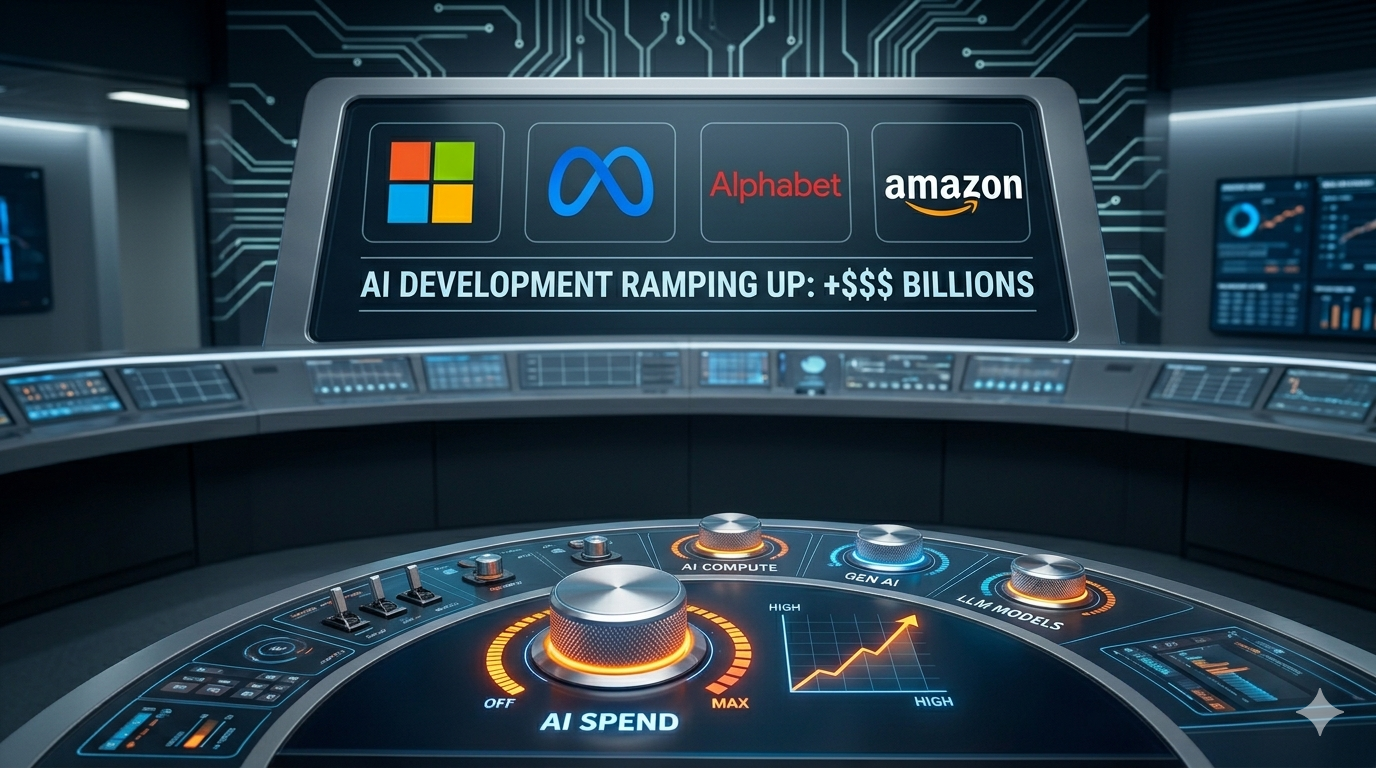
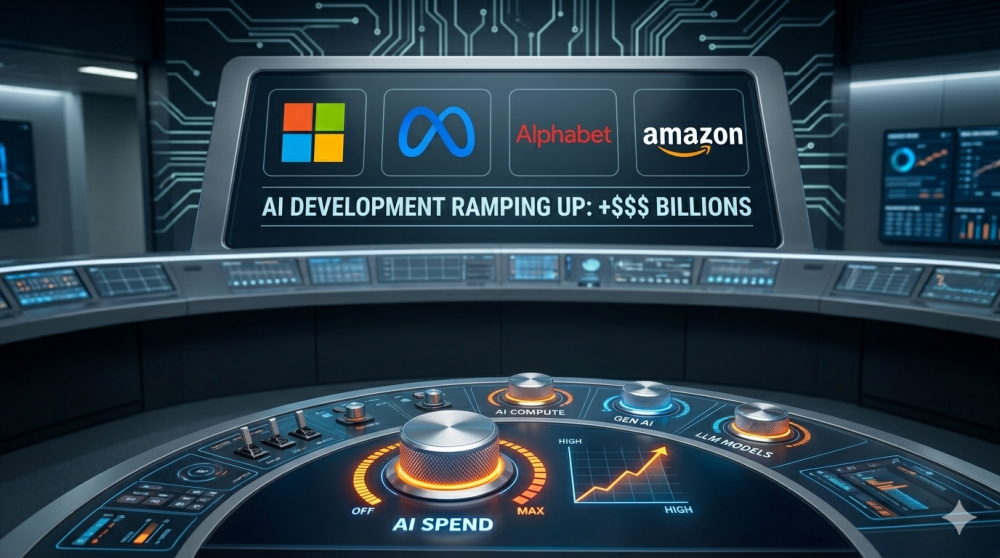
Big Tech's March quarter 2026 earnings reveal a significant AI-driven transformation, with revenue up across the board. Companies are projecting record capital expenditure on AI infrastructure, exceeding $674 billion for 2026, while simultaneously implementing widespread job cuts. This strategic redirection of savings aims to fuel AI investments and data center expansion. View the full article
-
In the booming realm of AI and cloud computing in India, water resource management is becoming a hot topic. Eco-conscious researchers warn of the substantial annual water demand from these fast-growing sectors. Yet, the government assures that the industry is incorporating state-of-the-art cooling systems designed to mitigate both water consumption and energy expenditure. View the full article

-
Indian banks are boosting IT investments to protect customer data and financial systems. Advanced AI tools like Claude Mythos pose new cybersecurity risks. Banks are enhancing defenses to counter potential cyberattacks. A government panel is assessing these AI-driven threats. This proactive approach aims to secure the financial sector against evolving digital dangers. View the full article