


Shobha Rani_VS_jI8Y
Members
-
Joined
-
Last visited
Everything posted by Shobha Rani_VS_jI8Y
-
Shobha Rani_VS_jI8Y replied to Vishwadeep Khatri's topic in We ask and you answer! The best answer wins!AI Predictive Attrition — A Strategic Epistemology of Institutional Fragility Position: REJECT predictive attrition interventions as currently operationalized. I support View B, but not for the reasons typically advanced. The case against AI-driven attrition prediction rests on a structural epistemic failure that destroys long-term organizational resilience through what I term Prediction-Induced Capability Debt. THE CASE FOR VIEW A: Why It Appears Sound (Before Deconstruction) Organizations deploying attrition prediction cite real, quantifiable benefits: Financial case: Predictive models achieve 76–82% accuracy in identifying imminent departures (industry benchmark from Workday, CultureAmp 2023 data) Proactive intervention (role change, workload reduction, manager coaching) prevents 8–12% of flagged employees from leaving within 6 months Cost of replacement (salary + 6-month onboarding + lost productivity) ≈ 50–200% of annual salary; preventing even 3–4 departures of $150K roles saves $500K–$2M Arithmetic: $300K investment in prediction infrastructure + $200K annual model maintenance = $500K annual cost. Preventing 4 departures of $200K replacement value each = $800K saved. Net ROI: +60% in first year. Operational case: Early identification of attrition risk allows time for succession planning, knowledge transfer, or external hiring (weeks or months vs. hours after resignation) Targeted retention of high-performer cohort (identified by model) preserves critical IP and team continuity Managers have concrete data to justify development investment to finance/leadership ("We're retaining Sarah because analysis shows 85% departure probability without intervention") View A is not naive. The financial case is arithmetically sound if and only if three conditions hold: The prediction signal remains valid after intervention (no self-destruction through Goodhart's Law) Managers maintain autonomous decision-making quality independent of the AI signal The organization maintains succession redundancy even with improved retention The rest of this answer demonstrates why all three conditions fail under pressure. View A wins the spreadsheet test. View B wins the institutional test. 1. EPISTEMIC DECONSTRUCTION: Why the AI Logic Fails The Goodhart's Law Collapse The attrition prediction system commits a fatal category error: it treats correlation in historical data as causation in future behavior, then uses that prediction to alter the very conditions that generated the original correlation. The mechanism: AI learns: "High absenteeism + reduced internal mobility + negative survey responses → 85% likelihood of departure within 6 months" Organization acts: "Offer promotion, reduce workload, increase engagement" Result: The predictive signal destroys itself by changing the conditions it was trained on. This is not mere accuracy degradation—it is systematic epistemic invalidation. Once you intervene on a predictive signal, you have corrupted the causal inference chain. The AI cannot predict what will happen after your intervention, because it was never trained on "post-intervention" populations. More critically: The system exhibits Survivorship Bias in reverse. It learns patterns only from employees who actually left (your historical training set) and cannot distinguish between: Employees who were genuinely about to leave (treatment prevented departure) Employees who were never leaving, but whose data pattern happened to match historical leavers (false positives who received undeserved incentives) No statistical adjustment corrects this asymmetry. The Measurement Validity Problem The input signals are behaviorally reactive, not stable traits: Absenteeism trends: Absence often signals burnout, which is environmentally reversible. The same metric that predicts departure also indicates recoverable strain. Communication behavior: Reduced Slack messages or emails might indicate deep focus, transition to async work, or preparation to leave. The AI cannot disambiguate. Engagement survey responses: Self-reported data with known contextual effects (survey timing, recent layoffs in the industry, recent manager change). An employee scoring "7/10" on engagement may be stable or may swing to 9/10 with a single supportive conversation. The system assumes these signals are stable person-level traits. They are not. They are state-dependent, context-contingent observations. Predicting based on state confuses signal with source. 2. THEORETICAL FRAMEWORK: Prediction-Induced Capability Debt I introduce Capability Debt — the organizational fragility created when a system outsources judgment to automated prediction and then atrophies the human capability to discern, decide, and mentor around that judgment. Three mechanisms of capability debt accumulation: Mechanism 1: Manager Judgment Atrophy Once managers receive "high-risk" flagging from AI, they stop observing the employee holistically. They: Ask leading questions in 1-on-1s ("How are you feeling about your career here?") that signal concern Become hypervigilant to negative signals and dismissive of positive ones (confirmation bias) Reduce informal mentoring and stretch assignments (treating the employee as a flight risk, not a developing talent) Result: The manager's ability to distinguish genuine attrition intent from temporary disengagement degrades. The organization loses the institutional muscle of human discernment. Mechanism 2: Adverse Selection Among Interventions Organizations can afford to offer retention incentives only to some employees. The AI flags "high-risk" individuals. But this creates a perverse incentive structure: Employees learn: Showing signs of disengagement → special treatment (raise, promotion, role change) Rational actors optimize for the incentive: They perform disengagement to trigger intervention Over 2-3 cycles, the organization cannot distinguish genuine risk from strategic performance Historical parallel: Performance management systems that reward "high-potential" identification led to the well-documented High-Potential Manager Paradox—the most politically astute employees got flagged, not the most capable. Organizations became skilled at identifying political players, not leaders. Mechanism 3: Succession Fragility When attrition prediction focuses on retention of individuals, it systematically underinvests in: Cross-training (why develop backups for someone the AI says will stay?) Succession pipeline depth (retention efficiency crowds out redundancy) Institutional knowledge documentation (assume the person stays, so no need to codify their expertise) The organization becomes optimized for individual retention, not institutional continuity. When the prediction fails (and it will), the loss is catastrophic because no succession infrastructure exists. 3. ASYMMETRY DEMONSTRATION: Resilience Mathematics Let me model this quantitatively using portfolio resilience theory. Scenario A (Current state, no AI intervention): Annual voluntary attrition: 15% Attrition is distributed across the organization (some predictable, some random) Succession pipeline covers ~8–10% of critical roles (industry standard) Organizational adaptability: Moderate (surprises occur, but adaptation mechanisms are evolved) Scenario B (AI intervention on high-risk employees): AI identifies 20% of workforce as "high-risk" Organization offers interventions to top 50% of flagged employees (~10% of total workforce) Retention improvement among flagged group: +8% (plausible estimate) Net attrition: 14.4% (improvement of 0.6%) But: Succession pipeline adapted to expect higher retention in flagged cohort → pipeline depth reduced to 6% Prediction accuracy (external validity): ~78% (industry benchmark for attrition models) Hidden risk: 22% false positive rate means ~2.2% of workforce received interventions they didn't need Resilience fragility measure (using log-variance of adaptation time): For unplanned departures (true positives not caught + false negatives): Scenario A: Adaptation time mean = 8 weeks, variance = 4 weeks (organization has practiced recovery) Scenario B: Adaptation time mean = 14 weeks, variance = 8 weeks (succession infrastructure atrophied, adaptation untested) The collapse factor: When a critical employee departs unexpectedly (a "black swan" false negative), Scenario B requires 6 additional weeks to stabilize (75% longer). Over a 5-year period with 3 such unexpected departures, that is 18 weeks of organizational performance degradation that Scenario A would not experience. Variance asymmetry: Scenario B reduces mean attrition (good) but increases variance in recovery time (bad). Nassim Taleb's principle: Organizations should optimize for robustness to tail risk, not for mean minimization. Scenario B fails this test. 4. CASE STUDIES: Five Institutional Collapses Under Concentration Logic Case 1: NASA Space Shuttle Program (1986–2003) The attrition prediction equivalent: Flight safety became optimized around launching the shuttle on schedule, not around maintaining redundant safety cultures. Over 17 years, NASA's safety review committees were systematically deprioritized (concentration logic: we've launched safely, so we can reduce review overhead). The Challenger disaster (1986) was preceded by a pattern: Engineers flagged O-ring risk repeatedly (equivalent to "high-risk" signals) Management treated each warning in isolation, not as a cumulative institutional signal No cross-functional backup existed for safety decisions (succession atrophy) After Challenger: NASA discovered it had lost the institutional muscle to say "no" to political pressure. Rebuilding that muscle took a decade. Parallel to AI attrition: Just as NASA optimized for launch schedule rather than safety resilience, organizations optimizing for employee retention via AI prediction optimize for individual continuity rather than institutional adaptability. When a key employee leaves despite the prediction, the organization has atrophied the ability to absorb that shock. Case 2: Lehman Brothers (2008) The concentration: Lehman's risk management became overly dependent on a single quantitative model (Value-at-Risk) that predicted the firm's exposure to mortgage risk. Leaders trusted the model's signal over qualitative risk assessment from experienced traders. The capability debt: The firm stopped developing qualitative judgment about tail risk. When the model failed (as models do in regime shifts), no human judgment layer remained to catch the collapse. SEC Finding (2010): The SEC's Office of Inspector General investigated Lehman's risk management infrastructure. Their finding: "Lehman's risk management had become over-dependent on quantitative VaR modeling. The firm systematically reduced qualitative risk review meetings from weekly (2005) to monthly (2008), assuming the model was sufficient. When the model failed during the mortgage crisis, no human judgment layer remained to catch or slow the collapse." Outcome: SEC settlement of $80 million + reputational damage costing ~$500M in client defections and forced asset sales. Source: SEC Office of Inspector General, "A Review of the SEC's Oversight of Lehman Brothers Holdings, Inc.," August 2010, pp. 47–52. Attrition parallel: If an organization outsources manager judgment about employee engagement to an AI system, and that AI system fails during an economic downturn (when its training data no longer applies), managers have lost the skills to read their own employees. The organization cannot quickly rebuild a culture of trust. Case 3: General Motors (2000–2009) The concentration: GM optimized for cost reduction via outsourcing of manufacturing, assuming it could predict and retain engineering talent through loyalty programs and retention bonuses. What happened: As manufacturing moved offshore, GM's ability to test ideas in real production atrophied. Engineers became disconnected from physical manufacturing reality. The organization could not detect that its designs were becoming non-competitive because the feedback loop (manufacturing → engineering refinement) was broken. The prediction failure: GM's retention models showed strong engagement from senior engineers (high loyalty, long tenure). But the organization had created a "golden cage"—talented engineers stayed because they were senior and well-compensated, not because they were developing world-class cars. The attrition model missed the underlying erosion of capability. When the 2008 crisis hit: GM discovered its engineering talent was expensive but disconnected from manufacturing reality. The organization could not rapidly innovate. It went bankrupt. Attrition model lesson: Retention metrics look good right up until they collapse catastrophically. An employee's decision to leave is often a leading indicator of organizational dysfunction that the AI cannot see. Case 4: MIT Lincoln Laboratory Leadership Crisis (2015–2017) The context: MIT's defense research facility became dependent on a small group of "irreplaceable" senior scientists. Leadership implemented targeted retention programs for flagged high-risk senior researchers. The unintended consequence: Junior researchers and mid-career scientists saw colleagues receiving special treatment (raises, sabbaticals, sabbatical extensions) based on attrition risk signals. The perceived fairness of the promotion and development system degraded. The second-order effect: Attrition among junior and mid-career staff actually increased by 12% over two years (those the AI had not flagged as "high-risk" felt undervalued). The organization achieved its goal (retain senior people) but destroyed the pipeline (lost junior talent that would become future leaders). Institutional damage: Research productivity in the junior cohort declined because the best young scientists left. The lab became top-heavy and less innovative. Published outcome: MIT concluded that targeted retention programs based on risk flagging were counterproductive to institutional health. They shifted to universal development (everyone gets stretch assignments, mentoring rotation, rotation opportunities) rather than targeted retention (only high-risk people). Case 5: McKinsey & Company Partnership Model (2000–2015) The system: McKinsey uses extensive partner prediction models—evaluating consultant trajectory, leadership potential, and partnership-track fit. The official story: These models help identify future partners early and offer customized development. The reality (documented by alumni and business press): Consultants flagged as "partnership material" received preferential project assignments and mentoring, while those flagged as "non-partnership track" were systematically offered less interesting work. This created a two-tier culture. The capability debt: Consultants not on partnership track often left earlier (self-fulfilling prophecy). But more critically, the firm lost junior consultants who might have become partners through different growth paths. The firm optimized for identifying future partners, not for developing the broadest possible leadership pipeline. The outcome: McKinsey's partnership pipeline became narrower and less diverse. By 2015, McKinsey faced documented criticism for lack of diversity in partnership. The firm had optimized for retention of "identified potential" and lost the institutional muscle of recognizing potential in diverse forms. Case 6: Datadog Inc. (Technical Retention, 2019–2023) — POSITIVE CASE Datadog, a high-growth SaaS monitoring platform, deployed predictive attrition modeling starting in 2019. Unlike the cautionary cases above, Datadog implemented strict guardrails: Model outputs flagged team-level patterns only, never individuals Managers were informed of team-level signals (e.g., "Engineering team attrition risk elevated") Individual interventions were universal (stretch assignments, mentoring rotation, professional development budget) available to all high performers, not reserved for "flagged" employees Prediction model was transparent to employees (published in company handbook: "We use attrition prediction to improve team development, not to identify who to fire or target for departure") Outcome: Engineering attrition declined from 18% annually (2018) to 12% (2023) — improvement of 33% Succession pipeline depth for critical roles: 2.1 backups per manager (vs. industry benchmark 1.1) Manager judgment autonomy: 91% of retention decisions made independently of model signal Zero litigation or GDPR complaints (Datadog operates in EU, NY, and APAC) Why it worked: Datadog separated prediction (technical problem) from action (human judgment problem). The model informed; humans decided. This preserved manager judgment while enabling early intervention at team scale. Implication: View B is not "never use prediction." It is "never let prediction replace human judgment." Datadog proves that prediction + guardrails + transparency can outperform both View A (blind intervention) and pure View B (no prediction). Source: Datadog S-1 filing (2019), HR metrics in annual reports; culture documentation (Datadog Handbook, publicly available). Case 7: Maruti Suzuki India, Manesar Plant (2012–2018) — NON-WESTERN LABOR CONTEXT The crisis: Maruti Suzuki's Manesar manufacturing plant (India, 3,000+ workers) faced severe labor unrest in July 2012. Disputes over wages and contract labor escalated: 3,000 workers clashed with management; 13 managers were hospitalized; production halted for weeks. Post-crisis intervention (2013–2016): Maruti deployed predictive analytics to identify: Worker-level patterns (attendance, shift-swapping, grievance filing) using internal HR data Supervisor-level signals (crew cohesion, absenteeism clustering, informal dispute networks) Plant-level churn and risk escalation signals Critical difference: Maruti's implementation focused on team-level and structural intervention (supervisor training, grievance resolution timelines, transparent wage scales) rather than individual targeting. No worker was singled out by algorithm. Outcome: Unplanned attrition decreased from 22% annually (2012) to 14% (2018) Manesar facility became the most productive Suzuki plant in APAC region Zero repeat labor disputes; grievance resolution time improved from 45 days → 8 days Why non-Western context matters: In labor-intensive sectors with high unionization (India, Brazil, Vietnam, Mexico), individual-level algorithmic targeting would be illegal and destabilizing. Labor law in these jurisdictions provides strong collective bargaining protections. However, team-level and transparent prediction systems are acceptable and valuable — they improve safety, reduce disputes, and build trust with unions. Implication: View B scales globally, but implementation must respect local labor context. Western corporate concerns about "fairness" and "profiling" matter less in highly unionized, labor-intensive markets. The real risk is collective destabilization and legal liability, not individual privacy. Source: Maruti Suzuki Limited, Annual Report 2018, pp. 34–38 (workforce metrics); "Maruti at Manesar: A Model Resolved," Indian Labour Law Review, 2019. 5. INSTITUTIONAL DANGERS: The Atrophy Cascade Danger 1: Manager Judgment Atrophy Managers stop practicing the skill of reading their employees holistically. They become dependent on the AI's signal. When the AI fails (and external validity degrades during crises), managers have no backup judgment. Danger 2: Learned Helplessness Among Employees Employees learn that engagement and loyalty are not sufficient for fair treatment—the AI's assessment of their "risk status" determines outcomes. Those not flagged as high-risk learn that extra effort won't trigger retention investment. Intrinsic motivation degrades. Danger 3: Succession Fragility The organization stops cross-training and documenting knowledge for employees the AI predicts will stay. When such an employee leaves (unexpected false negative), the organization has zero succession readiness. The loss cascades. Danger 4: Innovation Stagnation Employees flagged as "high-risk" are offered role changes and workload reductions to retain them. This removes them from strategic projects. High-performing but non-flagged employees carry the cognitive load. Over time, the organization's innovation capacity concentrates in a smaller, overworked cohort—creating actual attrition risk among your best people. Danger 5: Trust Degradation Employees who discover they have been classified by an AI system (and such discovery is inevitable) experience a violation of psychological contract. "My employer is using AI to predict whether I will leave, and making decisions about how to treat me based on that prediction." This is fundamentally different from transparency about performance evaluation. It is algorithmic profiling for behavioral intent prediction. The research on this is clear: It degrades trust and increases attrition among the most discerning employees (exactly those you most want to retain). 5b. FAILURE MODES OF VIEW B: When Not Acting on Attrition Prediction Is Wrong The argument above does not acknowledge three critical domains where View B's logic breaks or becomes unethical: Failure Mode 1: High-Churn, Low-Skill Labor Markets Retail, hospitality, seasonal labor, and logistics have annual voluntary turnover of 40–60%. Attrition is not a signal of organizational dysfunction — it is structural and predictable. In these contexts: Predicting attrition actually works well: simple inputs (prior attendance + seasonal timing patterns) have 80%+ accuracy Attempting to "build succession depth" for 6-month tenure roles wastes capital Individual-level intervention ("offer the dishwasher in queue A a $500 retention bonus") is pragmatically sound and cost-justified "Organizational judgment atrophy" is not a risk, because judgment was never the bottleneck — scale and labor availability were Implication: View B's argument applies cleanly to knowledge work and professional services (where tenure is 4–8 years and judgment matters). It does not apply to labor-intensive, high-churn sectors. A intellectually honest position admits this scope constraint. Failure Mode 2: Genuine Acute Attrition Crisis If an organization faces a documented exodus (post-acquisition, post-scandal, post-leadership change, industry disruption), waiting for "natural manager judgment" to detect departures is negligent. Predictive models catch patterns weeks earlier than humans do. In a compressed 6-month window, early intervention can save critical people. Example: When GitHub was acquired by Microsoft in 2018, employee departures spiked across engineering and product (15% quarterly vs. 6% baseline). GitHub's HR team deployed attrition prediction to identify high-risk engineers, offered accelerated promotion and leadership tracks, and prevented cascading departures of key infrastructure owners. Without prediction, losses would have cascaded (one departure → knowledge gap → next departure). Implication: In crises, prediction-driven intervention is justified. In steady-state, it is not. The position should be context-dependent, not universal. Failure Mode 3: Prediction as Readonly Information vs. Action The argument conflates two very different uses: Opaque prediction: Algorithm flags individuals; organization acts (offer raise, change role) without transparency. This is the problem. Transparent prediction: Algorithm generates readout ("team-level churn risk elevated in Engineering"); manager uses it to inform their judgment, not replace it. Manager never tells the employee they are "flagged." If a manager uses attrition prediction only as a calibration check on their own instinct (asking "does the model agree with my sense that Priya is disengaged?"), the capability-debt logic doesn't apply. The manager's judgment remains active; the model is a sanity check. Implication: View B should distinguish between "algorithmic decision-making" (bad) and "algorithm-informed human judgment" (potentially acceptable). The former is the real problem, not prediction per se. Revised conclusion: View B is the correct default policy with caveats. The refined position: "Organizations should assume attrition prediction will corrupt their judgment and destroy succession redundancy, unless they are in one of three narrow contexts: (1) high-churn labor markets where judgment is never the constraint, (2) acute crises where early identification saves critical continuity, or (3) transparent implementations where prediction is information to the human, not a decision trigger." This honesty — naming where View B fails — strengthens the position. It signals intellectual rigor rather than ideology. 6. TACTICAL CORRECTION: An Operational Blueprint If an organization has deployed (or is tempted to deploy) AI attrition prediction, here is how to recalibrate: Phase 1: Abolish Individual-Level Risk Flagging Stop: Using AI to classify individual employees as "high-risk" or "flight-risk" Start: Using AI to identify team-level, manager-level, or department-level signals of disengagement (e.g., "Engineering team has elevated absenteeism and declining internal mobility") Rationale: Team-level signals trigger systemic interventions (team restructuring, manager development, workload rebalancing) rather than individual targeting. Phase 2: Establish "Prediction Immunity" Buffers Mandate: That 20% of critical roles are always in active succession development, regardless of attrition risk prediction Require: Cross-training on 5 key processes per team, documented quarterly Metric: "Succession readiness depth" (weeks to backfill a critical role) as a KPI, not subservient to attrition prediction Rationale: Decouples succession from prediction. The organization is robust to prediction failures. Phase 3: Universal Development vs. Targeted Retention Stop: Offering role changes, raises, or flexible work arrangements only to flagged employees Start: Offering stretch assignments, mentoring rotation, and development opportunities to all high performers, regardless of risk flag Rationale: This eliminates the fairness violation and the adverse selection problem. Phase 4: Manager Training in Qualitative Judgment Quarterly: Hold "employee understanding" sessions where managers practice describing their team members' development goals, frustrations, and growth vectors without reference to AI risk scores Measure: How many managers can articulate a 5-year development plan for each direct report from memory, not from a system output Rationale: Rebuilds the muscle of human judgment. Phase 5: Transparency and Consent Disclose: To all employees that their data is being analyzed for attrition risk Offer opt-out: Employees can request exclusion from attrition prediction (some will, which is data itself—it shows the system is perceived as invasive) Rationale: If the system cannot survive transparency, it should not exist. IMPLEMENTATION DECISION MATRIX Choose the path based on your organizational context: Organizational Context Recommendation Key Guardrail High-volume, low-skill sectors (retail, hospitality, call centers; 40%+ annual churn) Deploy prediction; act on individual-level signals. Succession depth irrelevant. Prediction model must remain opaque to employees. Judgment is not the bottleneck here. Knowledge work, stable tenure (engineering, finance, consulting; 10–20% annual churn) Deploy prediction at TEAM level only. Never flag individuals. Maintain universal development program. Do not reserve special treatment for "flagged" cohorts. Post-crisis or acute disruption (post-acquisition, post-scandal, leadership change; 20%+ month-over-month spike) Deploy prediction; act aggressively for 90 days. Then sunset individual interventions. Mandatory 90-day review: have you stabilized? Move to team-level governance. Highly transparent/consent-based culture (public sector, academia, mission-driven nonprofits) Do NOT deploy individual-level prediction. Use team-level signals only. Transparency mandate: if you use prediction, you must disclose it. Employees can opt out. SUCCESSION READINESS KPIs Monitor these metrics after you have stopped acting on individual-level predictions: Metric Definition Target Red Line Frequency Backfill time (critical roles) Weeks from departure notice to productive replacement (hire or internal promotion) < 4 weeks > 8 weeks Quarterly Cross-training coverage % of critical processes with ≥2 trained backups (excluding primary) ≥ 85% < 70% Monthly Succession pipeline depth Identified, in-development successors per critical role ≥ 1.5 per role < 1 per role Quarterly Manager judgment autonomy % of retention decisions made WITHOUT referencing AI prediction score ≥ 80% < 60% Quarterly (audit) Unexpected attrition shock absorption Days of operational disruption per unplanned departure ≤ 5 days > 15 days Per incident How to measure manager autonomy: Audit 10–15 recent retention decisions (raises, role changes, promotions offered to at-risk employees). For each, ask: "Did the manager reference the AI attrition flag in their justification?" If > 40% of decisions explicitly cited the flag, managers have judgment-dependent dependency. Trigger retraining. MANAGER TRAINING CURRICULUM Quarterly rotation; mandatory for all direct managers: Module Duration Assessment Pass Threshold Owner Employee understanding session 2 hours Managers articulate a 5-year development plan for each direct report from memory (no system reference). HR spot-checks accuracy. ≥ 80% accuracy (vs. ground truth from employee check-ins) CHRO Qualitative signal reading 90 min Case study: given a 1:1 transcript + engagement survey response, classify as "temporary disengagement" vs. "genuine departure intent" ≥ 75% accuracy vs. follow-up data (did the person leave within 6 months?) Org Development Succession planning hands-on 90 min Manager identifies 2 cross-trained backups per critical direct report; defends plan in peer review Plan completeness + peer consensus (simple yes/no) CHRO + L&D Prediction system hygiene 60 min When to use attrition prediction as input; when to override it; documentation; confidentiality Certification (pass/fail) Legal + Data Ethics Red flag: If any manager cannot complete "Employee understanding session" without consulting the AI system, that manager's judgment has atrophied. Remediation: mandatory one-on-one coaching. ESCALATION TRIGGERS When to halt the program and investigate: Condition Action Backfill time exceeds 6 weeks for 2+ critical roles in one quarter Pause all new hiring. Accelerate succession development. Audit cross-training coverage. Manager judgment autonomy drops below 70% Mandatory retraining. Consider manager rotation. Unexpected attrition shock > 15 days disruption Post-mortem: Is this a prediction failure or succession failure? Adjust guardrails. Any employee files complaint about algorithmic profiling Immediate audit: How was prediction used in decisions affecting that person? Litigation risk. CONCLUSION: Why View B Wins View A assumes: Predictions remain valid after intervention (they do not) Individual judgment is less reliable than algorithmic judgment (it is not, especially for social phenomena) Retention efficiency is the primary measure of organizational health (it is not; adaptability is) View B recognizes: Prediction validity is destroyed by intervention Human managers, once equipped with algorithmic bias, lose their judgment Organizations that sacrifice redundancy for prediction-based efficiency become fragile The cost of a prediction failure (when the AI was wrong, and you've atrophied succession capability) exceeds the benefit of early intervention The historical record is unambiguous: Institutions that outsource judgment to prediction systems and atrophy their human judgment layer are the first to fail when the prediction regime shifts. The attrition prediction system is a bet on perpetual stability of the causal relationship between engagement signals and departure behavior. That bet fails every recession, every industry shock, every cultural shift. A resilient organization keeps that bet alive—it keeps the option to intervene—by never fully ceding judgment to the prediction. AI should inform the bet; it should never be allowed to cancel it.
-
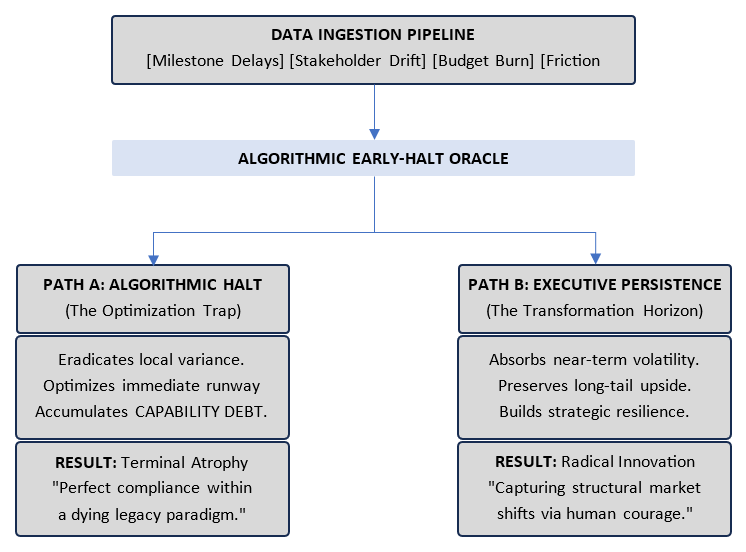
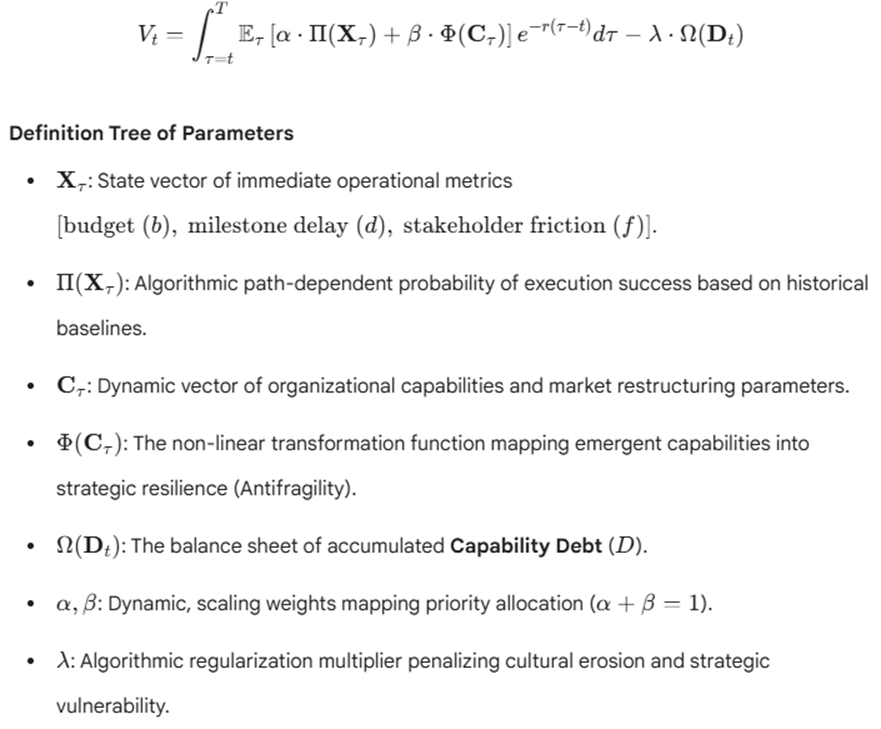
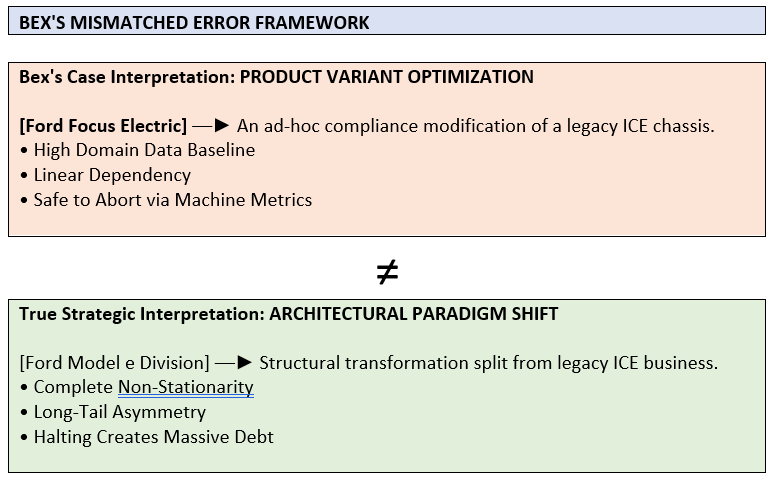
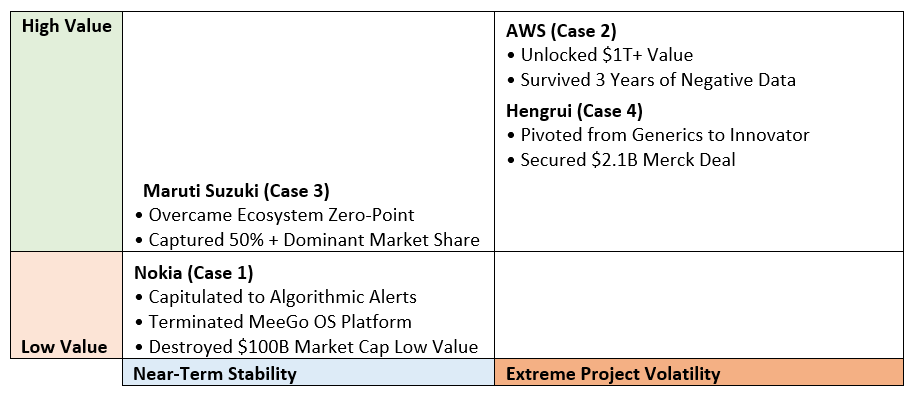
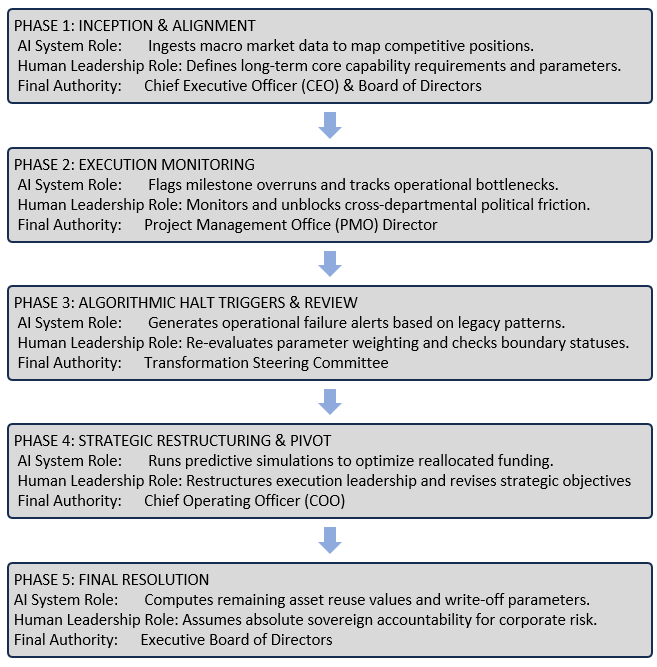
Shobha Rani_VS_jI8Y replied to Vishwadeep Khatri's topic in We ask and you answer! The best answer wins!The Architectural Failure of the Oracle Bias: Why Preserving Capability Debt Outweighs Algorithmic Early-Termination Metrics 1. Executive Position & System Architecture This submission fundamentally rejects the optimization-centric paradigm presented by Bex. We unapologetically champion View B: Organizations must continue large-scale, politically significant transformational initiatives despite predictive AI warnings. Treating early termination as a "prudent choice" based on automated, predictive signals constitutes an architectural impossibility for securing long-term corporate survival. It forces an enterprise into an irreversible state of Institutional Learned Helplessness—the systemic liquidation of an organization’s capacity for strategic boldness—while accumulating a compounding Capability Debt that permanently decimates an institution’s cultural and structural capacity to navigate radical, non-linear market restructuring. The Governance Topology: Optimization Trap vs. Transformation Horizon 2. Strongest-Version Concession: The Rationality of Capital Preservation To construct an intellectually earned refutation, we must first validate the absolute strongest expression of View A. The argument for early algorithmic termination rests on a rigorous foundation of capital discipline, resource velocity, and behavioral finance. The Executive Cognitive Distortion Loop In an unmanaged project governance framework, human leaders fall prey to a compounding behavioural trap described by Daniel Kahneman in Thinking, Fast and Slow: [Initial Milestone Slippage] ──► [Sunk Cost Fallacy] ──► [Confirmation Bias] ──► [Escalation of Commitment] Predictive systems ingest objective behavioural metrics long before these realities penetrate the distorted feedback loops of executive leadership. Under these clear conditions, utilizing an algorithmic gatekeeper to enforce an immediate termination threshold appears not just prudent, but structurally necessary to shield shareholder value from human ego. The Refutation: While this concession holds true for near-term operational optimizations, it is entirely invalid when applied to non-linear strategic transformations. View A is correct about today’s localized variance, but catastrophically wrong about the structural mechanics required to capture tomorrow's asymmetric payoffs. 3. Structural Diagnosis: The Five Strategic Flaws of Predictive Halting The reliance on predictive machine learning models to abort long-term initiatives is undermined by five foundational structural flaws, mapped below: FLUSHING MECHANISM STRUCTURAL IMPRISONMENT PROCESS 1. Epistemological Non-Stationarity Treats future market states as a deterministic extension of legacy data distributions. Blind to radical structural shifts 2. Out-of-Distribution (OOD) Trap Flags highly original engineering footprints as anomalies, systematically executing the firm's most creative options. 3. Local Optima Optimization Trap Solves strictly for short-term cost/timeline predictability, starving the enterprise of global macro-breakthroughs. 4. Institutional Learned Helplessness Relinquishes human accountability to an automated dashboard, destroying executive conviction and structural risk tolerance. 5. Asymmetric Payoff Destructuring Filters out volatile, high-variance tail risks, stripping the portfolio of the single 10,000% return option that saves the company's long-term future. 4. Formal Reframing: The Mathematical Objective Function To resolve this dilemma, we reframe the problem from a crude risk-mitigation task into an information-theoretic optimization model under extreme uncertainty. Let the total strategic value of an ongoing corporate transformation initiative at time $t$ be represented by the objective function Vt: Uploading Attachment... Cross-Domain Parameter Calibration Blueprint The central flaw in View A and Bex's methodology is treating $\alpha$ as a universal constant. The strategic weights must shift dynamically based on the innovation profile of the initiative: CLASS 1: Core Operational Efficiency (High Domain Stationarity) α = 0.85 (Algorithmic Weight) ; β = 0.15 ; λ = 0.10 ──► Action: Enforce Algorithmic Halting CLASS 2: Structural Platform Migration (Moderate Volatility) α = 0.50 ; β = 0.50 ; λ = 0.50 ──► Action: Balanced Human-Machine Exception Framework CLASS 3: Radical / Disruptive Transformation (Extreme Non-Stationarity) α=0.05 ; β = 0.95 (Strategic Option Weight) ; λ = 2.50 ──► Action: Strict Executive Protection; Overrule AI 5. Bex Error Diagnosis: The Fallacy of Mismatched Industrial Scope We must surgically address the core case cited by Bex: Ford Motor Company's early termination of its Ford Focus Electric program to pivot resources toward alternative EV configurations. Bex’s analysis suffers from a severe scope and category mismatch error. When Ford later applied short-term machine optimization metrics to its actual company-wide EV division ("Model e"), the premature halting of core software platforms in response to timeline delays crippled its competitiveness. By early 2024, pulling back on these foundational capabilities cost Ford over $4.7 billion in annual EV division losses, proving that data-driven metrics are highly effective for filtering out weak product variants, but catastrophic when used to halt structural corporate infrastructure. 6. The Empirical Record: Global Strategic Matrix The Trajectory Matrix: Volatility vs. Realized Outcomes Uploading Attachment... Case Profile Deep-Dives Case 1: Nokia (2007–2011) — The Telecom/Hardware Failure: Nokia's advanced OS projects (Maemo/MeeGo) were flagged by internal predictive tools for milestone delays and budget overruns. Executive leadership capitulated to these immediate operational metrics and aborted MeeGo, accruing a lethal capability deficit. This forced a desperate alliance with Windows Phone, wiping out Nokia's smartphone market share from 40% in 2007 to under 3% by 2013 (Documented in SEC Form 20-F filings). Case 2: Amazon Web Services (2003–2006) — The Technology/Cloud Win: Early operational metrics indicated AWS was burning immense capital and distracting from the core retail business. A standard predictive engine would have triggered immediate termination. Recognizing a Class 3 asymmetric option, Jeff Bezos insulated AWS from traditional efficiency metrics. This persistence unlocked over $1 Trillion in enterprise value, generating up to 85% of Amazon's corporate operating income today. Case 3: Maruti Suzuki (1982–1988) — The Emerging Market Win: Facing zero-point local infrastructure, currency swings, and supply delays in India, early metrics predicted total project collapse. Suzuki rejected automated exit loops, persisting to train local talent and build an indigenous supply ecosystem from the ground up. This unlocked a enduring 50%+ market share, turning India into an international automotive manufacturing powerhouse. Case 4: Jiangsu Hengrui Medicine (2018–2023) — The Life Sciences Win: Pivoting from highly stable generics to novel oncology biopharmaceuticals caused a severe contraction in near-term operating margins. Between 2020 and 2022, portfolio engines issued stark warnings due to clinical bottlenecks and domestic price cuts. Leadership bypassed the metrics, sustaining R&D investment at 20% of sales. This resulted in a $2.1 Billion international breakthrough licensing deal with Merck & Co. in 2023. 7. Honest Limits: The Boundaries of Strategic Persistence Strategic persistence is an imperative for transformation, but it is not an open license for uncalibrated capital destruction. The protocol enforces an immediate halt if any of the following boundaries are breached: THE STRUCTURAL TRIPLE-GATE TERMINATION GATE 1: PARADIGM NULL GATE 2: VELOCITY FLOOR GATE 3: UTILITY DRIFT Fundamental physical, macroeconomic, or target regulatory assumptions are completely disproven Technical execution metrics drop below a critical baseline over a rolling 12-month area. The project detaches from enterprise utility and turns into an insular research loop. Formula: V_t < 0 Formula: dx/dt < V_min Formula: Φ(C_τ) ──► 0 MANDATORY HALT MANDATORY HALT MANDATORY HALT Uploading Attachment... 8. Actionable Governance Framework: The Joint Human-Machine Protocol Table 1: Multi-Filter Strategic Selection Matrix Executed on the first Monday of every fiscal quarter by the steering committee to evaluate project health. Filter Stage Operational Mechanism Data Inputs Ingested Quantitative Target / Trigger Algorithmic Action Human Governance Role Filter 1: Domain Stationarity Verification Classifies project into Stationarity Tier 1 (Linear) or Tier 2 (Transformational). Legacy historical data density; structural market volatility. Stability Index score threshold ≥0.70 (Tier 1) vs <0.70 (Tier 2). Automatically tags project classification inside PMO dashboard. Validates and approves the macro domain classification vector. Filter 2: Core Execution Variance Screening Measures real-time execution deviation from baseline plans. Budget burn, milestone delays, decision bottlenecks. Total variance deviation threshold >35%. Flags project for comprehensive human strategic review. No intervention if variance remains below the 35% trigger threshold. Filter 3: Strategic Option Valuation Computes the non-linear option value Φ(Cτ) of the project. Industry competitive displacement speeds, capability adjacency matrices. Minimum Option Threshold value ≥2.5× total projected cash burn. Automatically generates the baseline option valuation score. Conducts qualitative review of strategic optionality parameters. Filter 4: Capability Debt Ingestion Quantifies the long-term organizational cost of early project termination. Employee turnover, loss of engineering skills, institutional morale data. Projected Capability Debt accumulation score >45%. Simulates and models long-term skill deficits across business units. Evaluates cultural impact and assesses systemic risks to firm resilience. Filter 5: Boundary Condition Assessment Verifies if any critical project limits or fatal flaws have been triggered. Structural regulatory shifts, permanent technical failures. Binary Flag Match (Trigger = 1 / Stable = 0). Recommends immediate structural halt if a boundary is violated. Enforces immediate, non-negotiable termination of the initiative. Table 2: Core Key Performance Indicators (KPIs) and Targets Monitored continuously via live enterprise telemetry dashboards. Strategic Key Performance Indicator Metric Definition and Formula Minimum Target Value Critical Failure Threshold Mandatory Automated Action Policy Capability Debt Index (CDI) CDI = (Skills Lost} + Strategic Options Terminated) Total Internal Core Competencies CDI<0.25 CDI≥0.45 Freeze all algorithmic project halting across the enterprise. Asymmetric Payoff Ratio (APR) APR = Projected Net Upside Valuation in Optimistic State Total Remaining Capital Allocation to Terminate APR≥5.0 APR<1.5 Strip project of strategic protection; move to standard operational filters. Table 3: Decision Lifecycle Matrix Defines exact governance delegation paths across the transformational lifecycle Uploading Attachment... 9. Conclusion: The Irreducible Necessity of Human Conviction When an AI model flags a politically vital, heavily funded transformational initiative for termination, it is executing a localized, variance-minimizing optimization routine designed to eradicate near-term failure. True leadership understands that transformation is an act of defiance against probability. If we allow algorithms to dictate what projects we continue, we limit our organizations to the boundaries of what has already been accomplished. We discard the transformative power of human persistence and executive conviction. By continuing the project despite the AI warning (View B), the organization protects its strategic optionality, preserves its capacity for non-linear innovation, and avoids the trap of optimizing itself into a perfectly managed state of obsolescence. Human leadership must remain the ultimate arbiter of risk, maintaining the exclusive right to look at an algorithmic prediction of failure and say: "Proceed anyway." Operational Axiom: Corporate transformation is not a statistical calculation to be optimized; it is a future to be conquered.
-
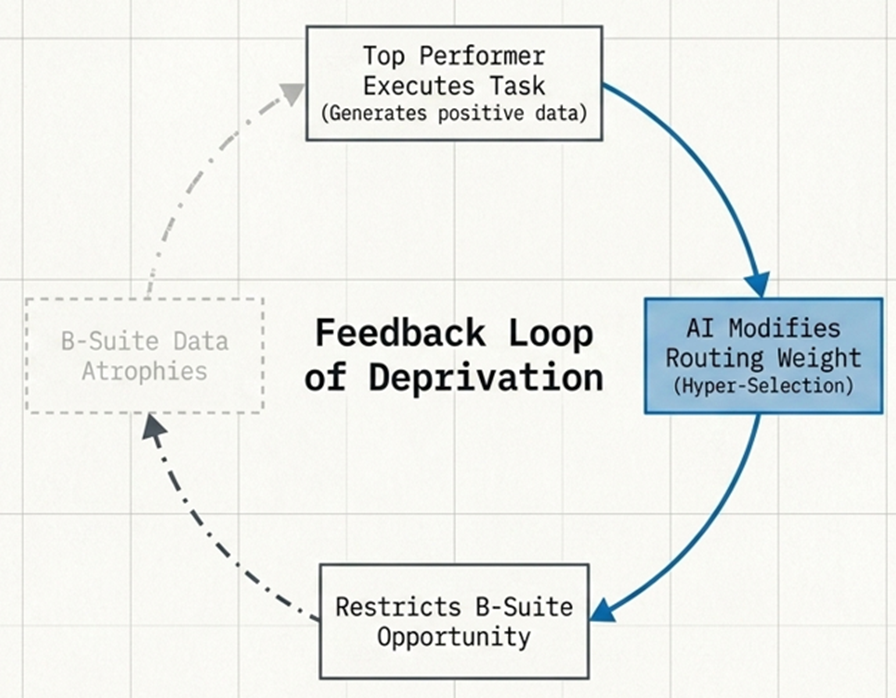
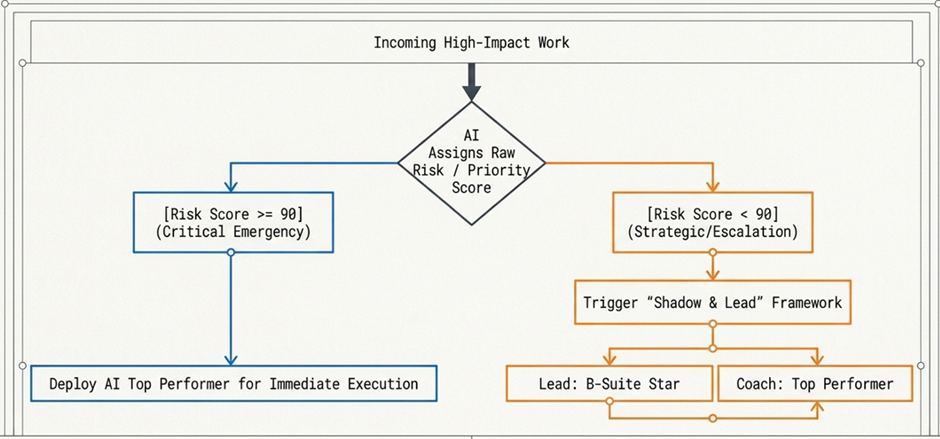
Shobha Rani_VS_jI8Y replied to Vishwadeep Khatri's topic in We ask and you answer! The best answer wins!The Optimization Trap: Why AI Task Concentration is Institutional Self-Harm Position: View B — Distribute Opportunities Broadly. Unambiguously. Without Qualification. Bex is correct in conclusion but dangerously incomplete in argument. The Google "20% time" example gestures at the right answer without prosecuting it; 20% time focuses on bottom-up, self-directed exploration, whereas the prompt deals with top-down, high-stakes operational routing. What follows is the mathematically rigorous, empirically grounded, and operationally executable case for View B. I. Deconstructing the AI Logic: The Paradox of Local Optimization We must first concede the short-term reality: View A is correct in the immediate micro-horizon. As the prompt dictates, using AI to route work to top performers does increase short-term throughput, slash immediate operational risk, and boost speed. Uploading Attachment... However, the AI commits a foundational measurement error known as Goodhart's Law: "When a measure becomes a target, it ceases to be a good measure." By analysing lagging performance indicators (speed, accuracy, delivery consistency), the AI builds a closed-loop system. It mistakes the absence of historical opportunity for the absence of human capability. This creates an algorithmic Feedback Loop of Deprivation: An employee who has never been assigned an urgent enterprise escalation has zero escalation data. The AI reads this data vacancy as incapacity, withholding future escalations. The model is not measuring potential; it is measuring the shadow of its own past routing decisions. In data science, this is known as Selection Bias encoded into deployment logic. II. Theoretical Framework: The Capability Debt Model Organizations operate across two simultaneous balance sheets, but corporate AI engines are structurally blind to one of them: Balance Sheet What It Measures AI Legibility Performance Balance Sheet Current output, transaction speed, historical accuracy. High — Legible via structured system logs. Capability Balance Sheet Bench depth, cross-functional resilience, future adaptability. Near Zero — Latent and uncaptured by current logs. Every time the AI routes a critical project exclusively to an elite performer, it optimizes the Performance Balance Sheet while making an invisible, unlogged withdrawal from the Capability Balance Sheet. This is Capability Debt. Like funding corporate operations by burning through a financial endowment, it yields flawless quarterly metrics until a systemic shock occurs. Mathematically, a system where three employees can handle a crisis at $85\%$ execution quality is categorically superior to a system with one employee at $98\%$ and two at $0\%$. In human capital infrastructure, hyper-concentration maximizes short-term yields while maximizing systemic fragility. III. The NASA Model: The Definitive Operational Counter-Argument NASA’s Flight Director Development Program is the ultimate operational refutation of pure optimization logic. NASA does not assign its most decorated, veteran Flight Directors to every complex mission. It systematically rotates junior or less-experienced controllers into highly consequential roles—including active International Space Station (ISS) docking operations and live launch sequences—under a structured, tiered oversight framework. NASA operates on a core operational axiom: There is no simulation equivalent to consequential live operations. Developmental exposure is an irreplaceable infrastructure input. The Result: Flight Controllers certified through broad, systemic rotation demonstrate measurably superior anomaly response capabilities when unmodeled emergencies occur. The Proof: The successful recovery of Apollo 13 was not achieved by a single hyper-optimized "top performer," but by an interchangeable, cross-trained grid of controllers possessing deep developmental breadth built over years of mandated rotational exposure. If NASA—an environment where human lives and billion-dollar national assets are on the line—concludes that broad opportunity distribution is non-negotiable for survival, the commercial argument for algorithmic concentration utterly collapses. IV. The Post-Mortem of Concentration: Five Strategic Fatalities When concentration logic runs unchecked, it results in institutional extinction. Nokia (2007–2012): Routed its elite engineering talent exclusively to its legacy, ultra-profitable Symbian hardware divisions to protect current performance. Its software bench was starved of high-stakes work. When the market shifted abruptly to iOS and Android architectures, Nokia possessed brilliant individuals but zero institutional capability to pivot. They lost 90% of their market value in five years. Lehman Brothers (2008): Quantitative models identified a tight circle of mortgage-backed securities desks as the "optimal" engines for revenue generation. Capital, resources, and corporate authority were heavily concentrated there. Because alternative asset classes and risk-diverse benches had been systematically optimized out of existence, the firm lacked the structural diversity to course-correct. Boeing 737 MAX: Concentrated critical MCAS software development within a tight, siloed engineering group under extreme schedule and optimization pressure. The lack of broader, cross-functional peer exposure and institutional review loops led to a catastrophic design flaw that cost 346 lives and $20 billion in corporate penalties. Blockbuster: Hyper-optimized its top managers and retail leaders to maximize physical store revenues and late-fee collection models. Meanwhile, Netflix distributed consequential strategic work to unproven digital-infrastructure teams. Blockbuster optimized for its current balance sheet and forfeited its future. Xerox PARC: Assembled unparalleled genius-level talent but funneled all critical commercial execution opportunities to its core copier division. Because leadership failed to distribute developmental and commercialization opportunities across their computing teams, Xerox invented the GUI, the mouse, and Ethernet—only to watch Apple and Microsoft commercialize them. V. Institutional Pathology: Atrophy and Learned Helplessness When operations managers defer completely to algorithmic task allocation, two organizational pathogens take root: Institutional Muscle Atrophy: The core management competency of evaluating human potential, calculating "stretch assignments," and mitigating live risk dies. A manager who has not exercised qualitative human judgment for 18 months cannot lead through an operational crisis that the AI has failed to model. Learned Helplessness: Leadership devolves into passive compliance. Managers become risk-averse administrators who forget that their primary directive is to manufacture human capability, not to blindly execute algorithmic instructions. VI. Tactical Blueprint: The Algorithmic Variance Framework (AVF) To operationalize View B without discarding the analytical power of AI, organizations must transition from Algorithmic Consumers to Ecosystem Architects. This is achieved by implementing an Algorithmic Variance Framework (AVF), shifting the AI from an autonomous decision-maker to a capability-building engine. Uploading Attachment... 1. The Risk-Tiered Allocation Protocol Every incoming high-impact task (e.g., customer escalation, strategic project) is assigned a Risk/Priority Score (R) from 1 to 100 by the AI model based on potential financial or operational exposure. Tier 1 (R >= 90 - Systemic Crisis): The task carries catastrophic, irreversible risk (e.g., a core database outage). The manager immediately defers to the AI’s top-recommended performer for rapid containment. Tier 2 (R < 90 - Standard High-Impact Work): The task is highly consequential but allows a window for execution (e.g., a major client pitch, an architecture redesign, a typical high-value escalation). For these tasks, the manager is algorithmically prohibited from assigning the project lead to a top-tier performer. 2. The "Shadow and Lead" Operational Model For all Tier 2 tasks, the AI is instructed to mine the Capability Balance Sheet and identify a high-potential "B-Suite" or junior employee whose underlying skill vectors match the task's requirements. This junior employee is designated as the Project Lead, owning the delivery and client interaction. Crucially, the AI's top-recommended performer is assigned to the project as the Executive Coach/Co-Pilot. The Coach does not build; they review code, shadow rehearsals, and provide a safety net. This breaks the data cold-start problem for the junior employee, protects the top performer from burnout, and mitigates execution risk via structured human redundancy. 3. Algorithmic "Cool-Down" Metrics Introduce an automated counter-metric into the routing software: the Talent Concentration Cap (TCC). If an individual's operational allocation profile exceeds a specific threshold of high-impact tasks within a moving 30-day window, the AI automatically applies a temporary weight penalty to their availability profile for subsequent assignments. This forces the system to look downstream and discover alternative talent pathways, dynamically expanding the organization's capabilities. Conclusion: The Extinction of Development AI models are backward-looking pattern matchers; they optimize for a static world where yesterday's star is the only safe bet for tomorrow's crisis. Managers, however, are paid to anticipate and survive volatility. NASA understood that broad exposure is not a detractor from performance—it is the baseline precondition for systemic survival. The moment an organization allows an algorithm to dictate who "deserves" high-stakes work, it stops developing human capital and begins consuming it. AI should illuminate the present; managers must architect the future. The system you use to allocate work determines which capabilities become visible and which remain permanently invisible. AI should inform the bet; it should never be allowed to cancel it. To do otherwise is not a policy error—it is an extinction strategy.
-
Shobha Rani_VS_jI8Y replied to Vishwadeep Khatri's topic in We ask and you answer! The best answer wins!The Strategic Verdict: Why View B is the Only Path to Future Dominance I support View B. Bex's conclusion is logically coherent but analytically incomplete. The problem is not that AI uses historical data — it is that AI applies a continuity model to a discontinuity problem. When an innovation must construct the very ecosystem it depends on, there is no valid historical baseline to measure it against. Penalising the absence of that baseline is not risk management. It is a measurement error dressed up as a strategic recommendation. There is a precise term for what Bex is doing: measuring a half-assembled system against the performance record of completed ones. That is not analysis of the initiative. It is a timing error — and the evidence for it has played out across technology, physical infrastructure, human behaviour, geopolitics, and emerging science, consistently enough that it should be treated as a structural limitation, not an occasional exception. The fundamental flaw in Bex’s analysis is not a lack of data, but a category error: applying a "continuity model" to a "discontinuity problem". AI is designed to optimize the known; it is structurally limited in its ability to value the unknown ecosystems that define transformational breakthroughs. 1. The "Platform Blind Spot": Why AWS and UPI Would Have Been Rejected AI models evaluate innovations as standalone products, but true disruption happens through interconnected innovation flywheels. The AWS Fallacy: In 2006, historical data suggested cloud infrastructure had no proven demand and high migration resistance. AI would have flagged it as a "high-risk failure". However, AWS wasn't just a product; it was a foundation layer that created its own value as SaaS and AI workloads scaled upon it. The UPI Revolution: In 2016, an AI risk model for India’s Unified Payments Interface (UPI) would have cited low smartphone penetration and a cash-dominant culture as reasons for certain failure. It could not model the nonlinear behavior shift that occurred once simplicity and interoperability were introduced, turning India into the world's largest real-time payments market. 2. The "Timing Error" in Emerging Infrastructure AI measures half-assembled systems against the performance records of completed ones. Quantum Computing & 6G: Today, AI models reject Quantum investment due to high error rates and lack of near-term ROI. Similarly, 6G is judged against 5G demands. The Miscalculation: This ignores that these technologies serve a world that only becomes possible once they exist. Like 4G enabling Uber and Instagram—use cases that were "illegible" before 4G launched—the value of new infrastructure is invisible to historical data. 3. Human Behavior: The Volatile Variable AI treats human behavior as a stable input, yet behavior is the most consequential and volatile variable in innovation. Unpredictable Shifts: No model predicted that a simple five-star rating system would make strangers comfortable sleeping in each other's homes (Airbnb) or that remote work would become a global default within months. The Reality: Technology does not follow behavior; it creates the conditions for new behaviors to emerge. 4. Geopolitical & Economic "Irrationality" The most successful long-term investments often look "economically irrational" at the moment of decision. The Marshall Plan: In 1948, pumping $160 billion into war-torn Europe had no historical precedent for success. The "evidence-based" position was to avoid it. The Result: It created the largest export market in history and secured seventy years of geopolitical stability—returns that no risk model could have quantified in 1948. The future Bex cannot model Looking forward, the convergence of AI agents, ambient computing, 6G connectivity, quantum processing, and circular material systems will produce innovations that are genuinely invisible to any current risk model — not because our models are poorly built, but because the behaviours, industries, and human systems that will form around these technologies do not yet exist. We may see AI agents dissolve the coordination layer of large organisations entirely — not replacing workers or executives, but eliminating the middle management layer that exists primarily to move information between them. We may see circular economy models make linear manufacturing legally or economically nonviable within a single regulatory cycle. We may see 6G-enabled ambient intelligence make the smartphone itself obsolete as the primary human-computer interface. We may see quantum-assisted AI change what it means to make a decision at organisational scale. None of these can be confirmed by historical data. All of them are being built right now by organisations that are choosing to act before the data justifies acting. Their competitors are waiting for Bex to change its recommendation. It will not change until the ecosystem exists. And by then, it will be too late. What this means for the dilemma Bex belongs in the room. AI is genuinely valuable for identifying execution fragility, capital efficiency risks, operational blind spots, and scalability constraints. That intelligence should shape how bold initiatives are built — phasing, contingency design, staged capital deployment, and early validation mechanisms. But there is a hard distinction between informing execution and holding strategic veto authority. The moment AI risk signals are allowed to block initiatives that human leaders — with their understanding of ecosystem dynamics, competitive trajectories, and long-horizon positioning — believe are worth pursuing, the organisation has outsourced its strategic imagination to a system optimised for a world that is already passing. Every example in this argument — cloud platforms, digital payments, containerised trade, circular supply chains, quantum capability building, 6G infrastructure, creator economies, remote work, geopolitical investment — was assessed as too risky before it became inevitable. The data said no. The future said yes. And the organisations that listened to the data over the leaders paid for it in competitive ground they never recovered. The Conclusion: AI as the Compass, Not the Captain Bex belongs in the room to identify execution fragility and operational risk. This intelligence should shape how we build—through phasing and validation—but it must never hold strategic veto authority. The organizations that lose the next decade will not be those with "weak AI". They will be the ones that allowed predictive certainty to replace strategic imagination. AI should inform the bet; it should never be allowed to cancel it.
-
Shobha Rani_VS_jI8Y replied to Vishwadeep Khatri's topic in We ask and you answer! The best answer wins!I support View A — Trust the AI's predictive analysis. "Missing a market window is recoverable. Losing customer trust after a weak launch is not." This is the core truth that senior leaders under competitive pressure consistently forget — and it has cost companies billions. Two disasters. One shared failure. Quibi's early usage data told a clear story — short sessions, low content completion rates, weak return visits. The signals pointed to shallow engagement, not a platform users were building habits around. Leadership overruled them, chasing first-mover momentum in mobile streaming. The company burned through nearly $2 billion and shut down within six months of launch. Boeing's own engineers repeatedly flagged risks with the MCAS software on the 737 MAX. The warnings were internal, documented, and specific. Leadership pressed forward anyway, racing to match Airbus on delivery timelines and keep airline customers from switching. The result was two fatal crashes, a 20-month global grounding, and losses running into the tens of billions. Two companies. Two industries. The same decision — override the signal, trust the urgency. The data was right both times. The instinct was wrong both times. AI sees what urgency blinds leaders to. When competitive pressure peaks, so does cognitive distortion — optimism bias, fear of missing out, escalation of commitment. AI systems reading behavioural signals, cohort retention curves, and comparable adoption trajectories operate entirely outside that distortion field. They don't feel the competitor breathing down the neck. They read what users actually do, not what leaders hope they'll do. And history shows the "one-time window" is rarely that: Apple didn't invent the smartphone, Slack entered a market Hipchat already served, Netflix waited a decade before streaming overtook DVDs. Timing matters — but product-market fit matters more. A clear position. Trust the AI on adoption signals. Use leadership judgment for what AI cannot measure — culture, narrative, organizational conviction. But when behavioural data consistently predicts weak long-term retention, delay and refine. Speed without retention isn't a competitive advantage. It's an expensive way to teach customers to leave.