


Kumar_Love_s9D0
Members
-
Joined
-
Last visited
-
Kumar_Love_s9D0 replied to Vishwadeep Khatri's topic in We ask and you answer! The best answer wins!I strongly challenge Bex’s analysis and support View B: Organizations should not act on individual predictive attrition signals. While Bex points to short-term retention metrics like IBM’s 25% turnover reduction as proof of success, this perspective fundamentally ignores the hidden, long-term systemic damage caused by algorithmic determinism. Acting on individual attrition predictions breaches the psychological contract of the workplace, penalizes employees for intent rather than action, and often creates the very turnover the AI is trying to prevent. Here is why View B is the only sustainable approach for high-performing organizations. The Flaw in Bex's Logic: The Pygmalion EffectBex assumes that managerial intervention based on AI profiling is inherently positive (e.g., "personalized career development"). In reality, human psychology rarely works this way. When an AI tags an employee as a "high flight risk," it introduces a severe cognitive bias for the manager. Instead of offering a promotion, a manager tasked with minimizing business disruption is highly likely to engage in protective behavior. They will begin subconsciously (or consciously) divesting from that employee. This triggers the Pygmalion effect—a psychological phenomenon where lower expectations and altered treatment lead to lower performance and eventual detachment. How the "Successful" Prediction Becomes a Self-Fulfilling ProphecyConsider the operational dynamics of an enterprise software company with long sales cycles. Suppose the AI flags a high-performing Account Executive (AE) as a 90% flight risk because her internal communication volume dropped, she browsed the internal mobility portal, and her workload signals dipped. In reality, she might simply be doing deep-focus work on a massive upcoming deal. Armed with this AI prediction, the Sales Director decides to "hedge the company's risk" by quietly reassigning a crucial, upcoming Tier 1 client account to a different, "safer" AE. The result: The flagged AE realizes she was passed over for a major account without cause. Feeling undervalued, she immediately starts looking for external jobs and resigns a month later. The AI system will log the AE's resignation as a true positive—a successful prediction. Bex’s data would count this as proof the system works. In reality, the predictive intervention didn’t forecast the future; it dictated it. When organizations act on behavioral micro-signals, they transition from managing performance to policing intent. Real-World Evidence: Why Predictive Profiling FailsThe failure of predictive HR algorithms is not just a theoretical risk—it is a documented reality currently playing out across multiple industries: Meta: Technology & The Surveillance Backlash: Organizations claim that monitoring workflows allows them to proactively help employees, but it usually breeds instant resentment. In May 2026, Meta faced a massive internal revolt after installing tracking software to monitor employee workflows for AI development. Employees protested the company's shift into an "Employee Data Extraction Factory." Monitoring micro-behaviors actively erodes the trust required to keep top talent. Amazon: E-Commerce & Metric Gaming: Proponents of View A assume AI data is objective. However, at Amazon, as pressure mounted on staff to adopt the company's agentic AI platforms, a phenomenon known as "tokenmaxxing" emerged. Employees began artificially automating unnecessary tasks simply to inflate their metrics and appear highly engaged. Employees will always learn to game predictive algorithms, leaving HR with manipulated, garbage data. Kistler v. Eightfold AI: HR Compliance & Legal Liability: Acting on AI-generated "flight risk" scores exposes organizations to massive legal liability. In early 2026, a major class-action lawsuit (Kistler v. Eightfold AI) centered on the compiling of secret employee profiles using opaque AI scoring. If an organization quietly demotes or reassigns a "high flight risk" employee, they are making an adverse employment decision based on a secret score—a massive compliance nightmare under regulations like the FCRA. The Trust Premium Beats SurveillanceA healthy organizational culture operates on a "trust premium." Employees give their best work because they believe they will be judged on their tangible output and explicit actions, not on algorithmic inferences about their loyalty. Furthermore, AI algorithms fundamentally fail to measure the "invisible work" that keeps a company running—such as informal mentorship, team morale, and edge-case problem-solving. Reducing an employee's complex value and future intent to a single "flight risk" score misunderstands how human organizations actually function. The Solution: Monitor the System, Not the IndividualThis does not mean AI has no place in HR analytics. The fatal flaw in Bex's argument is the target of the AI, not the tool itself. Instead of deploying AI to profile individuals, high-performing organizations use AI to run Organizational Network Analysis (ONA) and track aggregated, team-level metrics to identify systemic strain. Instead of asking, "Which employee is going to quit?" organizations should use AI to measure: Collaboration Overload (Betweenness Centrality): Identifying if a specific team or role has become a cross-functional bottleneck where too many workflows converge, indicating a high risk of collective burnout. Systemic Off-Hours Usage: Tracking macro trends in weekend or late-night tool logins across a department to identify a culture of overwork, rather than penalizing the specific employee who logged in at midnight. Network Density & Silos: Analyzing anonymized communication metadata to see if a newly acquired division is successfully integrating with the parent company, or if communication has fractured into isolated silos. Bottom line If an organization wants to fix attrition, it should look at the systemic root causes the AI uncovers—such as toxic managers, broken compensation bands, or chronic burnout—and fix those globally. Using AI to surgically target and intervene with individuals before they have actually done anything is a recipe for a paranoid, low-trust workforce where the best talent will simply learn to game the surveillance metrics.
-
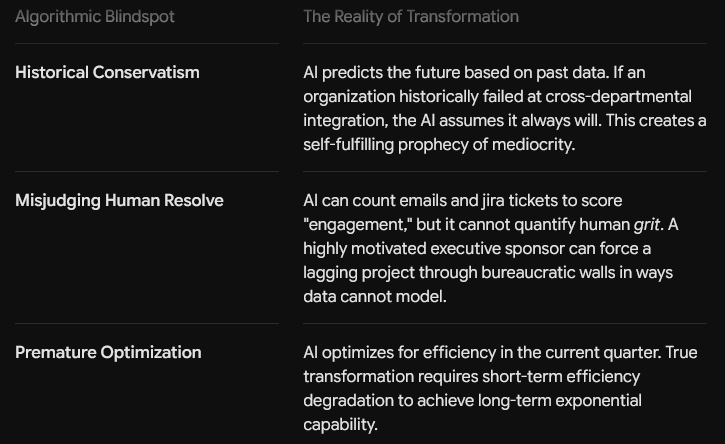
Kumar_Love_s9D0 replied to Vishwadeep Khatri's topic in We ask and you answer! The best answer wins!The Innovation Blindspot: Why Halting Transformations Based on AI Predictors Guarantees Strategic Stagnation Position Taken: I strongly support View B (Continue the project despite the AI warning) and challenge Bex’s position. The Flawed Premise of Bex’s ArgumentBex argues that early termination based on predictive data ensures better long-term resource allocation, citing Ford’s discontinuation of the Ford Focus Electric. However, this comparison conflates linear product optimization with complex organizational transformation. Discontinuing a specific vehicle variant due to weak market metrics is a transactional, structured decision. True transformation initiatives—the ones that alter an organization’s operational DNA—are inherently non-linear, chaotic, and politically disruptive. Predictive AI operates on historical patterns. By definition, a groundbreaking transformation has no historical precedent within an enterprise. Therefore, AI will inevitably flag its early stages as a "failure" because the initial operational noise—decision bottlenecks, stakeholder friction, milestone delays, and budget spikes—mimics a dying legacy project, when it is actually the natural friction of systemic change. Industry Proof-Points: When Continuing Saved the BusinessTo win a debate against algorithmic forecasting, we must look at major transformation pivot points across key sectors where predictive AI metrics screamed "ABORT," but human leadership pushed through to massive success. A. The Banking Sector: DBS Bank’s Core Digital Transformation (GANDALF)In 2009, DBS Bank set out to transform from a traditional, legacy bureau into a digital powerhouse, aiming to operate like a tech company (codenamed GANDALF). The AI Red Flags: In the early years (2010–2012), the project was a mess on paper. Milestone delays were constant because legacy banking infrastructure resisted agile integration. Budget consumption was massive, with massive upfront investments yielding zero short-term revenue change. Stakeholder engagement dropped as traditional banking executives fought against changing their entire operational workflow. The AI Verdict: Kill the project. The risk patterns perfectly matched historical IT failures in the financial sector. The Business Outcome: CEO Piyush Gupta maintained strong executive sponsorship and overrode the negative metrics. Today, DBS is repeatedly named the "World’s Best Bank" by Global Finance, powered by the very digital architecture that looked like a multi-million dollar failure in year three. B. The ITeS & Tech Sector: Microsoft’s Cloud and SaaS Pivot (2011–2014)Before Satya Nadella took over, Microsoft was deeply entrenched in a legacy on-premise Windows/Office licensing model. The pivot to Azure and cloud-based subscriptions (SaaS) required a radical dismantling of their sales and engineering structures. The AI Red Flags: During the transition, Microsoft’s traditional financial metrics and project milestones collapsed. Budgets were aggressively redirected to build massive data centers, chinking short-term margins. Sales teams bottlenecked because the compensation structure for selling cloud subscriptions didn't align with their historical targets. Internal friction was incredibly high. The AI Verdict: Stop or scale back early. The data points indicated that shifting away from the guaranteed cash cow (Windows licenses) to a low-margin, high-delay infrastructure project was a high-probability operational failure. The Business Outcome: Leadership persisted through the chaos, realigned internal culture, and absorbed the initial margin dips. Azure is now the bedrock of Microsoft's trillion-dollar valuation, a feat impossible if they had automated early project termination based on lagging risk indicators. C. The Manufacturing Sector: Tesla’s Model 3 "Production Hell" (2017–2018)When Tesla attempted to transition from a niche luxury automaker to a mass-market manufacturer with the Model 3, it undertook a radical transformation of its assembly line automation. The AI Red Flags: This initiative triggered every single failure signal in the prompt. It was plagued by extreme decision bottlenecks, missed production milestones (producing only 260 cars instead of the planned 1,500 in Q3 2017), massive budget consumption, and extreme risk patterns that threatened to bankrupt the company. The AI Verdict: Terminate the automated assembly initiative early and pivot back to manual, low-volume production frameworks to save capital. The Business Outcome: Elon Musk famously slept on the factory floor, choosing leadership commitment over catastrophic data signals. They re-engineered the automated bottlenecks, pushed past the "production hell" phase, and transformed automotive manufacturing. The Model 3 became the catalyst that made Tesla the most valuable automaker in the world. D. Netflix’s Content Delivery and Cloud Migration (2008–2010)To ground this in reality, consider Netflix’s transition from DVD-by-mail to streaming and its simultaneous migration to the AWS cloud. In 2008, Netflix experienced a major database corruption that choked its DVD shipping for three days. Reed Hastings decided to migrate the entire corporate infrastructure to the cloud—a completely unproven, highly unstable territory at the time. Concurrently, they poured massive capital into building a streaming platform. If Netflix had used an AI analyst like Bex in 2009, the AI would have aggressively recommended stopping the streaming/cloud initiative immediately. The early signals were disastrous: Milestone Delays & Budget Consumption: The technology didn't exist yet; engineers were building cloud tools from scratch, leading to massive cost overruns and missed deadlines. Stakeholder & Customer Friction: Internally, legacy DVD executives fought the change. Externally, when Netflix tried to separate the services (the Qwikster debacle), they lost 800,000 subscribers, and their stock plummeted by 75%. An AI analyzing these risk patterns and historical media business models would have calculated a 99% probability of failure and advised Netflix to stick to its highly profitable, stable DVD business. However, leadership persistence and executive sponsorship overrode the short-term negative signals. Had Netflix killed the project early based on data-driven "weakness," it would today be an obsolete footnote alongside Blockbuster, rather than a global streaming empire. Anatomizing the Algorithmic BlindspotsWhen an organization blindly follows an AI recommendation to halt a heavily sponsored, strategically vital project, it succumbs to three structural analytical flaws: 4. Conclusion: AI is a Diagnostic Instrument, Not an ExecutiveAI is an incredible diagnostic tool, but a terrible executive decision-maker. When an AI predicts a high probability of failure for a major transformation initiative, the correct corporate response is not to abort the mission, but to use the AI's granular insights to re-engineer the bottlenecks. Organizations must treat AI failure warnings exactly like a vehicle’s dashboard check-engine light. The light tells you there is friction in the engine—prompting you to pull over, identify the faulty component, and fix it. It does not mean you abandon the car on the side of the highway. By pushing forward through data-predicted volatility, leadership exercises the human intuition, resilience, and long-term vision that predictive code is structurally incapable of understanding.
-
Kumar_Love_s9D0 replied to Vishwadeep Khatri's topic in We ask and you answer! The best answer wins!The Core Stance: View B Foundational Premise: History Breaks Patterns Human history is driven by massive "Exploration steps" that a predictive model would have mathematically barred. In a pure data-driven paradigm, historical data operates as a system anchoring mechanism. If humanity relied strictly on historical probability distributions to authorize major initiatives, civilization would be trapped in permanent stagnation. The Age of Exploration: When early explorers set sail across the Atlantic or Pacific without maps, they were stepping into an absolute data void. The Apollo Program: When President John F. Kennedy announced the goal of landing a man on the moon within a decade, there was zero historical success data. Ultimately, history proves that breakthrough value is created by breaking patterns, not matching them. Predictive AI models excel at optimizing existing systems (Zone 1 and Zone 2 efficiency). However, using them to dictate strategic, long-term human direction fundamentally misunderstands what AI is. It turns a tool meant for exploiting known efficiencies into a cage that prevents exploring unknown breakthroughs. Argument 1: The Out-of-Distribution (OOD) Data ProblemPredictive AI models operate on the foundational assumption that your training data (past events) and your inference data (the new idea) share the same underlying statistical distribution. The Technical Failure: When an organization designs a radical, breakthrough business model, they are explicitly introducing Out-of-Distribution (OOD) variables. The Implication: Because the AI cannot find a matching vector space in its historical logs, its default mathematical output will inevitably flag the anomaly as high-risk. Relying on the AI here is an architectural misapplication; you are essentially asking a calculator to write poetry. Argument 2: Historical Bias Penalizes First-MoversIf enterprises let predictive models serve as absolute gatekeepers, the greatest historical market shifts would have been blocked at the design phase. Example A (The Streaming Shift): If Netflix had run an AI model on its DVD-by-mail operational patterns in 2007 to evaluate a pivot to digital streaming, the model would have flagged extreme risk. Global bandwidth infrastructure was poor, streaming video failures were historically high, and user preference data heavily favored physical discs. The AI would have forced them to stick to DVDs. Example B (The Smart Device Shift): In 2006, any machine learning algorithm evaluating enterprise hardware would look at keyboard adoption data. A radical touch-screen phone with a 1-day battery life (the iPhone) would be flagged with a 99% probability of failure based on historical enterprise user behavior. Argument 3: Over-Optimization for "Local Optima" Destroys ResiliencyAn AI system trained to optimize operational risk patterns will successfully find the Local Optimum—the safest, most efficient version of an organization's current state. The Structural Risk: By constantly choosing paths with "zero operational disruption risk," the AI slowly strip-mines the organization of its experimental capacity. The Reality: When a massive market disruption occurs from the outside (such as an unexpected competitor or new technology), a hyper-optimized, risk-averse enterprise becomes entirely brittle and unable to adapt. The AI effectively keeps the company "safe" all the way to its bankruptcy. The Architectural Solution: Move the AI from "Gatekeeper" to "Assessor"To resolve this dilemma without ignoring data entirely, a Solution Architect must design a Triage Architecture. We reject the AI's binary recommendation, but we extract its underlying feature weights. Instead of treating the AI as a "Go/No-Go" gatekeeper, we look at why it flagged the risk. [Strategic Idea] ──> [AI Risk Assessment Layer] ──> Extracts Feature Weights (Vulnerabilities) │ ▼ [Sandbox/Pilot Deployment] <── [Humans Design Mitigations] ────┘Sample Triage Architecture Workflow: Step 1 (AI Vulnerability Mapping): Instead of issuing a binary rejection, the AI maps the breaking points (e.g., flagging that "Operational disruption risk is high in the supply chain layer"). Step 2 (Human Mitigation Engineering): Senior leadership utilizes that AI risk map as a diagnostic tool to design safety nets specifically for those high-risk nodes. Step 3 (The Sandboxed Pilot): The bold idea is launched in a segregated, cloud-hosted sandbox environment or a low-value pilot to collect new, non-historical data without isolating or endangering the core enterprise infrastructure.
-
Kumar_Love_s9D0 replied to Vishwadeep Khatri's topic in We ask and you answer! The best answer wins!Position: I support View B: Retain the approval step, but with a strategic architectural evolution that moves it from a manual bottleneck to an "Intelligent Safeguard." 1. The Core Argument: Managing "Fat-Tail" RisksIn healthcare, we face "Fat-Tail Risks"—events that are statistically rare (<1%) but carry catastrophic human and legal costs. Removing a specialist simply because they "usually agree" ignores their fundamental role as a Systemic Barrier. Clinical approval is a Zone 4 task (High-Stakes Audit). LLMs and frontline automation are probabilistic; they "guess" based on patterns. High-stakes environments require the deterministic oversight of an expert to catch the outliers that models or exhausted frontline staff might miss. 2. Operational Parallel: Commercial AviationConsider the "Swiss Cheese Model" in aviation safety. Modern cockpits are highly automated, and for 99.9% of a flight, pilots "simply confirm" the computer's actions. However, the industry retains two pilots because of scenarios like Qantas Flight 32. When an engine exploded, the automation was overwhelmed by 54 conflicting alerts. It was the human pilots—who "rarely change the outcome" of a normal flight—who performed the complex reasoning required to land safely. The specialist in healthcare serves this exact same purpose. 3. The Solution: The "Red Flag" ProtocolThe 10-hour delay cited in View A is not a failure of the step, but a failure of the Process Architecture. We solve this using Agentic AI principles: Automated Slot Filling: AI ensures 100% of required data is present before the specialist even receives the file, eliminating back-and-forth delays. Intelligent Triage: A Regression Model flags cases that deviate from standard protocols. The Workflow: * Standard Cases (99%): AI summarizes the file (Zone 1), and the specialist provides a "one-tap" digital signature on their mobile device. High-Risk Cases (<1%): The AI triggers a "Red Flag" alert, paging the specialist immediately and highlighting the specific anomaly for urgent review. The VerdictBy implementing this approach, we move from a "Zero-Sum" choice (Speed vs. Safety) to an architectural win. We gain the speed of View A for the majority while maintaining the absolute safety of View B for the critical minority. This is the hallmark of a Certified AI Solution Architect: solving business trade-offs with intelligent design rather than compromise.
-
Kumar_Love_s9D0 replied to Vishwadeep Khatri's topic in We ask and you answer! The best answer wins!Choosing View B is the most strategic path for a large organization, because efficiency that damages the customer relationship is a "false economy." for example in Telecom, the business lives or dies on Customer Lifetime Value (LTV) and minimizing churn. When you prioritize speed over understanding, you trade a small operational saving for a massive revenue loss. Supporting Example: The "Churn Trap" in Telecom Imagine a major mobile carrier that implements an AI to handle billing disputes. The Efficiency Illusion: The AI reduces handling time by 30% by strictly enforcing logic trees. It "processes" thousands of disputes an hour, significantly lowering the cost per interaction. The Customer Experience Failure: A 10-year loyal customer calls because of a mysterious roaming charge. The AI, optimized for speed and policy adherence, fails to recognize the customer’s history or the nuance of the situation. The customer feels "rushed and less understood," leading to that 10% drop in satisfaction. The Real Financial Impact: In Telecom, it costs 5 to 10 times more to acquire a new customer than to keep an existing one. If that frustrated customer switches to a competitor, the $5 saved by the AI’s efficiency is instantly wiped out by the loss of a $1,200 annual contract. Why View B is the correct choice: Eliminating "Failure Demand": When first-contact resolution drops, the AI hasn't actually solved the problem. The customer will simply "channel hop"—calling the help desk or visiting a retail store. This creates redundant work that makes the initial "efficiency" an accounting fiction. Protecting the Brand: In a commodity market like Telecom, service is often the only true differentiator. Using AI to rush customers turns your service into a liability rather than an asset. To successfully implement View B, the organization should move away from using AI as a "barrier" to reduce costs and instead use it as a "Co-Pilot" to enhance quality.Here is a 3-point recommendation for a large organization like Telecom: 1. Shift Metrics from "Speed" to "Value" Stop measuring the AI’s success by Average Handling Time (AHT). Instead, use First-Contact Resolution (FCR) and Net Promoter Score (NPS) as the primary KPIs. If the AI is fast but the customer has to call back tomorrow, the AI has failed. The goal should be "Resolution Efficiency"—how quickly a problem is solved, not how quickly a call is ended. 2. Implement "Sentiment-Based" Routing Instead of making every customer talk to a bot, use the AI to analyze customer history and tone. Routine Tasks: Let the AI handle simple, low-stakes tasks (e.g., checking data balance or updating an address) where speed is the experience. Complex/Emotional Issues: If the AI detects a billing dispute from a long-term customer or a frustrated tone, it should immediately trigger a warm hand-off to a senior human agent. The AI should then provide that agent with a 1-sentence summary of the problem so the customer doesn't have to repeat themselves. 3. Use AI for "Agent Augmentation" (The Co-Pilot) Instead of putting the AI in front of the customer, put it behind the agent. The Recommendation: While the agent talks to the customer, the AI should scan the database to find the exact reason for the billing error and "suggest" a loyalty credit. The Result: This reduces the "Average Handling Time" (satisfying View A) but does so by removing technical grunt work, allowing the human agent to focus on making the customer feel "understood" (satisfying View B). The Bottom Line: Don't use AI to replace the human connection; use it to remove the friction that prevents human connection from happening.