Brindha Jayaraman
Members
-
Joined
-
Last visited
Everything posted by Brindha Jayaraman
-
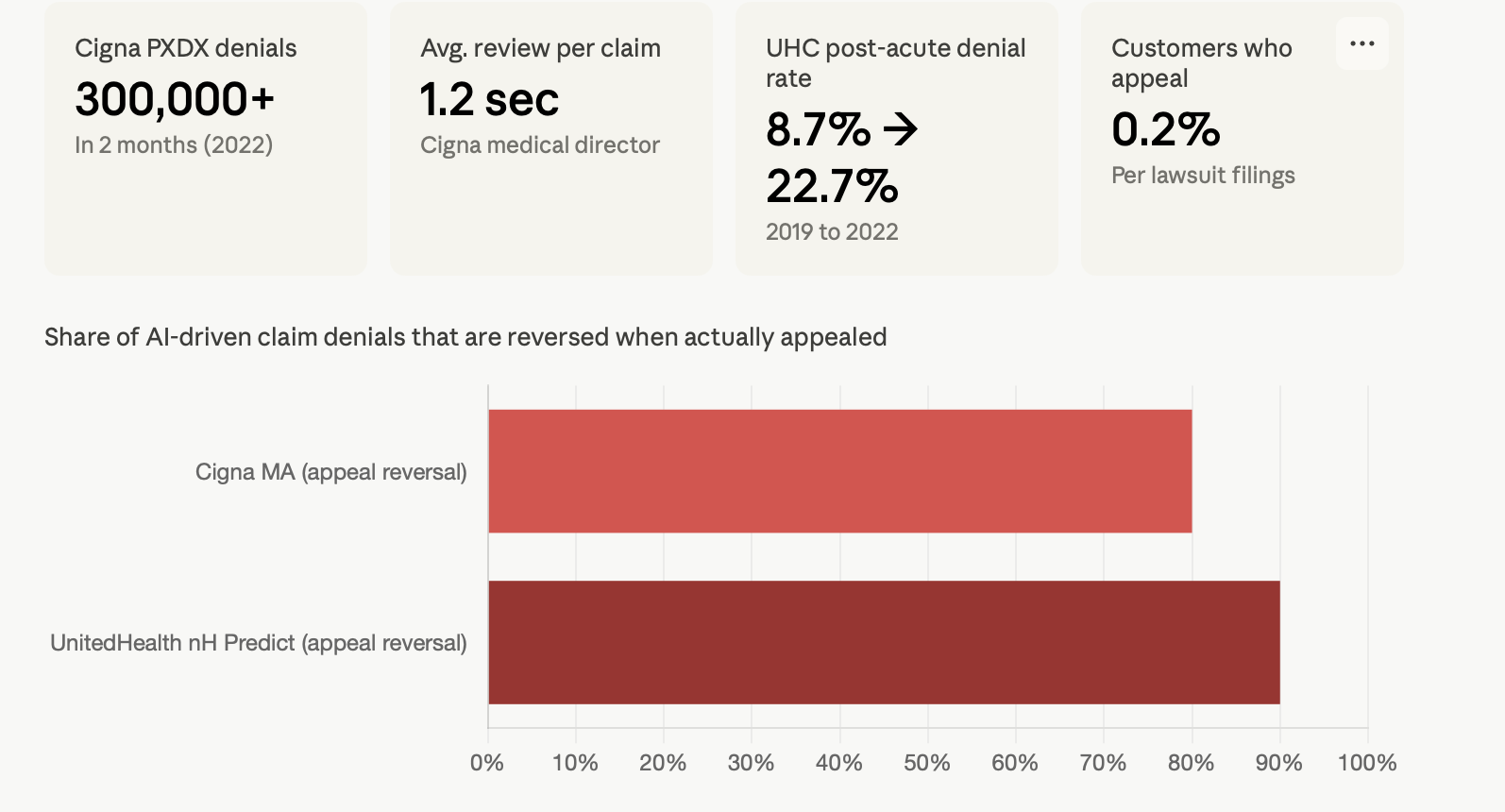
Brindha Jayaraman replied to Vishwadeep Khatri's topic in We ask and you answer! The best answer wins!My Position: View B — Don't Deploy Non-Explainable AI. Keep the Speed, Keep the Accountability.I'm not arguing we should accept slower operations for the sake of explainability. I'm arguing the trade-off doesn't exist. When you count reversals, appeals, litigation, and regulatory exposure, the "efficiency" of black-box AI collapses. What actually matters is durable decisions. And the real-world data show black-box systems don't deliver that durability. The Knockout: The Efficiency Is a Mirage Once You Count the ReversalsBex's argument rests on speed. But in insurance, the only number that matters is decisions that hold up. Across two months in 2022, Cigna rejected 300,000 claims using PxDx, with doctors spending an average of 1.2 seconds to review each. Only 0.1 percent of all people who experience those denials actually took it to a step to do a formal appeal. That's exactly how the "savings" materialize — customers are too sick or overwhelmed to fight back. When denials are appealed, they don't hold. About one in five Cigna Medicare Advantage denials are appealed, and about 80% are overturned. For UnitedHealth's nH Predict, nine of 10 appealed denials were ultimately reversed. UnitedHealthcare's denials for post-acute care reportedly increased by 227 percent in 2022 alone, and UnitedHealth's skilled nursing home denial rate increased ninefold. The Principle: Accountability Is Now Law, Not PreferenceRegulatory reality has already moved. The EU AI Act explicitly classifies insurance AI as high-risk: AI systems intended to be used for risk assessment and pricing in relation to natural persons in the case of life and health insurance fall under Annex III, Section 5(c). The Act mandates explainability, human oversight, Fundamental Rights Impact Assessments, and carries penalties of up to €15 million or 3% of global annual turnover for failing to meet high-risk obligations. Bex is measuring efficiency at the dashboard. Regulators are measuring it at defensibility — and writing the outcome into law. 🔴 Cautionary Tale 1: Cigna's PXDX — Medical Reimbursement Denied in 1.2 SecondsThe PXDX stuff is not reviewed by a doc or nurse or anything like that — a former Cigna medical director, on the record. One Cigna medical director denied 60,000 claims in a single month, according to the ProPublica report. https://www.healthcaredive.com/news/cigna-lawsuit-algorithm-claims-denials-california/688857/ U.S. District Judge Dale Drozd denied in part Cigna's bid to dismiss the claims, allowing the ERISA breach of fiduciary duty claim to proceed. The judge rejected Cigna's core legal defense, writing that its interpretation — allowing an algorithm to make the decision so long as a medical director pushes the button (https://www.courthousenews.com/judge-advances-class-claims-over-cigna-use-of-automated-algorithm-to-deny-benefits/) — did not satisfy plan obligations. The U.S. House Energy and Commerce Committee opened a formal probe in May 2023. This is View A in operation. Efficient? Yes. Defensible? Not in court, not in Congress, and not to the patients whose ultrasounds, vitamin D tests, and cancer screenings were denied in 1.2 seconds. 🔴 Cautionary Tale 2: UnitedHealth & Humana's nH Predict — The Elderly Cut Off From RehabSame algorithm. Two insurers. A systemic pattern. The plaintiffs claim that the use of AI to evaluate claims for post-acute care resulted in denials, which in turn led to worsening health for the patients and in some cases resulted in death. https://www.healthcarefinancenews.com/news/class-action-lawsuit-against-unitedhealths-ai-claim-denials-advances Humana must face a class action lawsuit alleging that its use of artificial intelligence to deny post-acute care to Medicaid Advantage beneficiaries became fraud when those automated decisions replaced the interpretation of clinicians. Plaintiff Sharon Merkley received seven denials for the same care within 30 days. https://www.mcknights.com/news/humana-must-face-class-action-suit-over-use-of-ai-in-denying-post-acute-care/ The U.S. Senate Permanent Subcommittee on Investigations (October 2024): Between 2019 and 2022, UnitedHealthcare, Humana and CVS each denied prior authorization requests for post-acute care at far higher rates than they did for other types of care. UnitedHealth's post-acute services denial rate increased from 8.7% to 22.7%. Two insurers. Same algorithm. Same outcome: elderly patients cut off from rehabilitation their doctors prescribed — now subject to active federal litigation and Senate scrutiny. 🔴 Cautionary Tale 3: Air Canada — You Cannot Hide Behind the AlgorithmWhen an AI makes a decision the company cannot defend, View A insists the company can keep operating the system. The Moffatt v. Air Canada decision destroys that assumption. Though Air Canada endeavored to argue that the chatbot was a separate legal entity responsible for its own actions, the Tribunal found that Air Canada still bore responsibility for all the information on its website, whether it came from a static page or a chatbot. Tribunal member Christopher Rivers called Air Canada's legal argument a "remarkable submission" — and rejected it outright. Air Canada was ordered to pay damages for negligent misrepresentation. https://www.envive.ai/post/case-study-of-air-canadas-chatbot You own what your AI says. Any insurer deploying non-explainable AI is one decision away from this courtroom. 🟢 The Blueprint: Lemonade — 2 Seconds, But AI Never DeniesThe counter-example isn't hypothetical. Lemonade settled a genuine insurance claim within a mere two seconds via its AI Jim chatbot. They capture the efficiency Bex claims requires opacity. https://aimagazine.com/articles/lemonade-sets-world-record-with-2-second-ai-insurance-claim But read Lemonade's explicit policy: whether AI is used to automatically decline claims (never!). AI is non-deterministic and has been shown to have biases across different communities. That's why we never let AI perform deterministic actions such as rejecting claims or canceling policies. Speed comes from AI-driven approvals; every denial goes to a human. This is operational proof that the View A trade-off is false — you can have 2-second decisions and human accountability for every negative outcome, simultaneously. Cigna vs. Lemonade — The Verdict Is Already In Cigna (View A) Lemonade (View B) Operation AI-driven medical claim decisions AI-driven claim decisions Decision speed Seconds (1.2s avg. review) Seconds (2-second world record) AI role in denials Flags claims for batch denial Explicit policy: AI never denies Legal standing Class action advancing in federal court; Congressional probe Operates across all 50 US states and Europe Public record ProPublica investigation, lawsuit, Congressional scrutiny World-record-setting operations Verdict: Both promised speed. Both delivered. One chose opacity on denials and is in court. The other refused the trade-off and became the industry benchmark. Two Defenses for View B That Get MissedSystemic risk and model drift: Claims mix, coding, and policy language evolve constantly. Black boxes drift silently; tail-risk incidents follow. Explainable stacks enable rapid root-cause analysis and targeted rollback instead of blunt shutdowns. Contractual interpretability and policy fidelity: Insurance is contract interpretation. If you can't map a denial to a specific clause and the facts, you're exposed on both merits and process fairness. A reasoning layer anchored to clauses improves first-pass yield and defensibility at the same time. The View B Framework — TRACERefusing non-explainable AI doesn't mean refusing AI. It means deploying it with explainability as the entry criterion. I propose TRACE: T — Tiered Autonomy. Green = auto-approve high-confidence clean claims (AI processes). Amber = AI recommends, human reviews. Red = human decides with AI assist — every denial, every high-value claim, every medically sensitive claim. This is Lemonade's operating model. R — Reasoning Layer. Every decision generates an explainability record at decision time — feature contributions, counterfactual explanations, and the specific policy clause referenced. Built in, not bolted on. A — Audit Trail. Model version, inputs, confidence score, rationale, and reviewer ID logged for every decision. EU AI Act, IRDAI, and NAIC compliant by design — regulator-ready. C — Customer-Facing Explanation. Plain-language reasons, the clause referenced, the appeal path, next steps. This ends the "I'm sorry, the system decided" moment that killed Air Canada in court. E — Escalation Pathway. Any denial, any sensitive claim, any customer request triggers guaranteed human review with a published SLA and a named owner. No algorithm hiding. Wrapped in governance: a Model Risk Committee for quarterly drift and bias reviews, continuous bias monitoring, a feedback loop from overturned appeals back into model retraining, and a Knight Capital-style kill switch. As a reminder — Knight Capital Group Inc.'s $440 million trading loss stemmed from old computer software that was inadvertently reactivated when a new program was installed. Forty-five minutes of unexamined automation destroyed the company. TRACE prevents that failure mode at the architectural level. Cigna's PXDX, UnitedHealth's nH Predict, and Humana's nH Predict deployment would all fail TRACE at the Reasoning Layer. That is exactly the point. The Knockout CloseBex is defending a position that has already been tested in the real world — and failed, publicly and expensively. Cigna auto-denied 300,000 medical claims in 1.2 seconds each. It's now in federal court, with a judge who has already rejected its core legal defense. UnitedHealth and Humana are both in active class action litigation over the same nH Predict algorithm, with plaintiffs alleging — and the U.S. Senate substantiating — that non-explainable AI was used to cut elderly patients off from medically necessary rehabilitation. Air Canada argued its chatbot was "a separate legal entity responsible for its own actions" — and lost. Binding precedent: companies own what their AI decides. These aren't hypotheticals. They are View A in practice. Every one promised efficiency. Every one delivered it. And every one is now a case study in why explainability is not optional. Five voices say otherwise to Bex: The appeals data: 80% of Cigna's Medicare Advantage denials and 90% of UnitedHealth's nH Predict denials are reversed when actually reviewed. The AI is wrong — at scale. The regulators: The EU AI Act has classified insurance AI as high-risk with mandatory explainability. Penalties reach €15 million or 3% of global turnover. The courts: Judges have allowed the Cigna, UnitedHealth, and Humana class actions to proceed. The Air Canada tribunal rejected the "separate legal entity" defense. The U.S. Senate: Post-acute care denials at the three largest Medicare Advantage insurers rose in lockstep with AI deployment, with UnitedHealth's skilled nursing denial rate increasing ninefold. Lemonade itself: 2-second claim processing and "AI is used to automatically decline claims — never." The trade-off Bex claims is forced is already operationally dissolved. View A doesn't fail because explainability matters more than efficiency. View A fails because it doesn't even deliver the efficiency — the denials come back as appeals, lawsuits, Senate reports, regulatory fines, and reputational damage. The speed is real. The interest on the loan is brutal. Don't deploy the black box. Deploy TRACE. Keep the 2-second approvals. Keep the human in the loop for every denial. Earn the efficiency instead of pretending it's free. Note: Human-driven insights | AI-assisted articulation.
-
Brindha Jayaraman replied to Vishwadeep Khatri's topic in We ask and you answer! The best answer wins!When the System Goes Down, the Clock Doesn't WaitImmediate resolution isn't just an IT priority — it's the only responsible first moveThe Fire Analogy Nobody Wants to Hear When a building is on fire, you don't convene a root cause meeting in the lobby. You evacuate. You call the fire brigade. You contain the damage. The investigation into what caused the fire — faulty wiring, a gas leak, a negligent contractor — happens after the building is safe. Bex's argument, however well-intentioned, is asking us to investigate the wiring while the building burns. In enterprise IT, that instinct doesn't make you thorough. It makes you dangerous. The Case for View A: Restore First, Learn Better I stand firmly with View A — not because learning doesn't matter, but because sequence matters most. The argument isn't speed over depth. It's this: every minute a system is down, the consequences compound. Customers lose access. Transactions fail. Data integrity is at risk. Trust erodes. And in the most critical industries, people are directly harmed. The question isn't whether to learn. It's when. And the answer is always after the system is stable, the impact is contained, and the evidence is intact. The Universal Cost of Getting the Sequence Wrong This isn't a biopharma problem. This isn't a healthcare problem. This is a fundamental enterprise IT problem. When Amazon Web Services goes down, thousands of businesses lose revenue by the minute — not by the hour. When a banking platform fails during peak trading, the cost isn't just financial — it's reputational, regulatory, and irreversible. When an airline's operations system crashes mid-day, passengers don't wait for a post-mortem. They miss flights. They miss connections. They miss funerals. In every one of these scenarios, the organisation that restores fastest suffers least. The organisation that pauses to investigate first suffers longest. This is not opinion. It is the consistent, documented pattern of every major enterprise IT incident in the last decade. And AI doesn't change that fundamental truth — it accelerates it. AIOps platforms restore fast and capture full forensics simultaneously. The root cause investigation begins with richer, cleaner data precisely because the system was stabilised first. Bex's dilemma only exists if you're doing this manually. With AI, you get both — in the right order. Now Raise the Stakes: Welcome to Biopharma If the argument holds in retail, banking, and aviation — it becomes indefensible to ignore in biopharma. Because here, the consequences of delayed restoration don't show up in a revenue report. They show up in a patient's life. In February 2024, Change Healthcare — the backbone of prescription processing for over 150 million Americans — was hit by a ransomware attack. Patients across the country were forced to choose between paying out of pocket for essential medications or going without entirely. Cancer patients couldn't get prior authorizations processed. Pharmacies saw patients walking away from diabetes medicines, antipsychotics, and ADHD medications. The scope and duration of the outage disrupted provider revenue cycles nationwide, forced manual workarounds in care settings, and instigated a wave of litigation. The attack impacted 190 million Americans, making it the largest medical records breach in US history. This is what extended downtime looks like when the stakes are highest. Not a delayed dashboard. A patient walking away from medication they need to survive. But Here Is the Question Bex Cannot Answer If deeper learning had been the priority — if Change Healthcare had paused to investigate thoroughly before restoring — would the outcome have been better? No. It would have been catastrophic for longer. Now imagine the same attack — but with a restore-first posture in place. A pre-validated failover environment activates within hours, not weeks. Pharmacy claims reroute to a secondary clearinghouse. Prior authorization queues shift to a manual-override protocol with defined SLAs. Cancer patients get their authorizations. Patients don't walk away from their medication. The blast radius shrinks from a national crisis to a contained operational event. The AI captures everything in parallel — full forensic trail, anomaly signatures, intrusion path — while the system is being stabilised. The root cause investigation begins with complete data, not assumptions assembled under pressure. The CAPA that follows is rigorous, documented, and fully defensible to regulators. Financial losses ran at an estimated $100 million per day for healthcare providers. Litigation followed, consolidated into multi-district proceedings in Minnesota federal court. A restore-first posture compresses that window from months to days. The litigation doesn't happen. The congressional hearings don't happen. The 190 million breach notification letters don't happen. Change Healthcare didn't suffer because they investigated too slowly. They suffered because they had no path to restore quickly. Bex's argument assumes the problem was insufficient learning. Change Healthcare proves the problem was insufficient resilience — and resilience is built before the incident, not discovered during it. The Toyota Trap: A Well-Meaning but Wrong Analogy Toyota pulls the andon cord on a controlled production line with standardised parts and predictable cycles. The line pauses safely. The team investigates. That model works beautifully — in that context. You cannot pull the andon cord on a live banking transaction. You cannot pause a mid-flight operations system. You cannot halt a GMP pharmaceutical batch mid-process. When Merck was hit by NotPetya in 2017, the attack caused $10 billion in global damages and specifically impacted pharmaceutical manufacturing at scale. The lesson wasn't "investigate faster." It was build resilience first, restore fast, investigate second. Toyota's model is a masterclass — in manufacturing. It is the wrong framework for high-obligation, always-on enterprise systems where downtime has a human cost. The Regulatory Reality In regulated industries — financial services, aviation, biopharma — the sequence isn't a best practice. It's a mandate. Systems must be returned to a known good state before investigation begins. A pharmacovigilance platform offline while your team runs root cause analysis isn't deep learning — it's a reportable compliance event. Skipping restoration to investigate doesn't yield better learning. It yields inadmissible findings. The Bottom Line Bex's position isn't wrong about the value of learning. It's wrong about when. In every enterprise environment, immediate resolution isn't a shortcut — it's the responsible first move. In biopharma, it's a patient safety obligation. Root cause analysis is non-negotiable. But it belongs after the system is restored, the impact is contained, and the evidence is preserved. Change Healthcare didn't fail because they didn't learn enough. They failed because they weren't ready to restore fast enough. That is the lesson. That is the argument. And that is why View A wins — not just on principle, but in practice, across every industry where downtime has a cost that goes beyond the dashboard. In the most critical systems, confusing the order of operations doesn't just hurt your metrics. It hurts the people depending on you to get it right. Human-driven insights | AI-assisted summary.
-
Brindha Jayaraman replied to Vishwadeep Khatri's topic in We ask and you answer! The best answer wins!The Case for Precision Over Panic: Supporting View B1. Opening Position: Embracing the Fragmented RealityWe live in a VUCA world—volatile, uncertain, complex, and ambiguous. In modern digital ecosystems, "universal compatibility" is a legacy myth. Between the explosion of Bring Your Own Device (BYOD) policies and fragmented hardware lifecycles, a product team is no longer shipping to a monolithic group; they are shipping to a thousand different micro-segments. The right question isn’t "Is anyone affected?"—someone always will be. The right question is: "Is the harm isolatable?" If the answer is yes, a global rollback isn't a safety measure; it's a risk-averse reflex that penalizes the majority. 2. The Anchor Example: The Netflix DeliberationThink about the last time Netflix looked slightly different on your phone versus your smart TV versus your laptop. That's not an accident—that's a deliberate product decision. When Netflix rolls out a major upgrade—better video quality, a new codec, or a redesigned interface—it doesn't deliver the same experience to a 2024 iPhone and a 2016 budget smart TV simultaneously. It can't. The older TV lacks the processing power to handle the new "bells and whistles." Instead of pulling the upgrade for everyone (View A), Netflix uses Selective Delivery: The Modern Majority: Gets the new, high-performance feature immediately, driving engagement. The Legacy Minority: The system detects the hardware limitation and quietly serves a stable, "lite" version of the experience—no error messages, no crashes. The Result: The 90% get progress; the 10% get stability. Nobody gets a worse experience than they had yesterday. 3. The Infrastructure of Control: Enterprise RealityThis isn't theoretical. The tooling to execute View B precisely and responsibly exists today—and enterprise technology teams are already using it at scale. Think about how SAP or Salesforce rolls out a major platform update across a global enterprise. They don't push it to 50,000 users on day one. They go region by region, department by department—watching for conflicts with local configurations, legacy integrations, or specific user roles. If the finance team in one region hits an issue, that cohort's rollout pauses. The London office, the APAC team, and the operations division all continue. The problem is contained. The progress is preserved. This is the gold standard of modern deployment. 4. Why "Roll Back" Is a Blunt-Force InstrumentView A frames rollback as a "trust" argument, but it actually creates a Trust Gap with your most valuable users. Value Regression: You are actively removing verified value from 90% of your users to solve an edge case. Reactive Management: Constant rollbacks signal that your team responds to friction with retreat rather than precision. It creates a culture of "playing it safe" that ultimately leads to product stagnation. 5. The "Fix Forward" MandateChoosing View B is not a license to ignore the minority; it is a commitment to Surgical Remediation. This stance is only defensible if the team executes three non-negotiables: Graceful Degradation: Use AI to automatically detect flagged patterns and "silent fallbacks" for those specific users. Transparent Accountability: Affected segments deserve a specific fix commitment, not a generic "we're working on it." The SLA Sprint: A defined date for the patch. The VerdictIn a world of fragmented device ecosystems, the ability to isolate, contain, and fix selectively is not a workaround—it is the core competency of modern product operations. View B doesn't ask you to ignore the 8–10%. It asks you to serve them precisely, without dismantling what works for everyone else. Precision over panic. Fix forward. Note: Human-driven insights | AI-assisted summary.
-
Brindha Jayaraman replied to Vishwadeep Khatri's topic in We ask and you answer! The best answer wins!The Era of AI: From Helpful to ExploitativeThe Fading Magic of PersonalizationWe have all been there. You’re scrolling through your phone and a recommendation pops up for something you almost forgot you needed. Your first reaction is a quiet moment of gratitude: "How did it know?" It feels almost magical. But today, that magic is curdling into unease. The recommendations aren't just coming from your search history or past purchases anymore—they feel like they’re coming from conversations in your living room or a casual chat with a friend. The question has shifted from "How helpful is this AI?" to "Is someone always listening?" Many of us now disable personalization not because it isn't useful, but because it feels like a violation. That shift—from gratitude to discomfort—is exactly where AI moves from being helpful to being exploitative. The Case for "View B": Setting Strict Ethical LimitsI firmly stand with View B: We must set strict limits. This doesn't mean abandoning personalization; it means establishing ethical boundaries. Most organizations only ask how much data they can use. We should be asking three far more important questions: What is the data being used for? How transparent is the process? Whose meaningful, informed consent was obtained? The Enterprise Trap: Surveillance vs. ServiceIn the world of Enterprise Technology, this boundary is often ignored. When an AI system monitors response times, collaboration patterns, or task duration, it’s often branded as "improving the employee experience." But the moment an employee realizes their daily behavior is being profiled to fuel performance decisions, engagement doesn't just decline—it collapses. The very tools designed to boost productivity end up destroying the psychological safety that makes people productive in the first place. This isn't hypothetical. Microsoft’s "Productivity Score" attempted to surface granular, per-user data to managers. The backlash was so immediate and overwhelming that Microsoft had to roll it back and anonymize the data within days. Even a company of that scale got it wrong because they optimized for insight instead of trust. Why "Strict Limits" (View B) is the Superior StrategyRelationship over Transaction: Maximization looks great on a dashboard—higher clicks, more time on platform. But these are short-term metrics built on a long-term liability. Once a user feels surveilled rather than served, you don't just lose their click; you lose their trust. Trust doesn't recover with a product update. Continuity over Clicks: In enterprise tech, success is measured by continuity. Continuity is built on the certainty that systems are working for you, not on you. Preventing the "Pigeonhole": Over-personalization creates algorithmic bias. By optimizing solely on past behavior, we limit a user’s growth and exposure to new opportunities, effectively trapping them in a digital echo chamber of their own history. The Bottom LineOrganizations must set strict ethical limits on personalization. Data isn't inherently dangerous, but how you use it defines who you are—as a business, as a brand, and as a technology leader. Note: Human-driven insights | AI-assisted summary.