Sanjib Ghosal
Members
-
Joined
-
Last visited
Everything posted by Sanjib Ghosal
-
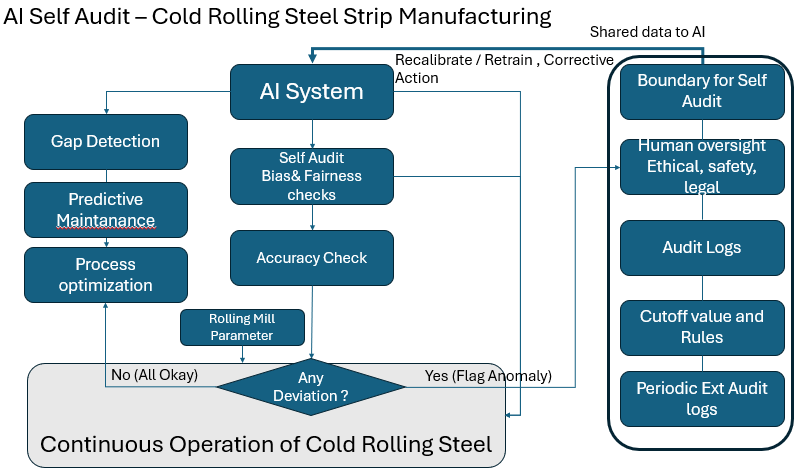
An AI can reliably flag deviations from predefined metrics like accuracy, data drift, fairness thresholds but true responsible auditing requires ethical, contextual judgement which currently needed human inputs as final authority. In cold rolling steel strip manufacturing, an AI system often controls rolling mill parameters like tension, speed, and thickness based on sensor data. These decisions affect product quality and energy efficiency. After every 50 coils processed, the AI runs a self-check, Compares predicted vs. actual thickness (in mm). Runs statistical tests (e.g. Hypothesis Testing, dynamic SPC) for bias across different suppliers. Alerts if rolling force models show drift beyond 2% In cold rolling, this self-check is highly critical for real time monitoring. However true responsible auditing remains a hybrid process of internal AI control system and human auditor / governance structure. To keep the AI aligned and auditable, AI can flag issues but cannot change control logic without human approval Every self-check and alert must be logged for traceability. Define clear limits (like max deviation allowed), so that AI cannot override safety or compliance standards Even with self-audit, schedule human audits quarterly / half-yearly to validate AI’s findings. AI must provide reasons for alerts in plain language to operator (e.g., “Sensor data drift detected in mill stand # 2”). The AI continuously checks for bias, data drift, and performance accuracy while adjusting rolling mill parameters. To maintain accountability, boundaries such as human oversight, audit logs and periodic external reviews ensure the AI remains transparent and aligned with business objectives (Human validations and governance as final decision-making authority).
-
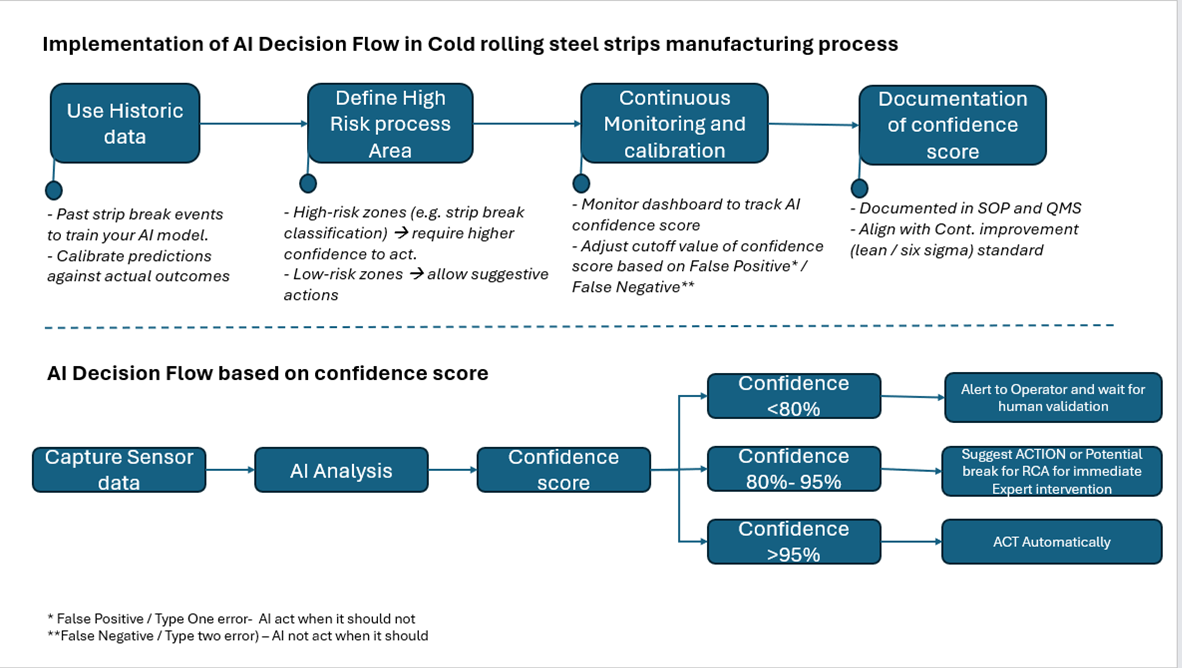
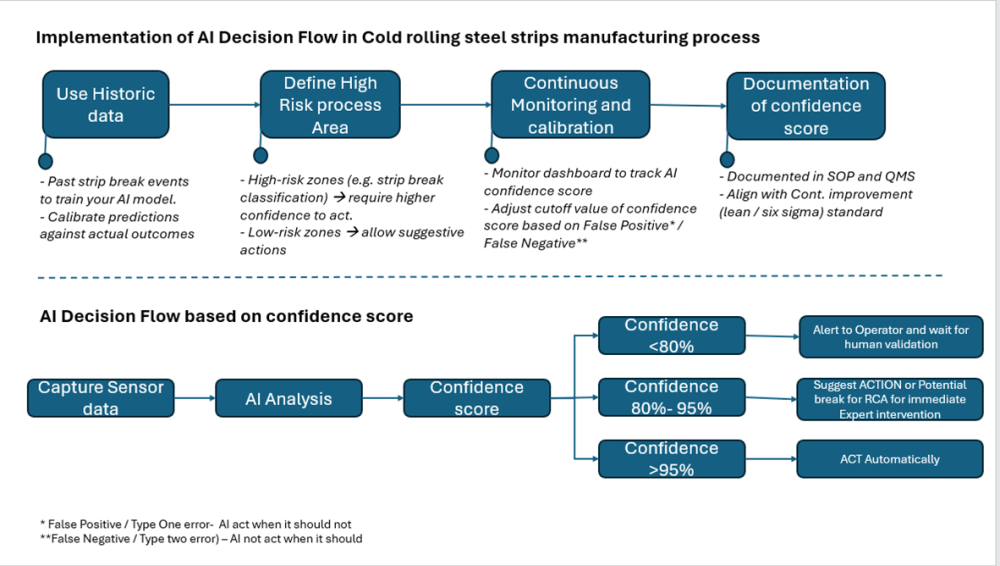
In manufacturing, especially in multi-stakeholder environments like cold rolling steel strip manufacturing, AI must act only when its confidence level is high enough to avoid costly errors. Confidence here refers to the probability that the AI's prediction or decision is correct. The correct confidence level is not a single static number. It depends on the risk and impact of the action on final product quality. The higher the potential cost of an error (a false positive and false negative), the higher the AI confidence level. Low confidence -> AI should alert an operator or wait for more data. Medium confidence -> AI can suggest actions but not execute them. High confidence (typically >95%) -> AI can act automatically, especially in routine or time-sensitive operations. Since Cold rolling is a continuous process where steel strips are passed through rollers to reduce thickness and improve surface finish. A key challenge is strip breaks—tears in the steel that stop production and damage costly machine. Let’s consider strip break classification process as an example, which is one of the most critical and high-impact areas in cold rolling process. If AI decision is 99% confidence, a strip will break due to high tension, it slows the rollers to adjusts tension automatically. Whereas if it’s 70% confidence, it alerts the operator to check manually and validate with functional expert. Example: Strip Break Classification Problem Impact: Strip breaks cause 4%- 5% production loss annually few crores of money Diagnosing causes manually takes few weeks to concludes. Unplanned downtime and production loss AI Solution: AI analyses sensor data (tension, torque, electric voltage) every 10 milliseconds. It classifies strip breaks in real-time, reducing downtime and manual effort. Confidence Threshold: AI acts only when confidence >95% in its classification. Because 95% and above confidence is statistically significant to justify the decision. If confidence is <95%, it flags the event for manual review or potential break for RCA.
-
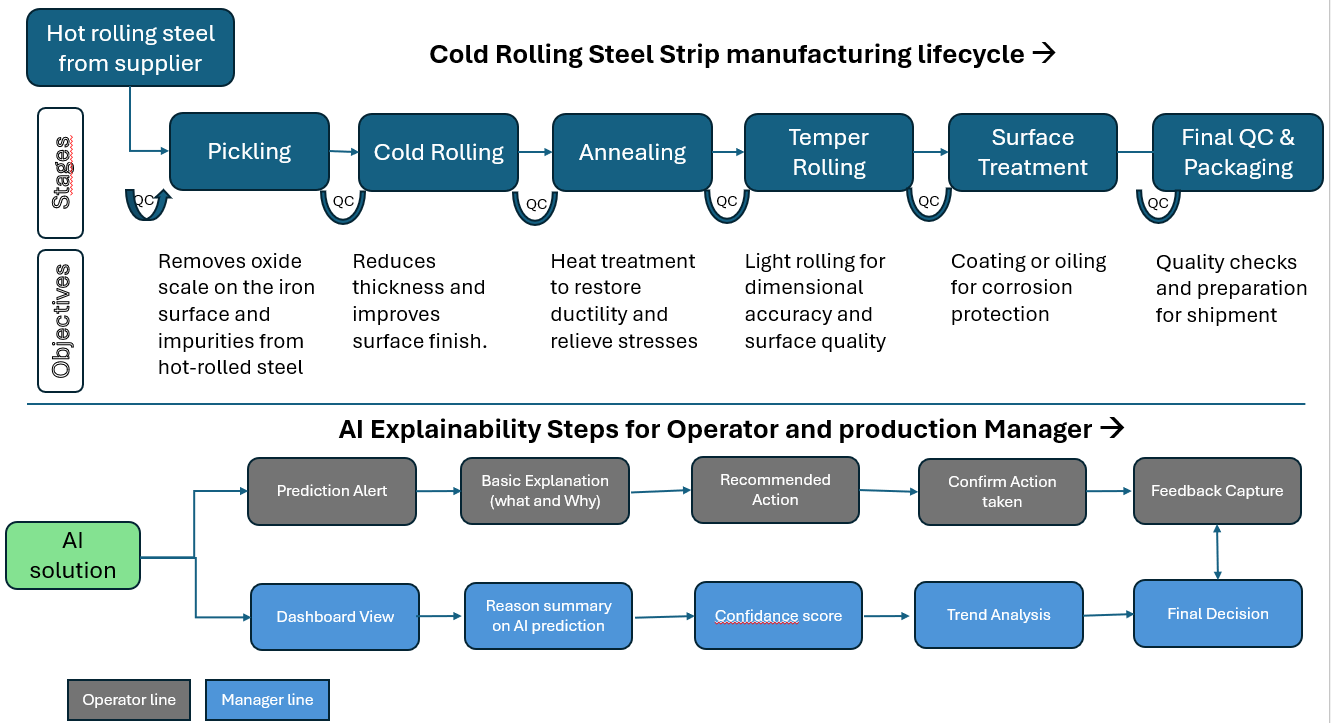
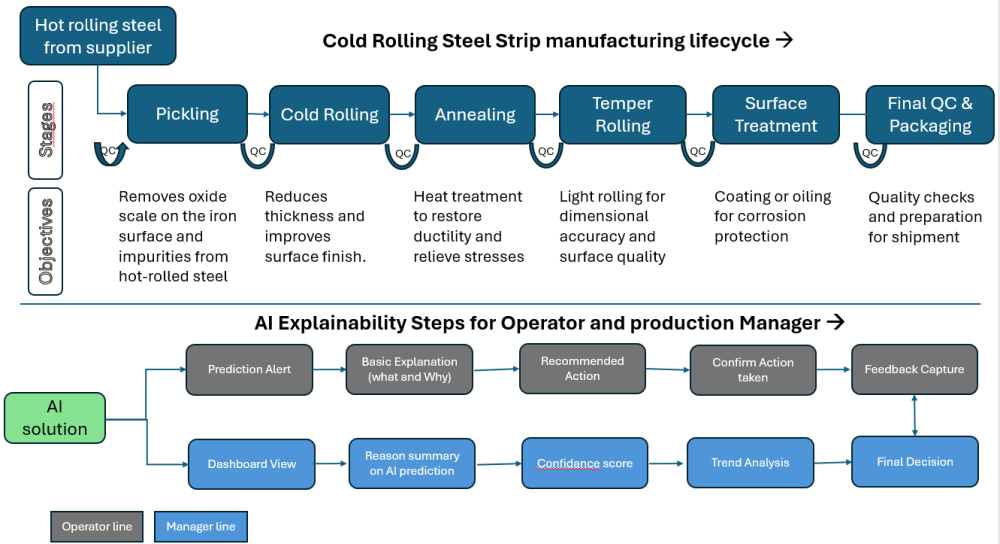
The required level of AI decision explanation depends on the context , the stakeholder involved and the user need for understanding and trust, where criticality of decision is low, a simple what and why is enough but for critical decision where cost impact is very high , we need detailed reasoning. AI explanation helps to build Trust & Confidence , Mitigating RISK , Faster end result . For example , consider the Cold rolling steel strip manufacturing lifecycle (refer attached slide#1) , which is highly complex , where multiple stakeholders are involved, multiple machines are used to thin a steel coil to a precise thickness with right hardness and surface flatness at high speeds. Where AI can be used to make real time critical decision to improve efficiency and performance. AI systems often consider below input variable factors. Rolling force, Lubrication Speed adjustments Temperature control Just imaging that AI predicts that the rolling force should increase by 6% during the final pass. Machine operators see this as a recommendation but don’t know if it’s due to material hardness, temperature shift , or sensor error. Without AI explanation , the risk is blind trust without understanding which can result in critical defects or equipment damage. But when AI explain its decision through dashboard 1. at Operator level (Actionable view) – (what?) -->Increase force by 5% to maintain thickness tolerance. 2. at Supervisor level (How?) --> Show top 3 contributing factors like hardness, temperature, speed etc. -->And new message on other influential feature to concern operator 3. at Engineer level (Why?) - Dashboard chart showing feature impact analysis, --> Maintenance History of all related machines. --> Historical Trend comparison of all related machine performance on similar production line. 4. at Manager Level (Trust and impact view) --> Confidence scores on decision and related risk indicators, like If force is not increased by 6%, predicted deviation - 0.15 mm. --> From a business impact angle, the proposed adjustment helps prevent a potential scrap loss of INR. 20Cr and maintain ISO quality compliance. There is no single standard for how much AI should explain but this explainability is needed due to legal, ethical, trust and risk mitigation perspective. AI explanations on its decision can be grouped into three parts, like · Prediction Accuracy – to show how effective, AI decision is, · Traceability – to confirm that decisions are based on valid data and processes, · Decision Understanding – to help user understand the reasoning behind the AI’s decisions. Ultimately the goal is to provide meaningful transparency, providing the right amount of detail to the right user at the right time to enable an effective decision-making process.
-
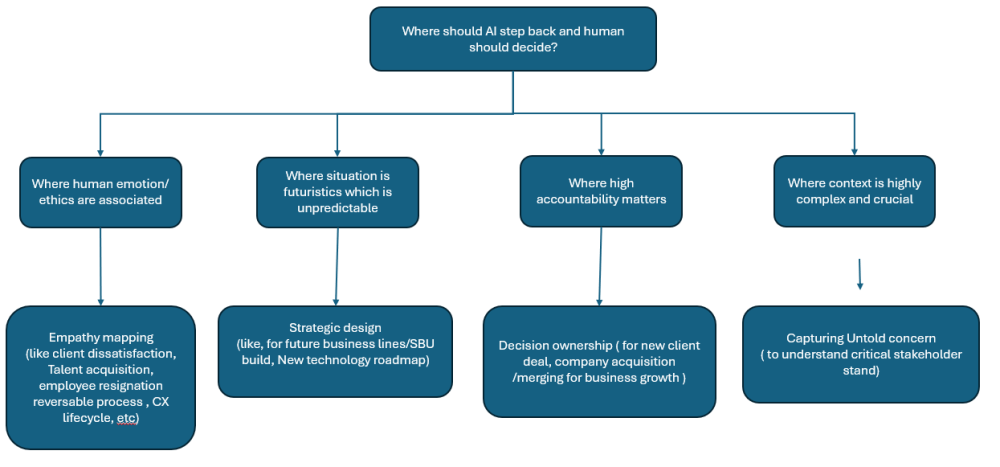
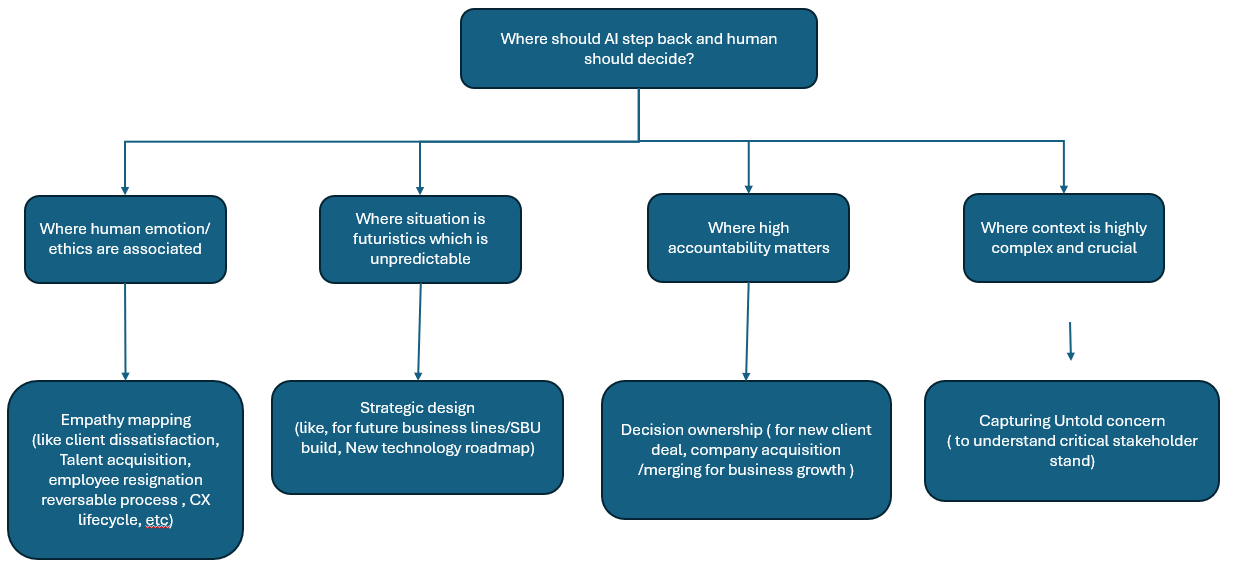
AI can analyze past data, spot gaps / anomaly logically and give a list of smart suggestion much faster than human but AI cannot feel, care and understand human emotion, and ethics. That’s why for any people emotion and relationship related issue, human must take the lead not AI. For example, during talent acquisition lifecycle with AI integration, AI can shortlist all suitable candidates based on their skill fitment and relevant experience, but the final decision should be taken by human (function head), because it need the trust and ethics both. Human can think what morally right not just what statistically significant. Especially when the situation is new and ambiguous or unclear, where AI can learn from the past data pattern and gaps, AI can guess wrong also. But human can use their intuition and creativity to handle any new problem together (AI+Human integrated system) . Because AI is great with past data and facts, but not with coming context. For example, in corporate leadership decisions specially in negotiation stage with multi stakeholder environment or for a critical client negotiation stage during new deal or renewal deal case , understanding individual tone, stakeholder’s body language, or unspoken concerns are also key factors. That’s where human intuition work effectively. So, the ownership should be with human not on AI . AI can advise only as a tool but cannot take blame for a very crucial decision (like a human life and death issue in healthcare). So, whenever a decision need human intuition, AI should step back and human decide.