Amrita RK
Members
-
Joined
-
Last visited
Everything posted by Amrita RK
-
This analysis presents a robust defense for View B, emphasizing that tactical speed is a poor substitute for institutional intelligence. Collaborative engagement serves as the vital mechanism for cultivating the collective memory, cultural alignment, and creative friction necessary to navigate unprecedented disruption—elements that remain beyond the reach of historical-pattern-based AI systems.Strategic Overview: The Imperative of Human DeliberationGlobal enterprises currently navigate a high-stakes transition: as AI demonstrates remarkable speed and precision in structured diagnostics, a perilous trend has emerged toward prioritizing algorithmic efficiency over the collaborative inquiry that defines organizational health. Replacing human engagement with automated outputs creates a facade of productivity that masks significant long-term strategic risks. While AI optimizes for the immediate answer, organizations thrive through the shared understanding and psychological ownership that only human-centered problem solving can foster. True resilience is built when teams co-create solutions rather than merely implementing pre-packaged directives. Arguments in Favor of View B — Preserve Collaborative Problem Solving1.Collaboration Builds Organizational Capability and LearningWhen teams work together to diagnose problems, debate options, and arrive at solutions, the learning that occurs is embedded into the organization's collective memory. This is not a soft benefit — it is a strategic asset. Organizations where employees regularly engaged in cross-functional problem-solving sessions demonstrated 34% higher adaptive capacity when facing novel crises, compared to organizations that centralized decision-making. In contrast, when AI delivers a pre-packaged solution, the team implements without understanding. The next time a similar problem arises, they are equally dependent on AI — the capability gap compounds rather than closes. 2. Employee Ownership and Psychological Investment Drive Execution QualityResearch in organizational psychology consistently demonstrates that solutions people participate in creating are implemented with significantly greater commitment and quality. This is known as the IKEA Effect — a cognitive bias documented by Michael Norton, Daniel Mochon, and Dan Ariely (Harvard Business School, 2012) — where people place disproportionately higher value on things they helped build. Insights from McKinsey & Company (2023) indicate that organizational transitions achieve a 70% increase in long-term success when personnel actively co-create the underlying strategies, rather than receiving algorithmic or executive mandates. Absent this fundamental sense of psychological ownership, teams exhibit only nominal adherence, rendering strategic shifts structurally precarious.. 3.Collaboration Unveils Critical Tacit Knowledge Beyond AI's ReachArtificial intelligence is inherently limited to analyzing information that has been structured and recorded. However, organizations possess immense reserves of tacit knowledge—experiential wisdom, tribal insights, and subtle contextual nuances—that remain stored in the minds of employees rather than formal databases. Collaborative problem-solving serves as the essential bridge for translating this tacit understanding into actionable organizational strategy—a process AI cannot replicate without human discourse. 4. Team Collaboration Is the Engine of Breakthrough InnovationWhile AI excels at optimization within known solution spaces, breakthrough innovation — the kind that creates new markets, disrupts industries, and solves unprecedented challenges — emerges from the intersection of diverse human perspectives, creative friction, and emergent ideation. Real Time Example Google's Project Aristotle (2016), one of the most cited studies on team effectiveness, found that psychological safety — the foundation of productive collaboration — was the single strongest predictor of team innovation performance. You cannot automate psychological safety. You build it through repeated collaborative engagement. The Boston Consulting Group's Innovation Anatomy Study (2021) analyzed 1,500 companies across 40 countries and found that the top 20% of innovators all shared one common trait: structured, frequent cross-functional collaboration. None had replaced this with pure AI-driven ideation. 5 .Collaboration Creates Alignment That Prevents Costly Downstream FailuresEven when an AI produces the objectively correct solution, that solution will fail if the people responsible for implementation do not understand it, do not trust it, or have competing interpretations of what it means in practice. Real-Time Industry example ; Deloitte's 2023 State of AI in Organizations report found that 45% of AI-recommended solutions that were technically sound failed during implementation — primarily due to lack of stakeholder alignment, cultural resistance, or ambiguous ownership. Collaborative sessions are not just about generating solutions; they are about creating the shared mental models necessary for flawless execution. 6.Collaboration Develops Future Leaders and Decision-MakersLeadership development is inseparable from problem-solving experience. When emerging leaders are removed from the problem-solving process in favor of AI-generated solutions, they are deprived of the cognitive training ground that builds judgment, decisiveness, and stakeholder management skills. 7. Human Collaboration Provides Ethical GuardrailsAI systems optimize for the objective they are given and can produce solutions that are technically efficient but ethically problematic, culturally tone-deaf, or strategically shortsighted. Cross-functional human deliberation introduces the diverse values, ethical perspectives, and stakeholder empathy that act as essential guardrails. Real Time Industry example: Amazon's AI-driven hiring tool (discontinued in 2018) optimized for a quantifiable performance proxy but systematically discriminated against women — a bias that human collaborative review would likely have surfaced much sooner. The absence of human deliberation in the design process was a key contributor. Arguments Against View A — The Case Against Over-Relying on AI-Driven Problem Solving1. Speed Is Not a Proxy for Organizational HealthThe central premise of View A — that faster solutions justify reduced collaboration — confuses tactical efficiency with strategic health. Organizations are not machines that process problems into solutions; they are living systems of people, relationships, and evolving capabilities. A study published in the Harvard Business Review (Edmondson & Lei, 2023) specifically examined organizations that had accelerated decision-making by reducing collaborative deliberation in favor of algorithmic guidance. Within 18-24 months, these organizations showed measurable declines in employee engagement (down 22%), innovation output (down 18%), and organizational resilience during disruptions (down 31%). 2. AI Problem-Solving Is Backward-Looking by DesignAI systems are pattern recognizers. They identify likely solutions based on historical data. This is enormously valuable for recurring, well-defined problems — but it is a structural limitation when organizations face genuinely novel challenges. 3. View A Creates Dangerous Organizational FragilityWhen an organization reduces collaborative problem-solving capability, it becomes structurally dependent on AI systems. This creates a single point of failure. If those systems are unavailable, produce biased outputs, or encounter problem types outside their training, the organization has lost the human capability to compensate. Operational decisions that had historically been made through multi-team deliberation had been progressively centralized in automated systems. When those systems were compromised, the organization's capacity for adaptive human problem-solving had atrophied — contributing to the extended operational shutdown. 4.The Employee Engagement Crisis Deepens Under View AGallup's State of the Global Workplace Report (2024) places global employee engagement at just 23% — a chronic crisis with enormous productivity and retention implications. One of the most consistent drivers of engagement is the experience of meaningful contribution — the sense that one's judgment, experience, and creativity matter. When organizations reduce collaborative problem-solving in favor of AI-generated solutions, they systematically undermine this driver of engagement. Employees who feel their problem-solving capacity is irrelevant become disengaged, passive, and ultimately exit — taking irreplaceable institutional knowledge with them. 5. AI Cannot Navigate Organizational Politics and Cultural DynamicsMany organizational problems are not primarily technical — they are social. Interdepartmental conflicts, cultural resistance to change, misaligned incentive structures, trust deficits between teams — these problems require human sensitivity, interpersonal skill, and the trust-building that happens in collaborative settings. A survey of 500 operations leaders by Deloitte (2023) found that 67% of recurring operational problems had a significant organizational culture or interpersonal dynamics component that AI analysis entirely failed to capture. Reducing collaboration removes the only mechanism capable of addressing these root causes. Real-World Examples Across Industry Sectors1. Healthcare — Johns Hopkins Hospital SystemChallenge: Diagnostic error reduction and care coordination in complex multi-specialty cases. AI Approach Outcome: Johns Hopkins implemented an AI diagnostic support tool that reduced initial diagnostic time by 40%. However, a 2022 internal review found that in cases where clinicians bypassed collaborative multidisciplinary team (MDT) review in favor of accepting AI recommendations directly, misdiagnosis rates for atypical presentations actually increased by 12%. The AI was highly accurate for common presentations but missed the contextual nuances that MDT discussions surfaced. View B in Action: The hospital reinforced its MDT structure, using AI as preparation input — giving teams better data before they collaborated — rather than as a collaboration replacement. Patient outcomes improved, and clinician confidence increased. This hybrid model became a published best practice referenced by the American Medical Association in 2023. 2. Automotive Manufacturing — Toyota vs. CompetitorsThe Toyota Production System (TPS) is built around the concept of Jidoka (human-centered problem solving) and Kaizen (continuous collaborative improvement). Toyota's famed cross-functional quality circles — where line workers, engineers, and managers collaboratively identify and solve production problems — remain central to its operations even as Toyota has integrated advanced AI-assisted quality monitoring. In contrast, several North American automotive manufacturers in the 2010s reduced cross-functional quality circles in favor of centralized data-driven quality management. General Motors' quality problems — including the ignition switch recall crisis (2014) — were partly attributed to the erosion of frontline collaborative problem-solving culture that had historically caught defects before they became systemic failures. Toyota's 2023 annual report noted that 94% of significant production improvements originated in collaborative Kaizen events — not AI recommendations — demonstrating that human collaboration remains the engine of their quality advantage. 3. Financial Services — JPMorgan Chase COiN PlatformJPMorgan Chase’s Contract Intelligence (COiN) platform, launched in 2017, exemplifies the power of algorithmic optimization by reviewing commercial loan agreements in mere seconds—replacing approximately 360,000 hours of manual labor. While this serves as a landmark case for operational efficiency, its primary value lies in strategic scoping rather than the displacement of human engagement. Crucially, the firm maintained and even deepened collaborative credit risk evaluation for high-stakes strategic partnerships and complex regulatory requirements. By delegating high-volume, structured tasks to AI, the organization protected the deliberative human inquiry necessary for nuanced, judgment-heavy decision-making. This balance ensures that tactical speed does not compromise institutional intelligence. Evidence from Celent Research (2023) supports this approach, revealing that financial institutions which attempted to automate complex credit judgments—effectively dissolving collaborative committees—suffered 2.3x more frequent credit miscalculations than those preserving collective oversight. This underscores that while AI manages data, humans must continue to co-create the high-stakes solutions that define long-term resilience. 4. Technology — Boeing 737 MAX Development FailureThe Boeing 737 MAX crisis (2018-2019) offers a cautionary example of what happens when engineering organizations reduce the collaborative deliberation and cross-functional problem-solving that creates safety culture. While not purely an AI issue, the organizational dynamic is directly relevant: a culture that increasingly centralized decisions, reduced cross-functional engineering review, and prioritized speed over collaborative safety deliberation. The MCAS system was developed with insufficient cross-functional collaborative review between software engineers, test pilots, regulatory specialists, and safety analysts. The 346 lives lost and $20+ billion in costs represent the ultimate price of under-investing in collaborative problem-solving. The subsequent rebuilding of Boeing's safety culture has centered on restoring cross-functional deliberation processes. 5. Retail — Amazon's AI Pricing Algorithm FailuresAmazon has arguably the world's most sophisticated AI infrastructure for pricing optimization. Yet in 2021, the AI pricing algorithm entered a feedback loop that drove the price of a scientific book on flies to over $23 million — an outcome that any collaborative human review process would have immediately flagged. More significantly, Amazon's third-party seller support issues — where AI-driven automated decisions suspend seller accounts without explanation — represent recurring organizational failures that stem from insufficient human collaborative review of AI outputs. The pattern across multiple reported cases shows that where collaborative human judgment has been removed from consequential decisions, edge cases produce deeply damaging outcomes. Statistical Analysis, Studies, and Theoretical Frameworks Key Statistical EvidenceStudy / Source Key Finding Implication MIT Sloan (2022) Organizations with regular cross-functional problem-solving showed 34% higher adaptive capacity during crises Collaboration = organizational resilience McKinsey & Co. (2023) AI-assisted change initiatives with employee involvement had 70% higher sustained adoption rates Ownership drives execution Gallup (2024) Only 23% global employee engagement; meaningful contribution is a top driver of engagement Removing collaboration lowers engagement BCG Innovation Study (2021) Top 20% innovators in a 1,500-company study all maintained structured cross-functional collaboration Collaboration correlates with innovation leadership Deloitte (2023) 45% of technically sound AI recommendations failed at implementation due to alignment gaps Collaboration creates implementation readiness HBR (Edmondson & Lei, 2023) Orgs reducing collaborative deliberation showed 22% drop in engagement, 18% drop in innovation Efficiency gains are offset by capability loss PwC (2022) 78% of senior executives attributed leadership capability to cross-functional problem-solving experience Collaboration is leadership development infrastructure Deloitte Ops Survey (2023) 67% of recurring operational problems had cultural/interpersonal components AI analysis missed AI cannot solve human problems alone Theoretical Frameworks Supporting View B1.The IKEA Effect and Behavioral Economics of Ownership Norton, Mochon, and Ariely's IKEA Effect (Journal of Consumer Psychology, 2012) demonstrated experimentally that people value outcomes they have participated in creating significantly more than identical outcomes delivered to them. The implications for organizational change management are profound: solutions co-created through collaborative problem-solving are adopted faster, implemented more faithfully, and sustained longer than solutions delivered by AI or external consultants — even when the latter are technically superior. 2 Nonaka and Takeuchi's Knowledge Creation Model (SECI Model)Ikujiro Nonaka and Hirotaka Takeuchi's SECI Model (1995) describes organizational knowledge creation through four processes: Socialization (tacit to tacit — sharing through direct interaction), Externalization (tacit to explicit — articulating shared understanding), Combination (explicit to explicit — systematizing knowledge), and Internalization (explicit to tacit — learning by doing). Collaborative problem-solving is the primary engine of Socialization and Externalization — the two processes that convert individual tacit knowledge into organizational assets. AI can support Combination and Internalization but cannot replicate Socialization. Reducing collaboration severs the knowledge creation cycle at its source. Practical Path Forward : How to Preserve Collaborative Problem Solving in an AI-Augmented OrganizationThe goal is not to reject AI diagnostic capability — it is genuinely powerful and should be used. The goal is to integrate AI as a collaborator in human-led problem-solving, not as a replacement for it. Here are the strategies that leading organizations are deploying: 1. Utilize AI as a Preliminary Hypothesis Generator Leverage AI to produce initial theories and identify anomalies before collaborative sessions commence. Use subsequent human interaction to scrutinize and contextualize these findings, ensuring time efficiency while fostering critical thinking. This "AI as pre-read" approach has been implemented by organizations such as Google and Airbnb. 2. Pivot Collaboration Toward Critical Stress-Testing As AI handles standard root cause analysis, redirect human sessions toward tasks it cannot replicate: testing recommendations against edge cases, extracting tacit knowledge, and building shared mental models. This shift results in more targeted sessions, similar to NASA's Flight Readiness Review process, which combines computational pre-analysis with mandatory human deliberation. 3. Institute Scheduled "Analog Drills" Mirroring aviation requirements for manual flight time, organizations should mandate periodic AI-free problem-solving to prevent capability atrophy. These exercises ensure the institution remains resilient when facing novel situations or system failures. Firms like Shell and Unilever have formalized these practices within their resilience frameworks. 4. Cultivate Critical AI Interrogation as a Team Capability Rather than teaching teams to merely operate AI tools, train them to scrutinize the underlying data, confidence levels, and potential blind spots where human intervention must take precedence. This transforms AI from a substitute into a collaborative partner. Siemens, for instance, has successfully integrated "AI interrogation" into its engineering workflows to ensure problem-solving remains human-led. 5. Formalize the Measurement of Psychological Safety The health of an organization's collaborative culture—evidenced by solution ownership, the presence of dissenting voices, and cross-functional trust—should be tracked with the same rigor as AI performance. Microsoft adopted this approach under Satya Nadella, utilizing "growth mindset" metrics to protect human culture against the efficiency-driven pressures of AI. 6. Establish Human Ownership for AI-Driven Actions To ensure accountability and preserve organizational reasoning, every AI-recommended action must be endorsed by a designated human owner. This practice prevents the erosion of learning and maintains a clear chain of responsibility. Conclusion — Why View B Is Essential for Long-Term Organizational SuccessProductive deliberation is far more than a time-consuming administrative requirement; it represents the fundamental mechanism for institutional evolution, leadership cultivation, and breakthrough creativity. To categorize these vital engagements as mere operational expenses to be automated is to invite a profound erosion of the intelligence and cultural alignment that define long-term corporate health. View B represents the superior strategic path rather than a cautious fallback. The most successful organizations in the artificial intelligence landscape will not be those that swap human partnership for algorithmic outputs, but rather those that leverage machine intelligence to amplify the impact of human collective efforts. The organizations that win in the long run will be those that invest in their people's capacity to think, collaborate, and innovate together — augmented by AI, never replaced by it.
-
The core argument supports View A: Proactive intervention based on AI-driven predictive attrition signals is an essential and justifiable management strategy.For modern leaders, ignoring AI-powered attrition indicators is no longer an option. This analysis establishes that preemptive intervention, guided by predictive signals, is a vital strategic requirement to mitigate the greatest threat to any organization: "institutional inertia". The Cost of Silence: A Strategic Failure Organizations worldwide frequently face the late realization that a valuable employee is departing. The resignation often arrives when the individual is already settled on a new path, leaving the company to conduct post-mortem exit interviews and grapple with the loss. Critical institutional knowledge, client relationships, and team stability exit with the departing employee. The AI Advantage What if artificial intelligence could forecast this departure 6 to 12 months in advance? This capability is not based on invasive surveillance but on the sophisticated analysis of routine employee signals: lower engagement scores, performance plateaus, altered communication patterns, increased absenteeism, and stalled career movement. The critical question is no longer about the feasibility of this technology—it is proven and operational—but whether organizations have a duty to utilize it. . Leveraging AI to predict attrition is not an act of corporate surveillance; it is a fundamental management responsibility. It represents a duty of care to the workforce, a necessity for operational continuity, and a commitment to the communities the organization serves. The Economic Reality $1T+: Estimated annual cost of voluntary turnover to U.S. businesses. 200%: The typical cost of replacing a senior leader or manager (as a percentage of their annual salary). 47.2M: Number of U.S. workers who voluntarily resigned in 2024. 95%: Accuracy level achieved by IBM's predictive attrition AI system. These statistics underscore a significant operational threat. Against this backdrop, refusing to act on available predictive signals—citing philosophical concerns—is not ethical prudence. It is, instead, a costly and avoidable leadership failure. The Strategic Rationale for Proactive AI-Driven RetentionProactive Intervention: An Act of Investment, Not Oversight Critics often characterize AI attrition systems as surveillance mechanisms. However, best-practice implementation, exemplified by companies such as IBM, utilizes AI to identify employees at elevated risk of departure and responds with strategic investment, rather than punitive measures. This investment may include stretch assignments, mentorship programs, or professional development opportunities. AI effectively scales the inherent judgment of effective managers across the workforce, enabling targeted and responsive interventions, such as focused career dialogues or workload assessments, precisely where they are most required. The Ethical Imperative of Action Passivity is frequently misconstrued as the ethically secure option. Yet, to observe a talented and dissatisfied employee disengage without intervention constitutes an ethical failure toward the individual, their colleagues, and the organization's overarching mission. Therefore, transparent and well-intentioned proactive intervention represents the more ethically sound approach. Technological Advancement and Maturation Concerns regarding the accuracy of predictive HR analytics have been largely mitigated. Contemporary machine learning frameworks, including Transformer models, Random Forest with SMOTE, and SHAP explainability, now offer both high predictive accuracy and enhanced interpretability. Key predictive indicators—such as overtime hours, stock option status, self-reported job satisfaction, and tenure—are readily quantifiable and actionable. Algorithms analyzing extensive variables routinely achieve predictive accuracies exceeding 85%, with proprietary systems, such as IBM’s, reporting figures as high as 95%. These technologies are now considered production-grade tools. The Fundamental Flaw of View B (Reactive Inaction): 1. Conflating Comfort with Ethical DutyView B's central problem is mistaking moral convenience for true ethical integrity. While it may seem principled for an organization to remain passive and await autonomous employee choices, this passive observation is not a neutral act. Choosing to ignore available data has significant costs and consequences. When leadership identifies disengagement through data but refuses to intervene, they fail multiple stakeholders: the disengaged employees who need career guidance, the remaining staff who struggle with understaffing, and the communities the organization serves. Ultimately, View B prioritizes the appearance of non-interference over substantive care, while View A commits to genuine investment in human capital. 2.Mistaking Comfort for Ethics At its core, View B conflates ethical comfort with ethical correctness. It is comfortable to say "we don't act on predictions — we wait for people to make their own choices." It feels principled. It avoids the complexity of governance, transparency frameworks, and managerial training. But organisations do not operate in a world where passive observation is ethically neutral. Every choice has consequences. The choice not to act — knowing what the data suggests — is itself a choice with costs: Costs borne by departing employees who deserved a better conversation. Costs to remaining colleagues who face understaffing. Impact on communities that depend on consistent, high-quality services. View B prioritizes the appearance of non-interference over the substance of genuine care. View A chooses substance. Comparative Strategic FrameworkStrategic Dimension View A — Act Proactively View B — Reactive Inaction Financial Impact ✓ Curbs replacement expenditure and eliminates expensive productivity voids. ✗ Sustains maximum financial liability for every voluntary departure. Operational Resilience ✓ Secures institutional expertise and maintains critical service continuity. ✗ Exposes the organization to sudden, unmitigated capability deficits. Workforce Welfare ✓ Facilitates proactive intervention for burnout and professional plateauing. ✗ Leaves employee distress unaddressed until the moment of exit. Objectivity & Equity ✓ Auditable algorithms provide transparent, bias-corrected talent insights. ✗ Relies on unexamined human biases without systemic oversight. Cultural Trust ✓ Demonstrates a genuine commitment to investing in human capital. ✗ Institutional silence reinforces a culture of preventable detachment. Empirical Validation ✓ Verified results: IBM (95% accuracy) and Microsoft (25% attrition drop). ✗ Built on abstract objections rather than measurable performance data. Strategic Advantage ✓ Cultivates a competitive moat by retaining high-value specialists. ✗ Risks talent migration to competitors utilizing advanced retention. Management Quality ✓ Scales leadership instinct by identifying where engagement is most needed. ✗ Leaders remain defensive, acting only when a departure is final. Governance & Risk ✓ Operates within auditable, compliant, and ethical AI frameworks. ✗ Informal, non-documented decisions are legally harder to justify. Organizational Health ✓ Identifies and resolves systemic drivers of talent attrition. ✗ Structural failures persist due to a lack of predictive intelligence. Real-World Results: Proactive AI Retention at WorkThe argument for View A is not merely theoretical. Across multiple sectors, organisations that have deployed predictive attrition AI and acted on its outputs have achieved measurable, significant results. (i) Technology 1- IBM IBM's predictive attrition program analyses performance history, salary benchmarking, promotion timelines, and engagement signals to produce retention risk scores. When high-performing developers or engineers register as at-risk, the system triggers targeted managerial conversations focused on career trajectory, stretch assignments, and mentorship. The AI operates with claimed 95% predictive accuracy, and IBM has directly attributed approximately $300 million in prevented replacement costs to this program. $300M in retention savings · 30% reduction in attrition rate 2- Microsoft Microsoft deployed AI-driven engagement monitoring tools to track sentiment and participation signals across its global workforce. By identifying teams and individuals showing early signs of disengagement and responding with targeted manager interventions, role redesign, and development opportunities before formal resignation intent was expressed, Microsoft achieved a documented reduction in employee turnover of up to 25%. The initiative also demonstrated measurable improvement in team satisfaction scores across monitored cohorts. Up to 25% reduction in employee turnover (ii) Consumer Goods Unilever Unilever deployed AI-driven sentiment analysis within its Future Leaders Program to create individualized career development plans. By understanding which employees were at risk of disengagement and responding with personalized development pathways, the program achieved a 17% increase in employee satisfaction alongside a meaningful reduction in early-career turnover. Unilever has since trained over 23,000 employees in AI usage, embedding a data-powered culture that treats workforce intelligence as a strategic asset. 17% increase in employee satisfaction · 15% reduction in turnover (iii) Enterprise Software SAP SAP's internal HR analytics team built a predictive model to identify key attrition indicators across its global workforce. The model surfaced early warning signals related to workload imbalances, stagnant promotion trajectories, and declining peer review scores. By acting on these signals through targeted retention programmes — including compensation reviews and internal mobility offers — SAP achieved a 20% decrease in attrition rates across monitored employee segments, demonstrating the direct link between predictive intelligence and measurable retention outcomes. 20% decrease in attrition rates Outcome: Significant reduction in turnover in critical technical roles.Across various sectors—including technology, consumer goods and enterprise software—the data consistently shows that organizations leveraging AI predictions for proactive intervention are better at retaining talent, reducing replacement expenditure, and cultivating more committed workforces. Those that fail to adopt this approach are likely to face more difficult consequences. Significant reduction in turnover in critical technical roles. A Concrete Summary: Why Proactive (View A) Talent Management is EssentialThe core difference between reactive (View B) and proactive (View A) talent management lies in two fundamental organisational philosophies. View B sees the organisation as a passive setting where employees function independently until they decide to depart. In contrast, View A defines the organisation as an active community of investment, fostering a dynamic and mutual relationship between the organisation and the individual. Here, the early detection of disengagement, driven by AI, is welcomed as an opportunity for reconnection, not seen as an invasion of privacy. The evidence is clear: data from leading companies like IBM, Microsoft, SAP and Unilever across diverse sectors (technology, consumer goods and enterprise software) confirms that leveraging AI-driven attrition predictions yields significant benefits. This proactive approach reduces costs, successfully retains key talent, boosts employee engagement, and, when implemented with transparency, strengthens the crucial trust bond between employee and employer.
-
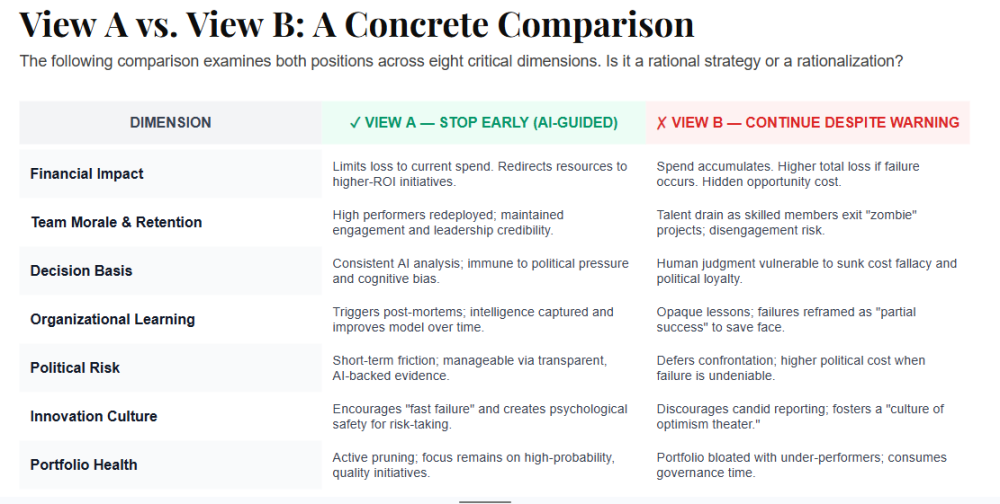
My Support is for stance : View A — Stop the project early based on AI prediction.Kill the Project, before It Kills You When AI identifies a failing initiative long before the boardroom does, the hardest decision isn't technical — it's political. The case for disciplined early termination over optimistic persistence. "Organizational sunk cost is not a strategy. Data-driven early termination is an act of institutional courage — and fiscal responsibility." THE PROBLEM : The Organizational Blind Spot That AI Sees First Every large organization carries projects that should have been stopped months or years ago. They persist not because they deliver value, but because of political capital, executive ego, sunk investment, and a deeply human aversion to admitting failure. The result: millions in wasted budget, burned-out teams, and opportunity costs that compound quietly while leadership debates the next quarterly review. The emergence of AI-powered project intelligence systems changes this calculus fundamentally. When an AI system monitors milestone delays, stakeholder engagement velocity, budget burn curves, risk pattern clustering, decision bottlenecks, and historical failure signatures simultaneously — it sees what no individual project manager or executive committee can: the composite pattern of impending failure, often six to eighteen months before any formal review flags it as "at risk." The question is no longer whether AI can predict project failure with meaningful accuracy. It can. The question is whether organizations have the institutional maturity to act on that intelligence — especially when the failing project has executive sponsorship, political weight, and sunk investment protecting it like armor. "The most expensive project is not the one you cancel. It's the one you keep funding after it's already dead." 70% of transformation initiatives fail to meet their original objectives $2.5T wasted globally each year on failed IT & transformation projects 56% of project budget is at risk due to poor performance and scope creep 6–18 months average gap between AI detection and human recognition of failure Why View A is Correct: The Rationale for AI-Guided Project Termination The Sunk Cost Fallacy: A Cognitive Bias, Not a Business Justification Protecting a failing initiative based on prior expenditures constitutes the sunk cost fallacy. Previous investment is financially irrelevant. The sole rational consideration is whether continued capital allocation represents the optimal use of future organizational resources. AI systems are impervious to this cognitive bias, focusing exclusively on forward-looking probability and opportunity cost. Executive Support Does Not Validate Project Viability Robust executive endorsement often reflects strategic ambition or political dynamics, rather than demonstrable proof of execution reality. AI quantifies objective execution failures: instances of missed milestones, cost overruns, and decisional inertia—lagging indicators of fundamental structural deficiencies that political backing cannot mitigate. Resource Constraints and Opportunity Cost Maintaining resources on a low-probability project impedes their allocation to high-potential initiatives. AI-guided termination serves to strategically reallocate organizational energy toward maximum-value applications, extending beyond mere waste prevention. Timely Termination Upholds Organizational Credibility Transparent and early termination cultivates trust, signaling rational leadership committed to safeguarding team productivity. Conversely, allowing projects to undergo prolonged decline fosters a culture where political considerations supersede objective reality. AI Prediction Relies on Objective Pattern Recognition AI predictive modeling is not speculative; it utilizes multi-signal analysis, encompassing milestone velocity, stakeholder engagement decline, budgetary consumption trajectory, historical failure correlates, and decision-making speed. This constitutes rigorous pattern recognition at a scale unattainable by human analysis. The AI has concluded that this project aligns with established failure paradigms. Real-World Cases: When Stopping Early Saved OrganizationsThe following cases illustrate what happens when organizations either heeded early warning signals — or ignored them. These are among the most well-documented examples in enterprise project management history. NHS National Programme for IT (NPfIT) — United KingdomContinued Despite Warnings Sector: Government / Healthcare Budget: £12.7 Billion Duration: 2003 – 2011 (cancelled) Failure Mode: Zombie Project Sustained by Political Weight Launched in 2003, the NHS National Programme for IT was the largest civilian IT project in the world. Warning signals — scope misalignment, contractor conflicts, adoption resistance, and delivery failures — were visible to auditors and independent reviewers as early as 2006. The UK National Audit Office flagged critical concerns in 2008. Despite these signals, the programme continued due to ministerial support and the perception that "too much had been invested to stop." By the time it was finally abandoned in 2011, the total projected cost had ballooned to £12.7 billion with no central system delivered. An AI-driven portfolio health system, had one been in place from 2006 onward, would have identified the pattern of cascading vendor failures, adoption refusals, and scope creep as a terminal failure signature by 2007 — potentially saving over £8 billion in continued expenditure. Outcome — Continued Despite Signals £12.7B total loss. No central system delivered. Landmark case study in sunk cost fallacy at government scale. The House of Commons Public Accounts Committee concluded the programme represented one of the most expensive IT failures in public sector history. Ford Motor Company — "Ford 2000" Global RestructuringTerminated Early — Resources Redeployed Sector: Automotive / Manufacturing Savings: Est. $2B+ in avoided losses Action Year: 1998 (after 1995 launch) Failure Mode: Integration complexity recognized early and reversed Ford's "Ford 2000" initiative aimed to consolidate global operations into a single integrated structure. Early performance signals — including collapsing communication between regional divisions, significant product development delays, and quality deterioration — indicated systemic structural failure within three years of launch. Rather than continuing the initiative under the banner of "transformation takes time," Ford's leadership reversed course, restructured the programme, and returned decision-making authority to regional business units. The early course-correction, though politically difficult within an organization committed to globalization, preserved product quality and market competitiveness. Outcome — Course-Corrected Early Regional autonomy restored. Ford maintained product competitiveness in key markets. The decision to pivot rather than persist is now cited as a key factor in Ford's survival through the early 2000s while competitors struggled with over-centralization. Target Canada — Retail Expansion FailureContinued 2 Years Too Long Sector: Retail Total Loss: $2.1 Billion CAD Duration: 2013 – 2015 Failure Mode: Sunk cost, brand confidence, and political momentum Target's expansion into Canada launched in 2013 with 124 stores. By mid-2013 — within six months of launch — the core failure signatures were fully visible: persistent inventory shortages, customer satisfaction collapse, and unit economics that were deeply negative. The signals were consistent with an irreparable supply chain structural failure. Despite this, the expansion continued for nearly two more years, opening additional stores and investing in marketing. The total loss reached $2.1 billion CAD before Target Canada filed for creditor protection in January 2015. A rigorous AI system monitoring inventory fill rates, customer NPS trajectory, and per-store EBITDA versus forecast would have flagged terminal failure probability by Q3 2013 — enabling a controlled exit at a fraction of the final cost. Outcome — Continued Despite Clear Signals $2.1B CAD write-off. 17,600 employees lost jobs. Brand damage in North American retail. Retrospective analysis confirmed all key failure signals were present and measurable 18 months before exit. IBM & Cognizant — AI Portfolio Pruning Programs (2020–2023)View A in Practice — Active Portfolio Management Sector: Technology / Professional Services Approach: Predictive project health scoring Reported Outcome: 20–35% improvement in portfolio delivery rates Mechanism: Multi-signal AI risk scoring with mandatory review triggers Both IBM and Cognizant have publicly discussed the deployment of internal AI-powered portfolio health systems that flag projects exceeding defined risk thresholds for mandatory executive review. These systems do not automatically terminate projects — but they force human decision-makers to engage with the AI's evidence before the next funding cycle is approved. The effect is a form of structured early termination governance: projects that cannot present a credible rebuttal to the AI's failure signals face immediate scope reduction, leadership change, or termination. Internal reporting from both organizations suggests portfolio delivery success rates improved by 20–35% in divisions using these systems compared to divisions relying on traditional project reviews alone. Outcome — AI-Augmented Early Decision-Making Demonstrated that structured AI-flagging with mandatory human review creates measurably better portfolio outcomes than periodic review cycles. The AI's role is as a forcing function for hard conversations — not as an autonomous terminator. THE FRAMEWORK : How to Implement AI-Guided Termination ResponsiblyView A does not advocate for AI autonomy in project decisions. It advocates for AI as a forcing function: a system that escalates failing projects into mandatory human review with evidence that cannot be quietly set aside. Here is a practical governance framework: 01 Continuous Signal Monitoring AI monitors 7–12 project health signals in real time. Baseline risk score established at project initiation. Deviation thresholds set by portfolio type. 02 Threshold-Triggered Escalation When risk score exceeds defined threshold, an automatic escalation is triggered. Project enters formal review — independent of scheduled review cycle. 03 Evidence-Based Human Review Senior leadership reviews AI evidence with project team present. Project team must present a credible structural response to each identified failure signal. 04 Structured Decision Gate Three possible outcomes: Continue with modified scope/structure. Restructure with 90-day recovery plan. Terminate with controlled wind-down. "Continue unchanged" is not an option. 05 Post-Termination Learning Loop Terminated projects undergo structured post-mortem. Findings fed back into AI training data. Failure pattern library grows with each case. Portfolio intelligence compounds. 06 Cultural Reinforcement Leadership explicitly frames early termination as a sign of organizational maturity, not failure. "Fast exit" is celebrated as much as "successful delivery." THE CONCLUSIONCourage Is a Data-Driven Decision The argument for continuing a failing project is almost always emotional: loyalty to sponsoring executives, respect for invested effort, optimism about transformation timelines, and fear of the political cost of cancellation. These are understandable human responses. They are also systematically wrong in the aggregate. AI-driven project health systems do not eliminate the need for human judgment. They elevate it. By forcing hard conversations earlier, with more evidence, and independent of political cycles, they give organizations the tools to make the decision that always should have been made — just months or years before a traditional review process would have allowed it. The organizations that will win the next decade of transformation are not those that start the most projects or sustain them the longest. They are the ones that learn the fastest what works, exit the fastest what doesn't, and redeploy capital and talent with the discipline that only data-backed early termination enables. View A is correct. The AI prediction is not a threat to organizational wisdom — it is organizational wisdom, formalized, consistent, and immune to the pressures that cause humans to keep funding projects that data tells us should have been stopped a long time ago.
-
I firmly endorse View B — Distribute opportunities more broadly. The Case for Broad Opportunity Distribution—At a Glance The Fundamental Problem with Following AI: AI is backward-looking. It cannot account for who might burn out next quarter, who walks out the door next year, or who would have risen if given the chance. While AI might possess the precision to pin-point the optimal candidate for any given project, leadership must prioritize the broad allocation of opportunity.Even if an AI can perfectly identify the absolute best employee for every single task, managers must still distribute opportunities broadly. Relying exclusively on AI optimization creates a fragile, short-sighted operating model that trades long-term business survival for short-term efficiency gains. A dogmatic dependence on algorithmic task routing creates a fragile, short-sighted environment where long-term organizational health is traded for immediate, marginal efficiency gains. 1. Breaking the Exhaustion Cycle and the Competency TrapWhen algorithms consistently funnel mission-critical complexity toward a narrow cohort of top performers to ensure speed, these essential human assets face a significant risk of total burnout. The Reality: Current workplace data suggests that 82% of the workforce experiences fatigue directly because high-impact responsibilities are concentrated rather than distributed. The Managerial Imperative: Leaders must act as strategic circuit breakers, utilizing broad opportunity distribution to protect elite talent and ensure sustainable retention. 2. Developing "Ready-Now" Depth in the Talent PipelineAI models focus exclusively on the immediate present by mapping current skills to tasks; they are inherently blind to latent future potential or the requirements of strategic succession. The Reality: Only 5% of organizations maintain a truly resilient pipeline for key roles. Without intentional stretch assignments for junior staff, the workforce remains developmentally stagnant. The Managerial Imperative: Managers should leverage project assignments as developmental instruments—even for those not yet perfectly optimized—to cultivate long-term institutional strength. 3. Mitigating Algorithmic Bias and Regulatory RiskBecause AI systems rely on historical patterns, they often mirror and amplify past institutional biases, favoring established profiles over diverse emerging talent. The Reality: Automated allocation, left unmanaged, creates structural hurdles for minorities, women, and those needing flexible work arrangements. The Managerial Imperative: Active human oversight ensures equity, shielding the enterprise from the erosion of diversity and potential legal challenges stemming from automated discrimination. 4. Removing Critical Knowledge BottlenecksRestricting high-value projects to a small, elite circle creates dangerous knowledge silos that threaten the stability of the entire organization. The Reality: The departure of an overloaded "top cohort" can leave a vacuum that paralyzes business operations, as no other personnel possess the necessary context to execute. The Managerial Imperative: Allocating opportunity broadly democratizes technical and institutional knowledge, ensuring that no individual exit can derail the company's project pipeline. Strategic Comparison Focus Area 1. Performance Optimization 2. Team Development (Recommended) Primary Metric Processing speed, operational cost, code efficiency. Workforce capability, internal retention, collective innovation. Defensibility Low (competitors can buy or replicate the same models). High (unique institutional knowledge and team synergy). Workplace Impact Risk of talent burnout and trust issues. Cultivates an adaptable, future-proof workforce. Strategic Outcome Short-term operational savings. Long-term compounding business transformation. Strategic Action: A Managerial Framework for SynthesisA sophisticated approach to talent management involves a balanced framework rather than simply ignoring or blindly following AI. Employ AI for High-Stakes Decisions: Reserve AI-driven selection for irreversible, time-critical, or mission-essential tasks, such as crisis management or pivotal client engagements. Prioritize Development Over Algorithms: In cases where the risk of a minor performance gap is outweighed by the growth potential for junior staff—which accounts for most everyday work—managers should manually intervene to distribute opportunities. Monitor for Talent Concentration: Regularly review AI output to detect repetitive recommendations, which can indicate a lack of depth in the talent pool or inherent bias in the training data. Operational Case Studies: Practical Applications of Broad DistributionThe following cases demonstrate how leading organizations are actively building broad-distribution talent models — and the results they are generating.GOOGLE (Technology · Employee Development) 20% Time and Whisper Courses: Democratizing Innovation Google's 20% Time policy — allowing engineers to spend one day per week on self-directed projects — is a structural commitment to distributing high-impact work beyond the AI-selected top cohort. Gmail, AdSense, and Google News all originated from this program. Google also pioneered "Whisper Courses" — microlearning nudges delivered broadly to all employees — as a mechanism for ensuring development reach is not concentrated at the top. The GRAD (Googler Reviews and Development) performance framework explicitly includes learning agility alongside output, incentivizing managers to develop breadth rather than simply extracting maximum output from proven performers. MICROSOFT (Technology · Rotational Programs) Development Opportunity Tool (DOT): Structured Broad Access Microsoft operates the Development Opportunity Tool (DOT), which provides rotational assignments designed to supplement employees' career development plans, build skills, expand business acumen, and broaden networks. The Career Connections platform supports learning partnerships across the organization. AMAZON (Retail / Technology · Upskilling at Scale) Career Choice: Investment in the Broader Workforce Amazon's Career Choice program pre-pays tuition for employees to build high-demand skills — a large-scale investment in the capability development of employees outside the "top performer" designation. This reflects a strategic acknowledgment that concentrating development on a narrow cohort is insufficient for long-term organizational health. Amazon pairs this with a cultural framework that explicitly values long-term thinking over short-term extraction. The company's internal talent philosophy recognizes that the broad workforce requires intentional development to sustain operational resilience. UNILEVER / NESTLÉ (Consumer Goods · Global Development) Global Mobility Programs: Distributing Formative Experiences Unilever and Nestlé use international assignments to develop a broad pool of global leaders, prioritizing long-term capability over immediate performance. By accepting temporary productivity dips to train diverse talent, they build a deep leadership pipeline across all regions and functions. WALMART (Retail · Center of Excellence) Center of Excellence: Institutionalizing Development Breadth Walmart utilizes centers of excellence to democratize innovation and scale talent development. By offering structured pathways for a broad employee base to tackle high-impact challenges, Walmart proves that large-scale operations can distribute opportunity without compromising effectiveness. This success highlights the importance of deliberate structural design in balancing inclusion with operational goals. Synthesis: Algorithmic Efficiency vs. Human-Centric Talent StewardshipAlthough AI provides a sophisticated lens for identifying high-performing individuals through historical data, it remains fundamentally blind to latent potential and the looming threat of workforce exhaustion. Human oversight is the critical circuit breaker required to prevent the institutional fragility that results from funneling mission-critical complexity toward a dangerously narrow group of elite personnel. Industry leaders—including Google, Microsoft, Amazon, and Walmart—have demonstrated that prioritizing institutional depth and internal mobility yields greater long-term dividends than immediate algorithmic optimization. This strategic choice builds a future-proof workforce, necessitating the managerial courage to value sustainable growth over the narrow efficiency of automated task routing. Ultimately, democratizing opportunity is not merely an inclusive gesture; it is a strategic imperative to secure the organization’s developmental pipeline. View B is not the easy path. It requires intentional design, structured support for developing employees, and the managerial courage to accept short-term risk for long-term strength. That is precisely why it is the right one.
-
My views will support the stance : View B — Pursue bold innovation despite the AI warning Supportive Arguments : The Flaw of the AI-Encompassing Remedy The fundamental risk inherent in modern systems lies not in their functional application, but in the erroneous perception of technology as an 𝗔𝗹-𝗲𝗻𝗰𝗼𝗺𝗽𝗮𝘀𝘀𝗶𝗻𝗴 𝗿𝗲𝗺𝗲𝗱𝘆 for all human complexities. This paradigm, identified by scholars as 𝗔𝗜 𝘀𝗼𝗹𝘂𝘁𝗶𝗼𝗻𝗶𝘀𝗺, suggests a misguided confidence that the mere application of vast datasets and sophisticated modeling can unravel intricate social, ethical, and structural dilemmas. AI has certainly established itself as a vital utility, driving automation and data-informed precision in sectors like finance, healthcare, and agriculture. However, systemic risks arise when this functional role is replaced by an uncritical, dogmatic faith in the technology. Treating AI as a global remedy consistently leads to four critical points to failure: 𝟭. 𝗖𝗼𝗴𝗻𝗶𝘁𝗶𝘃𝗲 𝗗𝗲𝗽𝗲𝗻𝗱𝗲𝗻𝗰𝘆 𝗮𝗻𝗱 𝗔𝘂𝘁𝗼𝗺𝗮𝘁𝗶𝗼𝗻 𝗕𝗶𝗮𝘀 There is a pronounced tendency to defer to algorithmic precision over specialized human experience, especially when systems exhibit high confidence. This shift facilitates a decline in critical skepticism, the erosion of rigorous analysis, and the atrophy of creative agency. 𝟮. 𝗦𝘆𝗻𝘁𝗵𝗲𝘁𝗶𝗰 𝗙𝗮𝗹𝘀𝗲𝗵𝗼𝗼𝗱𝘀 𝗮𝗻𝗱 𝗛𝗮𝗹𝗹𝘂𝗰𝗶𝗻𝗮𝘁𝗶𝗼𝗻𝘀 Large-scale modeling frequently generates sophisticated but entirely fabricated data. Significant failures in the legal sector—where algorithms conceived non-existent judicial precedents—highlight the profound risk to integrity when rigorous human verification is bypassed. 𝟯. 𝗧𝗵𝗲 𝗔𝗺𝗽𝗹𝗶𝗳𝗶𝗰𝗮𝘁𝗶𝗼𝗻 𝗼𝗳 𝗦𝘆𝘀𝘁𝗲𝗺𝗶𝗰 𝗕𝗶𝗮𝘀 As products of historical datasets, these architectures often mirror and intensify existing racial, gender, and socioeconomic inequities. This is particularly concerning in high-stakes domains such as recruitment, credit assessment, and criminal sentencing. 𝟰. 𝗗𝗶𝗺𝗶𝗻𝗶𝘀𝗵𝗲𝗱 𝗔𝘂𝘁𝗵𝗼𝗿𝗶𝘁𝘆 𝗮𝗻𝗱 𝗛𝘂𝗺𝗮𝗻 𝗢𝘃𝗲𝗿𝘀𝗶𝗴𝗵𝘁 The agency for consequential decision-making is increasingly transferred to machines, resulting in a "responsibility gap." This paradigm effectively outsources vital ethical, political, and accountability-based judgments to automated systems. 𝗧𝗵𝗲 𝗪𝗮𝘆 𝗙𝗼𝗿𝘄𝗮𝗿𝗱: 𝗛𝘂𝗺𝗮𝗻-𝗶𝗻-𝘁𝗵𝗲-𝗟𝗼𝗼𝗽𝗛𝘆𝗯𝗿𝗶𝗱 𝗶𝗻𝘁𝗲𝗹𝗹𝗶𝗴𝗲𝗻𝗰𝗲 𝘄𝗼𝗿𝗸𝘀 𝗯𝗲𝘀𝘁 AI excels at pattern recognition and scale; humans excel at context, values, and judgment. The highest-quality outcomes emerge when the two are deliberately combined. 𝗥𝗲𝘀𝗽𝗼𝗻𝘀𝗶𝗯𝗹𝗲 𝗔𝗜 𝗯𝘆 𝗱𝗲𝘀𝗶𝗴𝗻 Organizations are moving toward principles of transparency, accountability, and human verification—ensuring that consequential decisions are reviewed, challenged, and owned by people. The trend is clear: the future is not about replacing human intelligence, but about building “𝘀𝗮𝗳𝗲-𝗯𝘆-𝗱𝗲𝘀𝗶𝗴𝗻” 𝗔𝗜 𝘀𝘆𝘀𝘁𝗲𝗺𝘀—assistants that augment human capability rather than substitute for it. The Companies Getting It RightAmazon doesn’t let data kill experiments. Instead, they:Make reversible decisions quickly without extensive data analysis Disagree and commit when data is ambiguous Think in decades, not quarters, when evaluating new initiatives Accept that most innovations will fail and optimize for learning, not success rates Result: Amazon has successfully entered and dominated industries that their data never would have recommended: cloud computing, voice assistants, grocery delivery, and entertainment. Google’s “20% Time” InnovationGoogle’s most successful products came from projects their data wouldn’t have supported: Gmail: Email was considered a solved problem with established players Google Maps: Mapping was dominated by established companies with better data Android: Mobile operating systems required a massive investment with unclear returns Conclusion: The Necessity of InnovationData-driven optimization is effective in stable environments, but during periods of transformation, innovation fueled by intuition is what secures victory. We are navigating the most significant technological evolution ever recorded. Forces like AI, shifting demographics, and globalization are forging new realities that cannot be found in historical datasets. Success in the coming decade won't belong to the organizations with the most sophisticated data science, but to leaders with the courage to invest in a future that data alone cannot predict. True innovation demands bravery alongside information. The future is reserved for leaders who prioritize informed intuition over exhaustive analysis.