


Benoy Joseph
Members
-
Joined
-
Last visited
-
Supermarkets can be broadly defined as one of the pull strategies that can be used while designing “future state value stream maps”. Supermarkets are best used when the demand vs supply considerations are difficult to model or not predictable. The genesis of this idea was from the observations of American supermarkets by Taiichi Ohno, when he discovered the flawless mechanism used by the American supermarkets to effectively manage their inventory by making available a) what is needed b) at the time it is needed c) in the amount that is needed…. He then applied a similar concept to manufacturing production lines for seamless inventory/supply management. In best case scenarios, streamlined manufacturing line will align production capacity with customer demand. However, for all practical reasons it is quite seldom that such cases exist, and a supermarket concept can be introduce to manage workflows better. A well-established inventory strategy aims to use supermarkets at appropriate points in their production lines. Additionally, supermarkets are used to effectively manage peaks and valleys in downstream/upstream process supply/demand variations. Some of the scenarios where Supermarkets can be used – a) Different lot sizes requirement from one process to next, in such cases a continuous flow or FIFO cannot be implemented. b) If material flow splits into different processes throughout the value chain, i.e. Process 1 supplies material to Process 2 & 3, in such cases a supermarket is best positioned after process 1 to make sure the downstream (process 2&3) are not waiting for inventory c) Supplier with high lead time or unpredictable supplies. .. in such cases a supermarket helps to act as a warehouse and reduce the variability in the value chain d) Downstream process reliability is low, i.e. frequent defects are identified. In such cases a supermarket can be used to store buffer stocks and not impact the customer delivery timelines e) High changeover times in downstream process, in such cases supermarket can be used as storage Characteristics of a good supermarket – Any good supermarket will try to have the below – a) The supermarket should be located at appropriate points in the production life cycle to reduce variation due to demand and supply b) Kanbans are effectively used, to indicate when the a particular inventory is low on stock and flags production team c) Scientifically designed safety stocking mechanisms, which allows low disruptions to production line if there are delays from suppliers
-
Obeya is often referred to as “Large room” in a project. The origin of this term was from Toyota in 1990s during their project G21, which led to the first generation of Toyota Prius. Takeshi Uchiyamada was appointed the Chief Engineer for the project, and he always felt that he lacked the required authority to make the right decisions and feared being overrun by more experienced department leaders, which may adversely impact the project. In order to ensure he had alignment from all stakeholders he constituted the “large room” – Obeya in Japanese – as an arena for discussions with the department leaders. This forum will have all the relevant stakeholder with relevant data and information to make decision making seamless. The concept of Obeya room was largely successful in Toyota, and hence they integrated it as part of Toyota Product Development System. Why is Obeya required for large cross functional projects – The biggest challenge in cross functional project is, the individual functions not seeing the big-picture of the how a new product or service will bring to the organization. They operate in silos, which in-turn results in lack of synergy between functions or department and result in project delays or failure. According to Shigeo Shingo: "People don't care what until they understand why." The organization vision and operational objectives well-articulated, gives meaning to the employees, which result in improved commitment and accountability for employees to act. Various tools like Hoshin Kanri are used to create alignment between activities, and to establish organizations vision, Individual and team goals. Obeya, helps to visualize Hoshin Kanri, and helps create a collaborative environment for cross functional problem sharing and decision making. In Obeya rooms (as explained in the above diagram), cross functional project teams can be focused on the project or organizations vision. Measure the success using KPIs, identify gaps in meeting KPIs quickly and follow a PDCA cycle (plan, do, check, act) to resolve issues, resulting in timely completion of projects with minimum resistance.

-
Below explanation will allow us to better understand the roles of a Sponsor and Champion Project Champions – Champions provide the leadership oversight for a lean six sigma project. When working on a project, every improvement idea should require enough support and a champion’s role requires him/her to devote time and support to the project team to overcome any roadblocks in the project journey. Project champions is involved right from the early stage of the project selection, team selection and as the project progress providing support by a) Helping steer the team towards the strategic intent of the project b) Supports by critically reviewing the charter of the project to ensure the project scope is well defined and goals are SMART c) Conducts focused project reviews on each toll-gates and ensure project stays on track for timely completion d) Overseeing budget and resource requirements, and making sure these are available e) Ensuring the business benefits through the project are realized f) Ensuring the project team is appropriately rewarded for their involvement and success of the project Sponsors – The role of an executive sponsor for lean six sigma program should be with a senior executive in the organization, who is a strong advocate of Lean Six sigma and sees the tangible value the program brings to the organization. The role of the executive sponsor is providing the LSS program with strategic direction, ensure there is enough buy-in for the program across the organization. Jack Welch in his books have elaborately advocated to have a sponsor who is at the top of the company hierarchy and is committed to the success of the program. An executive sponsor of the LSS program has the below roles – a) Provide strategic direction to the LSS program to be deployed across organization b) Have clear vision laid out on how the LSS program will play a critical part in organizations success c) Provide financial support/budget to run and promote the program, by clearly defining the success measures, scope etc. d) Include LSS program as part of the leadership agenda and reviews, to communicate status, success, challenges etc. e) Actively participate in “Showcase events” or Promotional events in the organization to lend support to the program It is mostly recommended to have both Sponsors and Champions for a successful Lean six sigma deployment. However, the organization structure and hierarchy does play a role in this decision. A conventional organization with conventional hierarchy may best have a sponsor and champion both, however in a start-up where the senior executives might be also managing day to day operational activities, these roles might be quite diluted and we may often see the role of champion and sponsor being performed by the same leader. For example, in a large organization with 1000+ employee spread across multiple regions, the role of the executive sponsor will be to advocate the program in board meetings, engage leaders to support the budget for the program and commit to the successful delivery. The sponsor will make sure that there are clear vision and objective defined for the program, which makes the outcomes from the program tangible for the organization. The sponsor’s role will be to ensure there is enough buy-in for the LSS deployment across the organizations, i.e. enough support/synergies displayed by department leaders/employee and there is a shared vision on how important the LSS initiative is for the organization In case of the champion, his/her role will be limited to a particular project or a group of projects within a department. The champion will ensure there is clear strategic direction on the project, reviews and support is in place for the project to be successful and complete on-time. The champion will also actively engage with various stakeholders within the department to remove any bottlenecks or push-backs, impacting the timelines of the project.
-
Quality circles (QC)have been around for more than six decades now and this idea was coined by W. Edwards Deming in 1950 in Japan, and was further explored and instutionalized by Kaoru Ishikawa in 1960’s. In US, quality circles started with Lockheed in 1974, and is been widely used since. Quality circles can be defined as a group of motivated and committed individuals working in the same departments/organizations, who meet regularly to identify, analyse and find solutions for their most pressing work related problems. Quality circles are not just limited to identifying solutions for the problems in the organizations, however they actively participate in solution deployment, which in-turn improves employee motivation and satisfaction to see their ideas coming to life. There is no denial that quality circles indeed comes with lot of advantages to the organizations if they are implemented and maintained properly. Quality circles promote team work, encourage employees to participate and actively contribute to the organizations strategy, as the ideation and implementation are employee driven. However, it is argued that Quality circles are usually a short term trend and are do not stay popular for long time. This is due to the various bottlenecks,i.e. organization culture, training provided to employees to undertake and run quality circles, authority given to the quality circle to implement ideas/suggestions, organisation performance improvement is not directly correlated and shared with employees etc. Another contrasting reason why quality circles don’t succeed is due the parallel organizational structure they create. QC’s usually operate independently, and may be a bit different from the organizational culture. The emphasis is given to ensuring that the quality circles deliver faster results, and everyone has to contribute. There is also management intervention in what ideas should be promoted and what should not go forward. This long handed approach from management, also limits the quality circles from better engagement. Introduction of powerful Lean and Six sigma practices have also diminished the use of Quality circles effectively, as organization move towards a focused project driven approach. In this case, the accountabilities and responsibilities are well established with the project owner and results can be measured. In quality circles, the accountability is usually not directed towards an individual, and it is possible that the quality circles are unable to come up with strong solutions. Nevertheless, similar to any organization change, if quality circles are well planned and deployed with the right intention, they will indeed succeed. To develop effective quality circle program, the leadership should be committed and provide the right support to the quality circles to work.
-
MoSCow abbreviation is expanded as - 1. Must Have 2. Should have 3. Could have 4. Won’t have this time Dynamic system design or Agile project, which needs to be delivered in a fixed time, methodologies like MoSCoW helps with a framework to rationalize prioritization and align stakeholder’s expectations. The conventional prioritization approaches, i.e. Prioritization based on requirements being high, medium and low or a simple sequential tagging of requirements as 1,2,3,4… do not provide key stakeholders a very clear outlook on what to expect. The focused use of MoSCoW provides very clear visibility for key stakeholders on what to expect following the completion of a sprint (in agile methodology) or within a specific timeframe MoSCow rules elaborated further – a) Must Have- These requirements are the MUST have requirements which the project/sprint guarantees to deliver. To categorize a requirement as must have, the requirement should try and meet the below criteria – i) The product/service will not work in absence of this requirement ii) it is unsafe or not legal to launch the product or service without these requirements iii) Solution is not viable without including the said requirement b) Should Have - These requirements are not vital, however are important. Exclusion of these requirements will be painful, but the solution will still be viable to meet expectation. These requirements would usually have some workarounds, and the key differentiator between “Should have” requirements vs “Could have” requirement is to assess the pain caused by not meeting the requirement, i.e. number of users effected, pain to perform the work around etc. c) Could have – These requirements are desirable, but less important to the overall solution and the impact is limited if left out, when comparing with “should have” requirements. Could have requirements can be considered in the main pool of contingency, and if the project timeliness are at risk, one or more of these requirements can be dropped with limited or no impact to the overall project d) Won’t have this time – These requirements are classified as the requirements which will not be met with the current timeframe of the project. Nevertheless, these requirements gets documented to avoid any scope creep eventually. Project team and stakeholders both agree on these requirements not being prioritized within a certain time, as the focus will remain on completing the must have and should have requirements In summary, it is advised to not have anything more than 60% of the requirements as “must have” and 20% the requirements under “could have”. The change in this balance will pose a significant risk to the overall timelines of the project, and only exceptions to this will be in scenarios where the environment and technology is well understood and the project team is well established to accommodate such requirements. Example – Most of the organizations are tacking the new migration of IE to Microsoft edge. Microsoft has announced that the earlier version of IE will not be supported after July, and all users should effectively migrate to the new browser. Some of the legacy business applications have IE as their default browser and changes needs to be made to the system architecture and connected applications to ensure MS Edge supports the day to day business operations. Applying MoSCow, below are the critical requirements that the project team can prioritize – a) Must Have – Integration testing with all business critical applications using IE as default browser Test plan and outcomes of both IT managed and Business managed applications Functional testing and synergy with all business critical applications b) Should have Integration and functional testing of internal applications (HR and Payroll etc.) Integration and functional testing of internal Sharepoint used to track and monitor internal IT requests c) Could have – Integration and functional testing with other ancillary platforms, i.e. internal reward and recognition website etc. d) Won’t have this time UI and Design testing for any of internal applications, i.e. existing HTML code compatibility testing with MS Edge
-
Change effectiveness equations Effectiveness of a solution (E ) = Quality of the solution (Q) X Acceptability of the solution (A) Change effectiveness equation was practiced and endorsed by GE as “Change Acceleration process” (CAP). The need for a CAP was coined when GE started noticing low adoption of improvement solutions throughout the organization. Multiple studies were conducted to understand the challenge with adoption of new solutions and why change is not well received. One of the key insights from the study revealed that high-quality technical strategy solutions do not guarantee success, i.e. it was noticed that a high percentage of unsuccessful projects had brilliant technical solutions. Further studies into this area revealed that, there is a lot of focus and attention put into the technical strategy or quality of the solution, hardware/software, effort put to train the employees etc. However, very limited or no attention is given to the cultural factors or acceptance of the solution by employees who are impacted by the change. As such, the lack of acceptance and participation from the employees usually derail the project and this summarizes the challenge with effective change management. Change effectiveness equations helps to resolve the aforementioned challenges and Q x A = E is the most simple way to describe this equation, Effectiveness ( E) of any initiative is equal to the product of the (Q) Quality of the technical strategy and the (A) Acceptance of the said strategy. To further simplify this equation, paying more attention to the people aspect of the equation is as important as the technical aspect. To further explain this concept, we will consider using multiplicative relationship of the variables in this equation. E= Q X A, where Quality (Q) is 10 and Acceptance (A) =0, the effectiveness of the solution E will be zero, i.e. Q (10) X A(0) = E(0) E= Q X A, where Quality (Q) is 6 and Acceptance (A) =6, the effectiveness of the solution E will be zero, i.e. Q (6) X A(6) = E(36) E= Q X A, where Quality (Q) is 9 and Acceptance (A) =9, the effectiveness of the solution E will be zero, i.e. Q (9) X A(9) = E(81) In summary, the Effectiveness of a solution or strategy deployment can only be improved with developing a “shared need” very early in the project and continue to build momentum on the change initiative. Some organizations practice preparing their people /organizations for the change by answering most important human aspect “WIIFM!!” or (what’s in it for me). Increased acceptance significantly improves the project start and completion timelines, as there is faster consensus building and less numbers of non-compliance. It ensures there is enough support and acceptance to the project solutions, positive participation from customers and suppliers, and the most important, the deployed change is sustained. Improving acceptance also ensures change is visible, consistent and tangible.
-
Organizations usually take up projects or implement solutions that have a favorable cost-benefit analysis. Explain cost-benefit analysis in financial terms and its associated tools. Cost-benefit analysis is a versatile methodology very often used by businesses, projects, and public policy decisions to estimate cost and benefits, thus arrive at the most cost-effective alternative available. Organizations have to make informed decisions on their investment, and how they plan to spend their working capital. As such, the cost-benefit analysis uses a data-driven approach to narrow down the decision-making process and focus on areas where there are clear outcomes. The most common capital budgeting frameworks use a) Payback period, b) NPV (Net present value) c) IRR (internal rate of return) Payback Period – Looks for the duration required to break even the original investments, i .e. will the project be able to pay for itself and in what time period. For e.g. a project is estimated to have an outlay of ~ $2mn, and expected to return $50,000 annually. The payback period for the project will be estimated at 4yrs to recover the initial outlay. The payback period is a good enabler when the cash flow forecasts from the project are available and no additional discounting is required. Discounting can be applied to PB methods to further improve the calculation and factor in the time value of money. Another limitation of the payback period has is that it ignores the windfall if at all the project generates after the PB and which may have significance in the decision-making process. Internal rate of return (IRR) – IRR applies a discount rate which makes the net present value of the project zero. In other terms, the initial cash investment of the project will be equal to the future cash flow of that investment (cost incurred = Present value of future cash flow, thus NPV = 0) The IRR is usually compared with the organization's cost of capital, and if the IRR >= cost of capital, it is assumed to be a good investment to make. To further assess the cost of capital, WACC (weighted average cost of capital) is widely used. WACC assumes the cost of various capital sources for the organization, i.e. equity, debt, bonds etc. The key advantage of IRR as a decision-making tool, is that it provides a benchmark figure on which the project can be assessed and this based on the company’s capital structure, i.e. c cost of capital. Net Present Value - NPV is widely used and is one of the most accurate valuation approaches in capital budgeting. NPV discounts the net cash flow (after-tax cash flows), and compares it with WACC and thus allows the organization to make an informed decision if the project is profitable or not. NPV also helps to make a comparison of various projects and allows assessing if project A is profitable than project B and by how much. A positive or negative NPV is assessed by discounting the future cash flows at a certain discount rate, and a positive NPV indicates the project will be profitable. The discount rates are usually considered as WACC in most cases and 2. Are there any situations where organizations give an exception and still take up projects that do not have favorable cost-benefit analysis? Provide examples. There are multiple scenarios where the negative CBA projects are picked up. The challenge here is often not that the value of the investment is negative NPV/IRR, but that of the difficulty in quantifying the benefits. Keeping aside the decision-making process flaws, a negative CBA project may be undertaken in scenarios like a) To comply with regulatory requirement b) Undertaking the project, though with a negative CBA, but is of strategic importance c) Undertaking the project with negative CBA, due to product innovation, however, PBB is not near term For example, assume that an organization is planning to organize leadership training for its management staff and it requires a significant upfront cost. All the cost-benefit analyses return a negative result, due to the ambiguity in projecting positive cash flows from the investment made. However, the organization continues to go ahead with this, considering the opportunity cost of not training its employee for leadership roles and hiring externally for senior management roles. This disturbs the organization's culture, additionally, significant time is lost for the external hire to make sense of the business and operate the model of the organization. Assuming the larger opportunity cost of not having the leadership course, the organization believes it to be wise to invest in the training
-
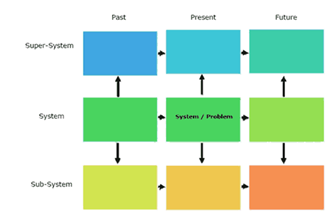
· What is 9 Window tool ? 9 Window tool is an innovation and thinking tool that comes from TRIZ (Theory of inventive problem solving). It helps to think through and identify, the current challenges, defining things in the past and future, to look at learnings and identify new innovative ways to design long term sustainable solutions · This 3x3 matrix can be further categorized into 3 levels – a) Super system (or system impacted by macro environment) – categorizes the external environment that the issue or product at hand interacts with or may interact with b) System – The current problems or the system (issue at hand) c) Sub – system – A component or parts of the problem or system Additionally the time period of Past > present> future can be defined based on the context of issue or system that is being resolved · How 9 windows drives solutions and idea creation? One of the most common challenges in driving innovation is the difficulty in defining a problem which needs to the solved. This is usually due to the complexity of the issue at hand and the psychological inertia. 9 windows methodology allows to break the conventional thought process of resolving the issue at hand in-short term, however look at redesigning the approach to accommodate future changes · Examples of Nine windows application – Problem statement – Organizations to plan for customer data protection in future product and service design. There is gradual shift in how consumers are reacting to organization using their personal/private data, without any preconditions. The lack of strong regulations makes corporations loosely comply with the law of the land, however in most cases the restrictions in how data is domiciled and who can controls this is very difficult to track and manage Past Present Future Super – System Governments or legal machinery was not focused on protecting consumer data and had provided corporations free access to how personal data is collected and used Law of the lands definitions of data privacy of customers is not well defined and is ever evolving Well defined laws, clearly articulating the do’s and dont’s of customer data protection, data retention and how data can be used System Consumable (product or services) were not designed to protect customer data privacy Non-compliance with the loosely defined customer data protection laws, resulting in litigations and government interference Non-compliance to local and international customer data protection law is unacceptable Sub-System Consumers are not aware or are not bother about how their personal data will be accessed, viewed and used by corporations Consumers are partially aware, however they do not read through the fine print of how corporations view, access and use their personal data Consumers are conscious on what data to share, how the data will be used, and what consumer can get in return for sharing their personal data Using the above example, organizations in the future will have the keep consumer data privacy in the core of their product or services design. Governments and regulatory bodies are drafting strict legal frameworks and laws to ensure the customer data is protected and only used with his or her prior consent. The shift on organizations focus will also bring in more transparency to the fine print that the customers acknowledge or approve, and also ensure that the customer is well monetized for the data being shared
-
The service recovery paradox (SRP) is a situation where it’s claimed that post-recovery satisfaction is greater than a service failure when customers receive good service recovery or after-sales service. There are conflicting results from the literature available on SRP. The one supporting SRP claims that a low-impact service failure and subsequent prompt recovery lead to higher satisfaction and vice versa. Hence, we can narrow down further on the impact of service failure on the value of the product or service paid by the consumer. To elaborate this with examples – a) A customer buys a Premium sedan and to his fate, the car breaks down or starts showing issues after 6months of use. Every time the user takes it to the service center, he is assured of prompt and good service. However, the customer is not satisfied with the product failing time and again, even though the service recovery is good. b) A customer is using amazon service to buy his day-to-day groceries and is happy with the timely and accurate delivery. It seldom happens that his orders are misplaced; however, rest assured the issue is fixed within 1-2 days upon registering a complaint. In this case, the dissatisfaction of the customer is low due to the value he/she is ready to pay for the product or service
-
Noise factors are concepts in Taguchi designs, which are inferred as uncontrollable factors in normal operating environments which cause variations. However, during experiments the noise factors are controlled or modulated to emulate different conditions. Few examples of noise factors are - Environmental factors (external), Product deterioration (due to environmental exposure). Noise factors are simulated in a controlled environment (for experiments) to test the product. There are also practices to compound different noise factors to produce extreme values and test the product robustness.