
MIsattar
Members
-
Joined
-
Last visited
Everything posted by MIsattar
-
In order to ensure that all critical checks, validations, and approvals are completed prior to the launch of an AI solution for a Customer Complaint Chatbot , There is a need to emphasis on governance, compliance, model integrity, transparency, operational security, ethical considerations, and ongoing oversight. These elements are important to certify that the system will meet the expectations. 1. Governance & Oversight Effective governance is fundamental for an AI deployment. The AI solution has to aligns with the organisation’s overarching AI policy, It should supports robust model lifecycle management which include and adheres to the relevant regulatory standards and guidelines. When defining the scope of the Project ,clear accountability for the AI system must be defined such as who is the owner, validator, business sponsor, and compliance officer. The Business Sponsor provides Final sign-off for accountability and role allocation. Additionally, it is essential that the AI system is properly registered as a critical application under the Risk Framework. 2. Regulatory & Compliance Checks The Compliance and Legal teams are responsible to ensure that the ChatBot demonstrate full adherence to financial regulations.Data privacy and protection checks are conducted to ensure use of data complies local regulatory requirement. Since we will be interpretating data to address customer grievances special attention need to be given on customer fairness and non-discrimination, The outputs to customer queries must be audited for biases across sensitive attributes such as gender, race, and age. This needs to be part of the Compliance department checks post the implementation of the system. 3. Model Development Validation When designing the Model it should undergoes rigorous validation to ensure data integrity and performance. The Data Governance Team will be responsible to validate the data source for accuracy, completeness, and traceability. The R & D team need to ensure that the Algorithm selection is scrutinised and that the chosen model is appropriate in the context of the Customer Complaints handling and aligns with risk appetite. Rigorous performance test is done against benchmark datasets to meet the expectation of customers in terms of output. Additionally, overfitting and stability are assessed through testing across various scenarios, and these checks require sign-off by an Independent Model Validator. 4. Explainability & Transparency Transparency is crucial for building trust in the AI systems. The rationale behind model decisions should be meticulously documented by the business Owner. To ensure accountability, there must be a clear audit trail for every prediction, with Internal Audit overseeing this requirement. Furthermore, the outcomes produced by AI systems must be explainable to customers, particularly in sensitive contexts. Both Compliance and Legal departments are responsible for ensuring customer-facing communications are clear and informative. 5. Operational Readiness & Security The Integration team does, thorough operational readiness checks prior to deployment. Integration testing validates that the AI system performs as expected within existing IT environments, with IT and DevOps teams responsible for this validation. Information Security ensure Access controls are checked so that only authorised personnel have the appropriate levels of access and that data is properly segregated. An incident management plan is defined to address potential issues, such as wrong information are being generated and given to customer thus creating more frustration and adds to reputational risk. 6. Ethical and Social Impact Assessment It is the responsibility of the Business Sponsor to includes a thorough evaluation of the AI system’s ethical and social implications. The Committee has to assesses potential social, ethical, and reputational risks. It is essential to ensure meaningful human oversight for critical decisions since the Bot will interact with customers. The Compliance unit has to build a Mechanisms for transparency, contestability, and recourse,inorder to ensure customers are treated fairly and can challenge or appeal decisions. 7. Deployment & Post-Deployment Controls Post UAT is done and concluded, and before the system goes live, pre-production testing has to be conducted in a sandbox or shadow environment this will validate the model performance and provides an assurance that the system is ready for deployment If all the key stakeholders mentioned above assume their roles and responsibilities in creating a robust system.
-
In a modern financial service environment, automated chatbots are increasingly used to assist customers in resolving issues. The scenario outlines a typical process for an Automated Dispute Resolution Chatbot, used to help a customer dispute a suspicious charge: 1. The chatbot verifies the customer’s identity using secure authentication methods such as multi-factor authentication or biometric checks. 2. Once authenticated, the chatbot accesses the user’s recent transaction history to identify the charge in question. 3. If the charge is indeed suspicious, the chatbot either files a dispute automatically or resolves it if possible, providing the customer with updates throughout the process. If a customer says “I didn’t make this charge, and the chatbot may incorrectly interpret the request as to cancel the card instead of to dispute the charge. Such a mistake can lead to unintended actions and disrupt user trust, and cause operational complications. The customer may feel frustrated or lose trust in the system. This can entail unnecessary card cancellations trigger downstream processes, such as reissuing cards and potential service interruptions. To minimise such failures, the AI system should actively monitor its own performance by making use of various self check techniques: · The chatbot should monitors user sentiment. Check if the tone is not normal or corrective phrases like “that’s not what I said”) , it should automatically triggers a check. · The AI cross-references the intended action with the conversation’s history to ensure logical consistency. · A secondary “monitoring AI” reviews the main model’s responses for deviations from expected conversational patterns or frequent need for human correction. The following remedials actions can be triggered when a mistake is identified · The Application should acknowledge the error in understanding the customer clearly. And reiterate the wordings from the customer to make sure that it has correctly understood the request · The system logs the event with a human-readable summary for later review by support staff. · Avoid silent corrections or opaque phrasing that could mask the issue from the user. How we rate the AI failure is dependent on the severity and confidence in its understanding: 1. There is a need to escalate the isse to a human agent for remedial if the confidence remains low or the consequences of an error are significant (such as financial or security implications), The agent receives the full conversation context and a trace of the AI’s reasoning. 2. Every misclassification is tracked and fed back into the system’s continuous learning loop, allowing for ongoing fine-tuning and improvement to prevent similar errors in the future. Deployment on an AI solution requires not only robust design but also continuous improvement and adaptive strategies which in turn can maintain Trust and minimize operational disruptions.
-
At the bank , we are located in 6 countries and this implies many travels planning that should be done for projects and workshops or even high level meetings. Each country has its own Travel Desk to handle all the arrangements in terms of Booking , approvals , expenses and pre Travel briefing and post review . An AI tool can be implemented to assist the desk in this process to bring in a greater standardization and effectiveness in managing the expectations. The Travel process includes the following end to end process Travel Request Submission Manager Approval Travel Booking (flights, hotels, transportation) Travel Insurance & Documentation Pre-Travel Briefing (risk, local policies) Expense Reporting & Reimbursement Post-Travel Review / Audit Below are some possible ways that AI can bring in greater standardisation in the above Travel process Travel Request Submission We can use AI chatbots to guide users to fill in policy-compliant request forms Manager Approval The AI application can recommends approval based on historical data, urgency and budget allocation Travel Booking (flights, hotels, transportation) The AI-Tool can do a search on travel platforms and suggest the best options that respect the policy guidelines Travel Insurance & Documentation The tool will also ensures that all travel documents meet visa, insurance, and policy requirements Pre-Travel Briefing (risk, local policies) The Travellers can rely on the AI tool to generates region-specific travel advisories (health, legal, weather) so that they are well informed on the country they are visiting Expense Reporting & Reimbursement With the use of OCR + AI tool . the travellers can upload their receipts so that the application can check if they are eligible checks against policy and ultimately proceed with automated reimbursement Post-Travel Review / Audit The tool will also allow management to flags non-compliant bookings or overspending patterns with generation of Audit reports per employee Given that the above covers the global policies and guidelines that the tool can aligned and standardise, there are also certain standards that can be maintained location wise like · Providing the currency conversion and real time Real-time accurate expense tracking · Given different geographies, implies dealing with different languages the AI tool can help with auto translation of SOPs and policies. · The tool can also recommend preferred vendors per regions based on ratings and reviews from other travellers. · The tool also ensure adherence to local laws On the Management level , with the implementation of of an AI tool to handle the Travel process , it helps to have an oversight of · Monitor travel costs by region · Flag high-risk destinations · Track policy compliance rates · Visualize approval bottlenecks To conclude, AI can definitely support greater standardization without stifling local adaptability in this process.
-
We are in Mauritius working as a shared service for five countries in Africa.The Service Delivery team has the responsibility of performing the End of Day process for all the countries. This process entails some pre requisite that the shared services team need to take into consideration in order to perform the End of Day process for each country seamlessly. 1. Respecting the time zone of the countries 2. Shared Services being located in Mauritius is 2 hours ahead of the countries. 3. Planned and unplanned holidays in countries 4. Planned and unplanned holidays in Mauritius 5. Labor law in all the countries and Mauritius 6. Duration of the End of Day process based on the volumes of the day. Nowadays AI intrusion in workforce scheduling and planning has become a trend that most organisations are adopting. At the bank, if we adopt AI scheduling to the above scenario it would bring more efficiency and fairness for the employees. The factors mentioned below would be essential to ensure its efficiency and fairness. 1. Regulatory landscape Each country has its own regulatory boundaries and labor law that we will have to feed in the system so that when allocating resources , it does not breach any law. Even from Mauritius , the Managers has resources located in Africa and India. They need to review the scheduling to ensure it is fair for all the staffs reporting to them. 2. Integration with Payroll and Time Sheet The AL solution will have to integration with the current Payroll system of the bank so that the employees leaves and shift roster are sync up.It should also allow to upload the time Sheet of the employees so that the application can deifne the trend and pattern on the employees performance and pace of execution . There is no need for manager to cross-check or intervene. With these data the entire employee lifecycle can be detailed out which give leadership a clearer view of workforce performance and cost drivers. 3. Decision-making transparency One of the challenge with an AI tools is that if scheduling are done and assigned without showing its logic, this can affect the level of trust with employees and managers alike.. This clarity reduces complaints, improves adoption, and supports a healthier scheduling culture. 4. Access to mobile The AI solution should be available as an app on mobile as it is more convenient to let employees check schedules, submit time-off requests, and swap shifts on the go without having to check using a desktop. Having the above embedded in the AI scheduling software allows to optimise by eliminating hours of admin work with automated shift creation, availability matching, and schedule distribution. It assist to avoid unnecessary overtime, overstaffing schedules. There is also a cost saving attached to it due to better shift alignment and reduced overtime. Whether there is a need to adjust due to an unplanned holiday surge, or sudden weather deterioration , the system anticipates and recommend the most appropriate scheduling . By adopting this AI solutioning to the End of Day process , will make a positive impact on workforce optimization.
-
In today’s world , we have to manage the customer’s expectation and perceptions when interacting with AI across digital platforms . At the bank , we do have the Customer kiosk for the customer to trigger any request . With the help of a virtual customer assistants which combines NLP and ML it may create human like interaction in a more personalised way whereby it handle complex tasks for the customer without crossing boundaries of privacy or trust. The AI solution acts as a self service tools which recognize the preferences of the customer and make relevant suggestion to add value in the interaction with the customer. With the use of predictive analytics, the AI solution looks at the past behavior of the customer and compares it to real time patterns to figure out what the customer needs and suggest some recommendations. By analyzing customer data and behaviors, The AI solution can deliver highly personalized recommendations, responses and support tailer made recommendation to the individual customer needs. In this case, based on the previous loans taken or pattern of transactions done using their card, the AI solution can help the customer to take a decision easily. The AI solution can predict when customers might encounter problems and offer solutions before they even realize there’s an issue, increasing customer satisfaction and loyalty. The AI tools can read the tone and emotion in a customer’s message. With sentiment analysis technology the AI solution evaluate language cues to understand how someone feels, whether they’re angry, frustrated or happy. This helps to respond faster to unhappy customers and handle tough conversations with more care. In the event there is an issue in their account and some wrong transactions was done, then the AI solution To summarise , the evolution of AI as a simple Chat bot which interact with the customer on simple FAQ has transform over the time to a more human like interaction which is more personalised and sets its boundaries.
-
There is a Ticketing process at the bank to handle requests coming to Service Delivery team. They do the filtration of these tickets and allocate all issues or new request raised to the respective clusters for resolution. This is a domain where the use of an AL solutions will definitely helps out to transform knowledge into a competitive advantage. Below points highlight how we can make use of the Ai solution to integrates the process 🔍 1. Intelligent Ticket Classification & Routing Using AI , the categorisation of the issues and request can be done without manual intervention. Since at times the triage is not done in a consistent and regular basis. This can improve the routing time and improve time resolution rates.Based on the information provided , the tickets gets routed to the right support team based on historical resolution patterns 📊 2. Predictive Analytics for Incident Management The advantage of using AI, helps predicts recurring issues before they get escalated and it flag them so that appropriate action can be taken in time . Some critical example like adding on space on database or addressing recurring network issues helps to maintain stability of the systems and applications. 🧠 3. Knowledge Base Optimization When technicians resolved Tickets , they provide a resolution to the issue or incident raised. With the AI agent, a knowledge database is created with all the steps provided at the resolution stage and this helps when similar past incidents are raised, users can make reference to the recommended solutions, this will in turn reduced the volume of tickets getting loaded to the service delivery team, it acts like a self service portal. 🤖 4. Conversational AI & Virtual Agents In an environment where there are lots of applications spread across different countries, it is cumbersome to handle common IT requests like (password resets, access issues). Embedding the required steps in the AI agent help to assist users in handling these L1 support with the introduction of a ChatBot. Given that we worked in different time zone across 5 countries, The Chatbot provide support 24/7 just reducing the dependency on human agents. On top of it, with the interaction with users, it improves the quality of the response over time. 📈 5. Performance & Compliance Monitoring Most of the time, when handling tickets , we do noticed long overdue items which have crossed SLA since there is a delay in assigning the ticket and get it to closure, the AI solution helps to monitor the adherence to the SLA set and regularly provide a feedback to the requester which when manually done, the technicians does not revert back on time and thus creates frustration among users. Feeding the AI solution with banking regulations and internal policies, ensure that when resolutions of the tickets are captured, it is in line with the internal and external policies. 🏦 6. Competitive Edge for Banks Making use of the AL solution with the ticketing system, helps to enhance operational efficiency and deliver faster and smarter support to the internal and external customers. It also reduce the cost of adding additional resources to handle tickets and improves the service quality . In a nutshell , Making use of AI to manage the ticketing process helps in terms of using the data coming out from these tickets getting raised into useful information for the clusters and the bank . It ensure that anomalies are flag faster and helps the bank stays compliant. It also enhance customer Trust which is a competitive edge, since faster internal issue resolution leads to better customer service. Most importantly with its predictive capabilities it reduce the occurrence of downtime of critical systems which ensure operational resilience.
-
An AI agent designed to support decision-making for managers could assist with a variety of complex issues. To ensure its advice is reliable and aligned with organizational goals, specific checks would need to be built into its design and implementation. The AI agent is replacing the role of the Secretary and Business planning Manager for C level. All the planning and administrative tasks done by these roles are being replaced with the AL Agent, the latter does the planning and provide insightful recommendations to the C level for decision making. Decisions to Assist With An AI agent could be a powerful tool for assisting with data-intensive and high-stakes decisions where human cognitive biases or time constraints could lead to suboptimal outcomes. Examples include: Supply Chain Optimization: The agent could analyze real-time data on inventory levels, and demand forecasts to recommend the most cost-effective and efficient distribution strategies. This goes beyond simple automation by adapting to dynamic disruptions .In our organisation , which is represented in five countries across Africa, analysis of real time data is crucial to quickly overcome unexpected scenarios. Talent acquisition is a tedious task when making hiring decisions, an AI could evaluate candidate profiles against the department requirement from a vast dataset of employee to identify individuals with a high probability of success in a new role. This can help mitigate unconscious bias in hiring. The agent could process and synthesize a market research and competitor analysis, to recommend the optimal geographic regions or product categories for the company's expansion. In terms of logistics acquisition like Laptops , PC ,AC , the AI agent would look for the best cost effective option to choose from which at time it is oversight by the human analyst working on it. For the AI's advice to be trusted and effective, these checks are mandatory and crucial: 1. Explainability and Transparency The AI should not be a "black box." As mentioned in the previous answer provided on whether it is a black box or glass box .It must be able to explain the reasoning behind its recommendations in a clear and understandable way. For example, if it recommends a new supplier, it should be able to show the specific data points—such as historical on-time delivery rates, cost comparisons, and risk scores which helps to come to a conclusion. This builds user trust and allows managers to interpret the advice within a broader context in committees and clients meeting. 2. Human-in-the-Loop Validation The AI agent should function as a co-pilot, not an autonomous decision-maker. Nowadays the co pilot functionality of Micosoft 365 has become a powerful tool used in the organisation when doing meetings on Teams, the minutes of meeting and summary of the long conversations done are easily summarised and make up to the point. The manager would then use their domain expertise, emotional intelligence, and contextual understanding . This is a quality the AI lacks to make the final judgment call 3. Goal-Weighted Metrics The AI's objective function should be weighted to reflect organizational priorities. Feeding the AI tool with the organisation strategic plan ensures that when decisions are taken , it is abiding to the company core values. 4 Ethical Constraints The system must have built-in ethical checks to prevent recommendations that could lead to unfair or biased outcomes. Given that we operates in different markets with a mixture of people from different ethnicity , the AI is specifically trained to avoid making decisions based on protected characteristics and to flag any potential bias in the input data. These checks turn the AI from a simple tool into a collaborative partner, empowering managers to make better-informed, more strategic decisions while maintaining accountability and ethical oversight.
-
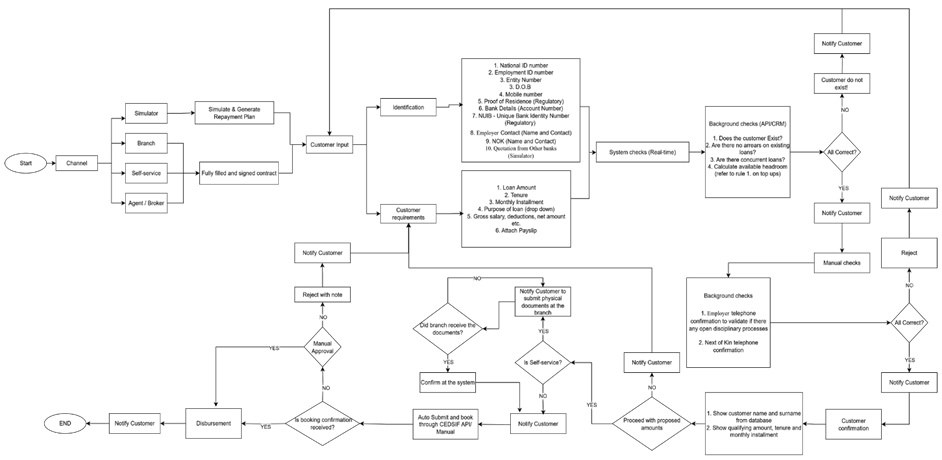
The Process that I would elaorate on would be the Loan origination / Management system that encompass the interaction of the system with below players . Either the solution is a black box to them or it is transparent and up to what extent they can can draw the line of explainability and simplicity . The key stakeholders involved included 1. the applicant , 2. the loan officer / Manager processing the loan. 3. Underwriter who is there as a second line of verifier The AI agent in below process touch point at key stages where decision and assessment are done. 1. The Applicant interaction with the AI agent A way to avoid long waiting time in branches to get serve for a loan request is to use the AI agent via the available channel put in place by the bank which could be via mobile or on the website. In terms of Transparency and simplicity, the applicant interacts with the chatbot and ask queries that he /she would have ask the branch staff in order to take a decision. The system will keep the response simple for the applicant to understand it in a layman terms. For the applicant given that they will not get all the analysis done in detail, it is like a blackbox to them on the decision taken, In the event it is a positive response to their request for a loan its fine , but when it gets rejected , then rational behind the rejection is not clear to them 2. The branch staff retrieving the details of the applicant For the branch staff , it implies the degree of interaction with the system , how knowledgeable they are with the AI agent . the front lines normally are all the time taken up with many tasks at the same time and they take the output and analysis of the system since they just want to get a quick answer and move it to the next level which is the underwriting team, This is where the gap prevails and the applicant and the branch staff are not able to have a clear conversation on the outcome of the request 3. The underwriter second layer of verification The system will come up with the eligibility of the applicant and will have some keys parameters set by the bank to filter good or bad customers who can be eligible for a loan In reality there are certain events that can allow for a leap way for an applicant to get the loan approved which the AI agent will reject based on the information provided on its configuration. The underwriting team have the in & out of the criteria to accepts and put forward to the committee for approval. These information does not go back to the branch people or event to the applicant as it can be taken as a given for most of the reject cases. Thus the balance of ex explainability and simplicity is vital to make it succesful and workable for the bank and the applicant As a conclusion , the system helps to moderate the expectation of all the key stakeholders involved in the process, but should not be the sole reason to take the final decision. The bank has to play the role of the good cop and bad cop as and when required
-
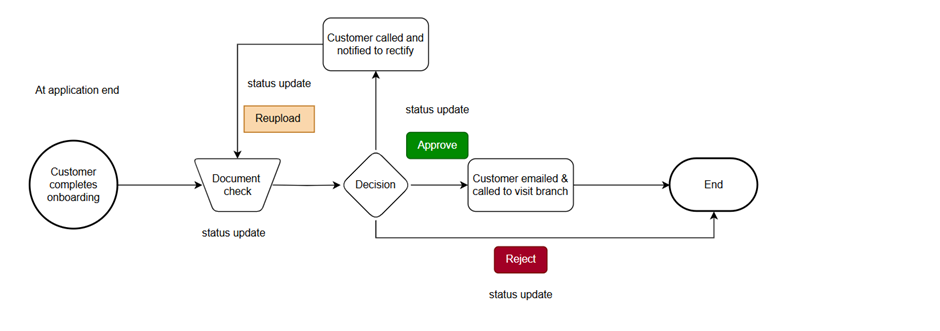
At the bank we have a clearly defined handing over process when a solution is deployed. From the development to the User testing and approval to deploy in Production. The Application team together with the Project Manager ensure that a proper handling over milestone as part of the project closure is done when the Application is handed over to business. In the project framework, when the project closure is done proper documentations are provided and most of the time, the application owner is the key stakeholder owning the application post-deployment. For example, we have recently deployed a self-onboarding application using AI. This allows the customer to initiate the process without having to go to a branch and wait in the queue to get served. Below process map depicts the different stages where AI facilitates the interaction with customer without the bank having to allocate additional resources to assist the customer. The following key components are documented as part of the hand over which happen when the solution is stabilised and working fine. 1. Technical Documentation 2. Operational Documentation 3. User Manual 4. Train the Trainer ( Champion ) 5. Performance and Monitoring 6. Governance and ownership 7. Change Request 8. Compliance and data protection policy 1. Technical Documentation The Technical team will prepare the release documents which will includes the rational behind the design and architecture of the application. Data sourcing , regular updates and what third party tools used to transform raw data will be included as part of the documentation Setting up of the different environments like the Production /Disaster Recovery/ User acceptance testing , all these environment will be needed to maintain a long term stability of the application. All these information will be useful for Audit review purpose. 2. Operational Documentation Deployment plan and rollout plan will give and overview of how it was deployed and how it can be roll back in case of malfunction of the system . Configuration set up and access rights given to which roles are important facts to allow for future references in the event of troubleshooting . 3. User Manual Both Technical and Functional documentations are required as part of the handover. This helps for a better understanding of the functionality of the system and limitations. The input required from business side in terms of mandatory fields and what should be the output are mapped in these manuals . Well defined guidelines are published in order to maximise on the usage and its potentials and just the solution can keep its effectiveness in the process. 4. Train the trainer ( Champion concept) With the deployment of the solution, it is important to have workshops and training done with both , the technical and functional users. This is done to showcast the capabilities of the system.Identifying champions in each key departments allow to form users as subject matter experts, these people will be the L1 support for assistance to queries from users and customers. Building up FAQs and feed the AI solution allow the customer to interact with a chatbot for basic level of request and queries 5. Performance Tracking and Monitoring Clearly defined Performance Metrics and Key performance indicators (KPIs) meticulously agreed upon during the development phase set as a baseline metrics for future performance evaluations. We do have Monitoring Dashboards which provide valuable insights into the system performance and complemented by Red Flag alert mechanisms in the event of significant performance degradation, data drift, or service interruptions. . 6. Governance and Ownership As part of the handling over of the solution , the different roles and responsibilities need to be properly defined which ensure continuity and scalability. The following key stakeholders need to fulfil their part of the process. • Product Owner that ensure overall business alignment and budget management with organizational goals. • Technical Owner that ensure regular ongoing maintenance of the infrastructure and implementation of critical updates. • Data Owner that ensure the accuracy, integrity, and availability of data necessary for the AI system's operations. • Support Team which is a dedicated group tasked with addressing user inquiries and providing solutions to minor issues, fostering a smooth user experience. • Escalation matrix which is important and clearly mapped out procedure for escalating issues, ranging from operational glitches to critical model performance challenges, along with designated contacts for first-line, second-line, and third-line support. 7. Change Management Every changes requested by business need to go for proper approval process in order to maintain a consistency in the modus operandi of the solution . The changes should go through the Change Management process which follows ITIL framework. 8. Compliance and Ethical Considerations Data Privacy Detailed documentation outlining the methods used to handle personal or sensitive data, including robust practices for anonymization or encryption to protect user privacy is critical to the success of the deployment . All the above checkpoints are done in order to maintain clarity and completeness of the solution deployed,
-
The Bank has a Complaint Desk, comprising of a Complaint Officer and a Coordinator, working under Retail unit and reporting to Head of Retail. This is a unit that has lots of manual steps in its process and involvement of multiple staff within the bank whereby the collaboration of Human and AI is a must. The process starts from the different channels that the bank has , where it can register complaints or a request from the customer via 1. Face to face by customer 2. Through phone 3. Through email 4. Website 5. Letters / Suggestion Box The nature of the request can come in the form of a query or a complaint and this is where there is a filtering done by the person acknowledging the request in order to decide on its nature : 1. Inquire on type of complaint. 2. If query; 2.1 liaise with staff /department concerned. 2.2 To respond to client immediately and resolve issue. 3. If it is a complaint, 3.1 To ask client to sign a complaint form 3.2 Inquire on the issue, root cause, details from branch staff concerned or relevant department. 3.3 Escalate to Complaint desk by email under copy to Head of Retail. 4. Issue letter to client upon advice from Complaint desk 5. Log on LDC in case any operational loss 6. Prepare paper for approving authority in case of any refund to client. 7. Send letter to HOR for 2nd signature. Each department or unit has its own way of handling the request or complaint in the following way: 1.1 SME Level 1. If it is a complaint, 3.1 Received by RM, he/she shall handle the client & resolve the issue 3.2 If issue not resolved, log on to complaint ticketing system IN most of the cases, complaints are received through mails or website. Based on the fact it is an administrative activity, IT operator channels these request to Complaint desk, who in turn sends mail to SME unit for inquiry. 1.2 Corporate Level 1. Once a Query/complaint is received at the unit, same is sent to HOD. 2. HOD sends to the respective RM looking after the portfolio of clients for whom the query/complaint was received. 3. Matter is tackled at RM level after consultation either within the department or with any other department concerned with the case and HOD is copied/informed of all steps/progress. 4. Copies of the correspondences pertaining to the complaint are kept in file. 1.3 SAM Level 1. Most of the time Complaints desk channels complaints to SAM 2. HOD SAM refer the complaint to the RM in SAM handling the file. 3. RM calls client & tries to resolve the issue. 4. If unresolved, escalate to HOD 5. HOD tries to resolve the issue, talk to client 6. Letter is sent to client 7. Update Complaint desk Ultimately all request or complaints are channeled to the complaints unit and the internal process requires lots of follow up to ensure prompt response to the customer 1. Upon receipt of complaint, the details of the complaint is log on an excel format. 2. Then Identify whether it is a query or complaint. 3. Inquire & follow up with respective business unit 4. If matter resolved, update the excel 5. If unresolved, escalate to senior management 6. Prepare letter to customer 7. Prepare reports for Complaint forum (Compliance) 8. In case of any compensation, give assistance to Business unit to prepare paper for approval. 9. Prepare reply letters to regulator for cases reported by them 10. And report submission on a monthly or quarterly basis. In all the above units , either the RM/HOD/Complaints officer and Complaints coordinator are involved in handling the request of the customer. If AI has to be introduced to this process , then the following changes will happen in the process and certain activities within the roles of the front liners will be changed or eliminated. Nowadays the use of mobile and website are more adapted to the trend of live of people. And more and more people make use of these means to send their request With the introduction of AI, The activities at the initial stage which determine whether this is a complaint or a query can be handle by AI just by feeding in some parameters for the system to be able to channel the request to the appropriate stakeholder Also the frontliners like the branch staff will not have to attend to this tasks of sending this to the department or stakeholder concerned and do a follow up By providing some filters at time of input by the customer can already save the bank time and resources to complete this task. On top of it also , due to regulatory requirement, the bank has to acknowledge the request or complaint from the customer within a minimum delay. Which at time if done by human , this can be omitted or done outside the SLA The recording and tracking of the request or complaint will be done by the AI without anyone having to log the record on the system . This also reduced the tasks of both the officer and supervisor who are involved in the creation , verification and allocation of the ticket. On the reporting part , whereby the bank has to send a report to the regulator on a monthly or quarterly basis, this can be handle by the system through AI. In a nutshell the collaboration of Human and AI works smoothly in this scenario, since some optimization of the existing process was done to eliminate manual intervention as far as possible through AI , thus allowing the different players in the process to have more time to spend with the customers. For this process, the roles of the different stakeholders might not change drastically, it might be that some training to the OLD school ageing staff is needed, since they will have to adapt to the new process in collaboration with some of the steps being done by AI instead of Human.