

Topics
-
The latest setback has fueled worries that Google was losing momentum just as OpenAI and Anthropic and a host of Chinese rivals have accelerated the pace of model releases. On the call on Wednesday, Pichai struck an unusually defensive tone as analysts pressed him on the state of Google's frontier models and whether they could still compete at the cutting edge of AI development. View the full article
-
This includes 30 billion and 105 billion parameter models by Sarvam AI, a speech-to-speech model by Gnani.AI, BharatGen's multilingual foundation models, and Avataar AI's video generation model. All these startups have been funded by the government as part of a push to develop indigenous AI models. Of the 20 models, five have been released so far. View the full article



Leaderboard
-
Vishwadeep Khatri
Administrators1Points6,717Posts -
Shraddha Sequiera
Lean Six Sigma Black Belt1Points10Posts -
P Balakumaaran
Members1Points13Posts


Popular Content
Showing content with the highest reputation on 06/06/2022 in Posts
-
Six Sigma expert specializes in efficiency and management as they would always look at maximizing output, minimizing cost whilst not compromising on Quality. A mater black belt acts as a leader and is able to develop and design the path of internal leaders, other six sigma specialist and management as a whole. He acts a guide in right selection of project until its executed and delivered with quantifiable impacts. The various roles that a Master Black belt can opt for Project Manager Strategy building & Management Business Excellence Quality Management Change & Transformation roles Process Excellence/Re-Engineering roles Risk and Compliance roles Re-Engineering and Transformation roles can be more challenging High Risk May not be replicable Each company will have their own challenges & shortcoming Different Priority for Leader in Management Resistance to Change Business Excellence & Quality Management can be more rewarding Not limited to a specific Industry Free Lancing is possible Helps in increased profits, CSAT levels, Employee satisfaction levels Encourage innovation1 point
-
1 pointWhile both points of view can be supported, I believe that the second statement is more apt - A process with higher maturity opens door for many rapid DMAIC sequences. A process that is low on maturity is usually hard to approach with DMAIC type sequences for two reasons. DMAIC is very time consuming for such processes. Unreliable data and lack of standardisation makes it hard to even define and measure the problem areas. While all approved answers are appreciable, I liked Balakumaaran's response the most. He is the winner for this question.1 point
-
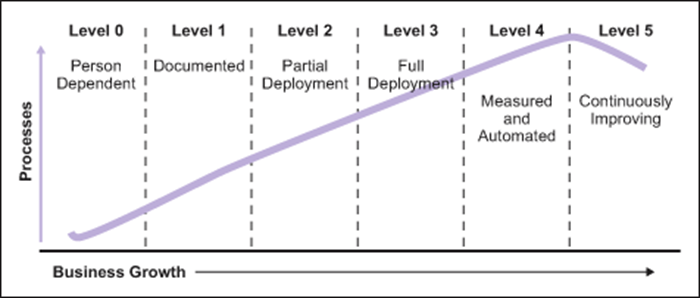
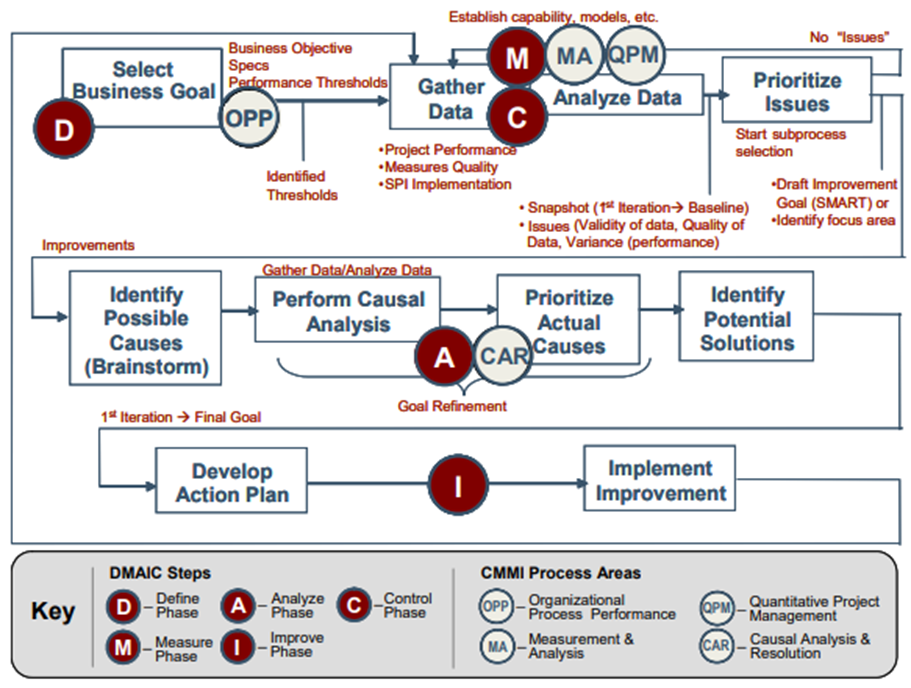
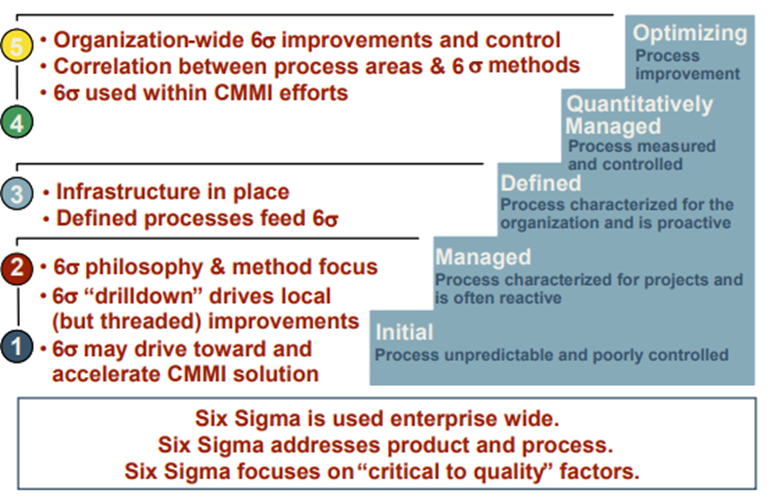
1 pointProcess Maturity Model involves 6 stages : Level 0 – Person-Dependent Practices Level 1 – Documented Process Level 2 – Partial Deployment Level 3 – Full Deployment Level 4 – Measured and Automated Level 5 – Continuously Improving We cannot compare between CMMI and Six Sigma. Simultaneous implementation of these concepts in an organization produces a synergy that helps in the successful accomplishment of company goals in a faster, better, and cheaper way[4]. Some companies use integrated process architecture to integrate CMMI and Six Sigma. Such integration could take four approaches: · Implementation of CMMI to the highest level to establish systems and processes based on established best practices. Then, these practices are followed by implementation of Six Sigma to fine-tune such processes based on customer expectations and to continue with needed improvements. · Implementation of Six Sigma as the governance model first, followed by using CMMI to close problematic gaps in process infrastructure. · Simultaneous implementation of CMMI and Six Sigma by using CMMI to identify critical process factors and deploying Six Sigma frameworks in such critical factors, or using Six Sigma to identify areas where CMMI is required. · Implementation of CMMI Level 3 to establish defined processes and then establishing Six Sigma to seek higher CMMI maturity levels. Six Sigma enables the successful implementation of CMMI, or accelerate the transition from one CMMI level to another. The best approach is chosen based on the organization’s circumstances. The overall relationship between Six Sigma and CMMI The relationship between CMMI process areas and the DMAIC framework can be summarized as follows; Relation 1: CMMI Process Areas, DMAIC Steps, and Generic Practices Several CMMI process areas and generic practices align with DMAIC roadmap steps. The diagram in Fig 4 shows a flowchart of an organization’s overall measurement process, overlaid with DMAIC steps and selected process areas. While this organization’s process was designed with model compliance in mind, it represents an integrated approach to the overall use of measurement instead of a replication of the specific practices of each process area. Similarly, this organizational process leverages ideas of DMAIC, but is not a replication of the DMAIC steps The relationship between CMMI process areas and the DMAIC framework can be summarized as follows; Relation 1: CMMI Process Areas, DMAIC Steps, and Generic Practices. Many CMMI process areas and generic practices align with DMAIC roadmap steps. The diagram shows a flowchart of an organization’s overall measurement process, overlaid with DMAIC steps and selected process areas. While this organization’s process was designed with model compliance in mind, it represents an integrated approach to the overall use of measurement instead of a replication. Similarly, this organizational process takes the ideas of DMAIC, but is not a replication of the DMAIC steps Relation 2: CMMI Project Management Process Areas and Six Sigma Project Management The CMMI process areas involving project management can be leveraged in the management of Six Sigma projects. This enables Six Sigma project teams to rely on the organizational norms for things like project launches, resource commitments, and schedule tracking. The process areas that can be useful in this context are • Project Planning (PP) • Project Monitoring and Control (PMC) • Integrated Project Management (IPM) • Organizational Process Performance (OPP) (for organization-level execution, management, and oversight of the aggregate set of Six Sigma projects) Relation 3: Incorporating DMAIC Steps within CMMI-Based Processes As alluded to , aspects of DMAIC can be incorporated into the fabric of an organization’s process. As such, it would become part of the organizational approach and should be documented within Organizational Process Focus (OPF) and Organizational Process Deployment (OPD). Relation 4: DMAIC-Based Improvement of Process Areas All CMMI process areas are eligible for DMAIC-based improvement. For instance, the measurement process was created based on CMMI but also contained aspects of DMAIC. The defined process for measurement in that example, and for other processes defined based on each of the other process areas, could also be improved by applying multiple iterations of DMAIC. DMAIC & CMMI Maturity Level: When considering the implementation of DMAIC alongside a staged implementation of CMMI, You may wonder what a DMAIC methodology might look like for an organization at a lower maturity level. When at a lower maturity level, this selective improvement likely means conducting improvement projects in subsets of the organization, for instance in a specific development project, group, or product line. These projects can be managed as pilots for potential institutionalization across the organization. Case 1: A process with higher maturity provides lesser opportunities for DMAIC Case 2: A mature process open doors for many rapid DMAIC sequences I agree with Case 2. A process with higher maturity level / mature process, exhibits a well-defined system being followed and this gives a lot of opportunities to work on DMAIC in a stable environment. Both Process Maturity and DMAIC are a Continuous Improvement & never ending methodologies. Process maturity improvement happens continuously and this can be done as a DMAIC project. Not only DMAIC, it also open up the doors for DFSS / DMADV, TRIZ, and other detailed and focused improvement techniques.
 1 point
This leaderboard is set to Kolkata/GMT+05:30