All Activity
Past hour
-
AI notetakers offer convenience but pose significant data privacy risks. These tools convert all spoken words into searchable data, potentially exposing sensitive information. Companies may store or use meeting transcripts to train their artificial intelligence models. Individuals should assert privacy rights and understand data storage policies before use. Asking for consent and establishing clear boundaries ensures meeting confidentiality. View the full article

-
EY India has launched its new Cyber Performance Management platform. This integrated platform quantifies cyber risk for enterprises in real-time. It uses artificial intelligence and cybersecurity on a single window. The platform helps organizations analyze and govern cyber threats before attacks occur. This empowers leaders to make decisive choices and build resilient organizations. View the full article

Today
-
Nearly 762 AI application suggestions are being evaluated by Meity from various ministries. Discussions will soon begin with stakeholders to draft new AI regulations. Existing IT rules have addressed initial concerns regarding deepfakes and synthetic content. Stricter disclosure norms for AI-generated content are also being proposed. India is tightening its IT rules to firmly crack down on AI deepfakes. View the full article

-
In an interview with CNBC on Thursday, Altman said the ChatGPT maker had a “collaborative back and forth” with top US officials, including Commerce Secretary Howard Lutnick and Treasury Secretary Scott Bessent, in the weeks leading up to the wide release of GPT-5.6. View the full article

-
Newspapers have asked a federal court to sanction OpenAI for allegedly lying about its AI training data. They claim OpenAI falsely stated it could not search its systems for copyrighted articles. This comes as OpenAI is accused of misusing millions of news articles without permission. The newspapers seek attorneys' fees and a court finding of misuse of their works. View the full article
-
Prateek _Harsh_dl5h replied to Vishwadeep Khatri's topic in We ask and you answer! The best answer wins!I support View A — deploy the AI vision system — but on tighter grounds than “safety trumps cost.” The real argument isn’t that consumer’s risk always dominates producer’s risk. It’s that on a safety-relevant part, the two failure modes are not symmetric in kind, only in dollar count, and the scrap cost View B worries about is an engineering variable while the escape cost is a tail-risk variable. You can retune a threshold. You cannot retune a fatality. The reasoning View B is missing: these two costs don’t compound the same wayView B compares $3.8M/year certain scrap against a “rare, speculative” recall exposure and concludes the certain cost should win. That’s a category error. Run the numbers the scenario itself gives you: • Escapes with AI: 28/month → 336/year. At 1-in-50 severity odds, that’s ~6.7 severity-triggering escapes/year, each with a $1.5M–$3M exposure → expected annual exposure ≈ $10M–$20M, before counting stop-ship penalties or OEM relationship damage. • Escapes with humans: 240/month → 2,880/year → ~58 severity-triggering escapes/year → expected annual exposure ≈ $86M–$173M. So the AI doesn’t just cut the count of escapes by 88% — it cuts the expected-value cost of the tail risk by roughly the same 88%, from a ballpark $86–173M/year down to $10–20M/year. That swamps the $3.8M scrap delta by an order of magnitude, even using conservative severity assumptions. View B’s framing (”$3.8M certain vs. a speculative tail event”) only looks reasonable if you refuse to multiply probability by consequence — which is exactly the calculation a safety-relevant Tier-1 supplier is contractually and morally obligated to do (this is the whole logic behind FMEA/PPAP severity-occurrence-detection scoring in IATF 16949). Scrap is also the reversible variable. You can re-thresholds a model in weeks. You cannot un-ship a brake part that failed in the field. Real-world evidence 1. Sandia National Laboratories — human inspection has its own false-reject problem, even at its best. In a peer-reviewed 2015 study, 82 trained inspectors in the U.S. Nuclear Security Enterprise — arguably as rigorous a human inspection population as exists — inspected 140 precision parts. They correctly rejected 85% of true defects but incorrectly rejected 35% of good parts to get there. This is the same trade-off your scenario shows: humans don’t have a free lunch on false rejects either; they just have worse detection and still scrap good product. It undercuts the premise that “keep humans” avoids the yield problem. 2. BMW Group’s AIQX system. BMW deploys AI-based automated image recognition (AIQX, built with Axis Communications network cameras) across its global BMW iFACTORY plants for crack, paint-defect, and mislabeling detection, explicitly to catch defects human inspection was missing and to eliminate “pseudo-defects” (false flags) through retraining — i.e., they built the false-reject-reduction loop into the deployment rather than treating it as a reason not to deploy. 3. BMW Regensburg. BMW’s Regensburg plant now uses generative AI to automate bespoke quality inspections on a mixed-model line, specifically because rule-based systems couldn’t keep pace with variant complexity — a direct parallel to your Tier-1’s need to hold a tight safety spec across volume. 4. The GM ignition-switch recall (2014). GM concealed and then had to recall ~2.6 million vehicles for a defect ultimately tied to 124 confirmed deaths, paying a $900 million criminal settlement plus ~$600M in a victim compensation fund, on top of billions in related charges. The root defect could reportedly have been fixed for $0.90 per part. This is the canonical illustration of View A’s core claim: escape costs are not linear with scrap costs — they’re a different order of magnitude, and they don’t stay contained to “engineering.” 5. GM’s 2020 Takata airbag recall. GM recalled 5.9 million SUVs/trucks over faulty Takata inflators at a disclosed cost of ~$1.2 billion — about $14,000 per recalled vehicle. Compare that to your AI’s added scrap cost of $40/unit. One severity event at that scale would fund roughly 30,000 years of your incremental scrap bill. 6. Ford — the strongest real-world case for this exact scenario, evidence and counter-evidence both included. Ford built two in-house AI vision systems, MAIVS (Mobile Artificial Intelligence Vision System, launched January 2024, using iPhones mounted at inspection stations) and AiTriz (launched December 2024, continuous video-based CNN inspection sensitive to sub-millimeter misalignments). By mid-2025 the two systems were running at roughly 735 stations across North American plants (about 90 AiTriz nodes plus close to 700 MAIVS stations). Built on IBM’s Maximo Visual Inspection platform, the combined system had performed 150 million individual inspections and flagged 400,000 quality issues that a human worker may have missed — a concrete, company-reported escape-detection gain at real production scale, not a lab estimate. Ford’s own framing for why it built this: the automaker has led the auto industry in total vehicle recalls for three of the last four years (second only to Stellantis in 2024, and again leading through mid-2025 with 82 recalls), and warranty costs have been a persistent drag on earnings — i.e., a real company with a real escape-cost problem, choosing to expand AI vision, not retreat from it. 7. Peer-reviewed literature base. A January 2026 systematic review in Sensors covering 50+ studies across automotive, aerospace, and general manufacturing found ML-based vision inspection routinely exceeds 95% detection accuracy in live production, with some configurations at 98–100% — consistent with your pilot’s 99.3%. The same review found 77% of deployments remain stuck at pilot scale, mainly due to integration and threshold-tuning challenges — not because the underlying detection case doesn’t hold up. 8. Cost-of-quality baseline. Industry cost-of-poor-quality data consistently shows that the cost of a defect escalates by roughly an order of magnitude at each stage it travels further from the point of manufacture (in-plant catch → dealer/field catch → recall/liability). That escalation curve is the underlying reason the 1-in-50 severity assumption in your scenario, even though it looks small, should be weighted far more heavily than a per-unit scrap number. Countering View B directly• ”$3.8M certain vs. a speculative tail event” is a false framing. As shown above, expected-value math (not speculation) puts the AI’s tail-risk reduction at roughly $70–150M/year in avoided expected exposure. It’s View B that’s comparing a real number to an unquantified one; quantify it and the comparison flips. • “Yield damage may itself jeopardize the contract via missed delivery” is a real risk — but it’s a threshold-tuning problem, not a deploy/no-deploy problem. A 5.5% false-reject rate is where you land with the AI’s default decision threshold from the pilot. Vision systems’ ROC curves let you trade detection sensitivity against false-reject rate continuously — the plant doesn’t have to accept the pilot’s exact operating point in production. • “You can improve your way out of scrap” is true — and it’s actually the strongest argument for deploying now. You improve a live system with production data. You cannot generate the data needed to retune a system you never deployed. Holding back trades a fixable near-term cost for permanent stagnation on the harder problem. Deployable framework: risk-tiered, human-anchored deployment (not either/or) 1. Two-threshold decision architecture, not one. Set a high-confidence “auto-scrap” threshold only for defects the AI flags with near-certainty, and route everything between “clearly good” and “clearly bad” to a fast human second-look station — this is standard practice (Ford’s own current posture, and BMW’s pseudo-defect filtering) and it directly attacks the false-reject rate without giving back detection gains. 2. 90-day threshold-retuning sprint post go-live, using production data (not just the pilot’s 90-day sample) to move the false-reject rate down from 5.5% toward the 2–3% range while holding detection above 98%. Track this on an ROC curve, reviewed weekly by quality engineering. 3. Segregate the false-reject bucket for value recovery. Route wrongly-scrapped units to a rapid re-inspection loop (this is explicitly View A’s own proposal) before they’re counted as scrap — many false rejects on vision systems are borderline calls that a human confirms as good within seconds. 4. Keep humans in the loop, permanently, at the tails — not as a rollback of AI, but as the standing architecture: AI does 100% inline screening, humans arbitrate the ambiguous middle and audit a statistical sample of “AI-passed” units weekly to catch model drift. 5. Measurement dashboard, reviewed monthly by plant quality + the OEM: Escape rate (defects/month) and severity-weighted expected exposure (your 1-in-50 assumption, refreshed with real field data as it comes in) False-reject rate and $/month scrap cost, trended against the retuning sprint Re-inspection recovery rate (% of AI-flagged rejects overturned by human second-look) Model drift indicators (week-over-week shift in flag rate by defect category) Rolling cost-of-quality comparison: scrap cost vs. expected escape-cost avoidance, recalculated quarterly Final ConclusionDeploy the AI. Not because safety outranks cost as a matter of principle, but because the cost math itself says so once you price both sides honestly: an 88% cut in escapes is worth on the order of $115M/year in avoided expected exposure against roughly $3.76M/year in additional scrap — a ~30-to-1 return that stays firmly positive even if the tail risk is ten times smaller than stated. On a safety-relevant part, one escape at GM’s demonstrated cost ($900M in penalties from a $0.90 part; $14,000/vehicle in the Takata recall) can exceed decades of that scrap delta. Then neutralize View B’s one legitimate concern — yield — not by refusing to deploy, but with a tiered, human-anchored architecture that engineers the false-reject rate from 5.5% toward 2–3% using production data, exactly as Ford and BMW have done. "Immediate AI deployment is non-negotiable to secure the customer-facing boundary. Once this baseline is established, we can aggressively mitigate producer’s risk through post-deployment model optimization, closed-loop process engineering, and human-anchored re-inspection loops. In safety-critical manufacturing, preserving brand equity and OEM confidence drives sustainable enterprise value that dwarfs the transient friction of internal yield-loss."
-
Siddesh_GN_rifx joined the community
-
Rushikesh Kothawade joined the community
-
Meta Platforms plans to manufacture its own artificial intelligence chip starting September. This initiative aims to significantly increase the company's overall computing power by next year. The custom-designed chip, code-named Iris, is part of a multi-generation project. Meta is working with Broadcom and Taiwan Semiconductor Manufacturing Co for design and production. This move seeks to reduce costs and gain independence from external chip suppliers. View the full article
-
IBS Group has launched Naviq Technology, an artificial intelligence firm for the global travel sector. The company will invest $500 million over the next five years. Naviq Technology aims to partner with airlines and hospitality groups for business transformations. It will initially hire 2,000 people and expand to over 5,000 professionals. The new campus in Kochi will be inaugurated on July 23. View the full article

-
Speaking at a parliamentary hearing, Governor Yang Chin-long told lawmakers that the AI boom has become a major driving force in Taiwan's economy, while warning that the central bank must carefully monitor the risks of speculative capital expenditures financed by aggressive corporate borrowing within the tech sector. View the full article

-
InShot میں پروفیشنل ویڈیو کیسے بنائیں؟ السلام علیکم دوستو! 👋 اگر آپ چاہتے ہیں کہ آپ کی ویڈیوز پروفیشنل نظر آئیں، تو آج میں آپ کو InShot کی ایک ایسی ٹرک دکھانے والا ہوں جسے سیکھنے کے بعد آپ کی ایڈیٹنگ کا لیول بدل جائے گا۔ سب سے پہلے InShot ایپ اوپن کریں۔ اب New Project پر ٹیپ کریں اور اپنی ویڈیو منتخب کریں۔ اس کے بعد نیچے موجود Canvas کے آپشن میں جائیں اور 9:16 سائز منتخب کریں تاکہ ویڈیو YouTube Shorts، TikTok اور Facebook Reels کے لیے بالکل درست ہو۔ اب اگر ویڈیو چھوٹی یا بڑی لگ رہی ہو تو Pinch کرکے اس کا سائز ایڈجسٹ کریں۔ اس کے بعد Text پر جائیں، اپنی پسند کا ٹیکسٹ لکھیں، فونٹ منتخب کریں اور رنگ تبدیل کریں۔ اگر آپ چاہتے ہیں کہ ٹیکسٹ خوبصورت انداز میں آئے، تو Animation میں جائیں اور کوئی Smooth Animation منتخب کریں۔ اب ویڈیو کو مزید پروفیشنل بنانے کے لیے Music پر جائیں، ہلکی بیک گراؤنڈ میوزک شامل کریں اور اس کی آواز کم رکھیں تاکہ آپ کی وائس واضح سنائی دے۔ اگر ضرورت ہو تو Volume میں جا کر اصل ویڈیو کی آواز کم یا بند کر دیں۔ اب Filter یا Adjust میں جا کر Brightness، Contrast اور Saturation اپنی پسند کے مطابق سیٹ کریں تاکہ ویڈیو زیادہ دلکش لگے۔ جب سب کچھ مکمل ہو جائے تو اوپر Export کے بٹن پر ٹیپ کریں۔ Resolution 1080p اور 60 FPS منتخب کریں، پھر ویڈیو Save کر لیں۔ بس! آپ کی پروفیشنل ویڈیو تیار ہے۔ اگر آپ کو ایسی مزید آسان ایڈیٹنگ ٹپس چاہییں تو ویڈیو کو لائک کریں، چینل کو سبسکرائب کریں، اور کمنٹ میں بتائیں کہ اگلی ویڈیو کس موضوع پر چاہیے۔
-
H Khan Khan joined the community
-
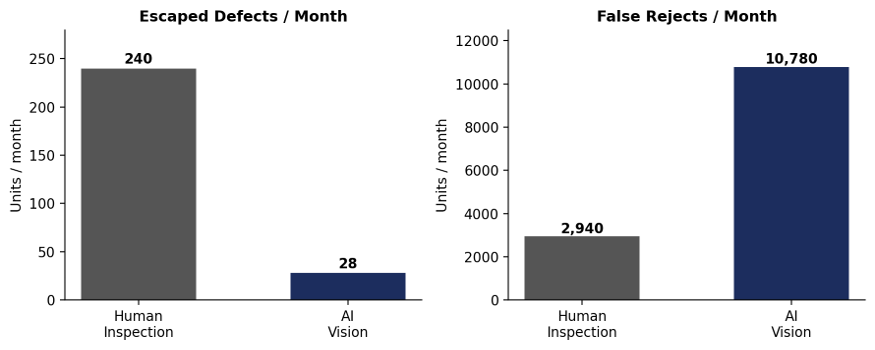
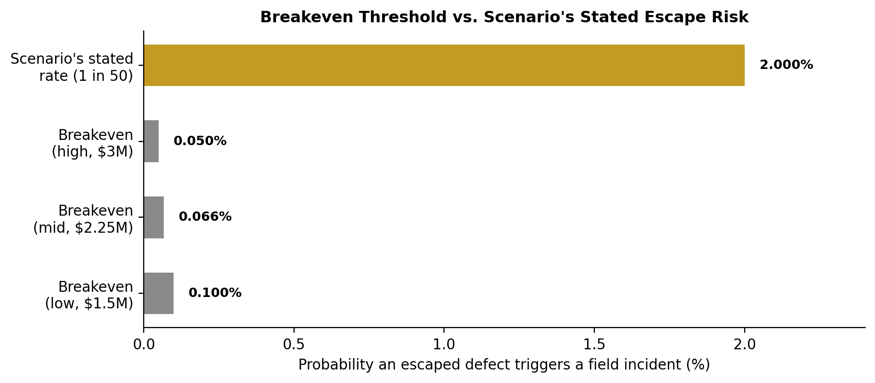
Position: VIEW A — Deploy the AI; Minimize Escaped Defects I support View A. On a safety-relevant brake subassembly, the asymmetry between the two views isn't close once the numbers are actually worked through, and it becomes even clearer once this decision is placed inside the broader discipline the automotive industry already uses to price defects: the cost-of-quality framework, safety-critical PPM benchmarks, and three decades of recall history showing exactly what an escaped defect costs once it reaches a vehicle. Below is the full reasoning, the math, and the evidence. Bottom line up front: the AI needs an escaped defect to have only a 0.05%–0.10% chance of triggering a field incident to break even against its extra scrap cost. The scenario itself states that chance is roughly 2% — twenty to forty times higher than breakeven. On the yield side, human inspection runs at 98.53% yield and AI runs at 94.61% yield — a real but modest 3.92-point difference, not the yield collapse the raw unit counts might suggest. Catch every defect wins this trade by a wide margin, on the numbers the scenario itself provides. The Math: What the Trade Actually CostsThe certain cost is straightforward: the extra scrap from AI's higher false-reject rate is 7,840 more good units scrapped per month. At $40 per unit, that is $313,600 per month, or approximately $3.76 million per year — matching the scenario's stated ~$3.8M/year figure almost exactly. The uncertain cost — escaped-defect exposure — is deliberately harder to price, and the scenario says so directly: it is "rare and hard to price precisely, but severe when it lands." Rather than guessing at a number, the more rigorous approach is to solve for the breakeven point: what is the minimum probability that an escaped defect actually triggers a $1.5M–$3M field incident, at which point deploying the AI becomes the cheaper option purely on cost, before any reputational or OEM-relationship damage is even counted? AI reduces escapes from 240/month to 28/month — a reduction of 212/month, or 2,544 fewer escapes per year. Incident cost assumption Breakeven probability (escape → recall) As a rate $1.5M per incident (low end) ~1 in 1,004 escapes ≈0.10% $2.25M per incident (midpoint) ~1 in 1,506 escapes ≈0.066% $3M per incident (high end) ~1 in 2,009 escapes ≈0.050% The scenario itself states that escapes carry "roughly 1 in 50" potential to trigger an incident — the 2% figure referenced above, and 20 to 40 times higher than the breakeven threshold in the table. Even if only a small fraction of that stated potential — say, one-twentieth of it — ever actually materializes into a real claim, AI still clears breakeven with a wide margin. The chart below makes the gap visible: the scenario's own stated escape-risk rate (right-most, gold bar) sits far above the threshold needed to justify the AI purely on defensive cost grounds (grey bars). Figure 1 — Breakeven probability required to justify AI deployment (grey) vs. the scenario's own stated escape-risk rate (gold). The stated rate is 20–40x higher than what's needed to break even. The volume comparison below shows the same trade from the production-floor side: AI cuts monthly escapes by 88% while increasing false rejects roughly 3.7x. Both effects are real. Only one of them is reversible after the fact. Figure 2 — Escaped defects and false rejects per month, human inspection vs. AI vision, using the scenario's own validation-pilot figures. It's worth showing the arithmetic behind the yield figures referenced above, since "protect yield" is the framing View B leans on. Human inspection yield is (200,000 − 2,940) ÷ 200,000 = 98.53%. AI inspection yield is (200,000 − 10,780) ÷ 200,000 = 94.61% — the 3.92-point gap already previewed, between two configurations that both still run above 94% yield, not the four-fold collapse the raw "7,840 more scrapped" figure might suggest in isolation. Framed this way, the actual question isn't catch-every-defect versus protect-yield as a binary. It's whether a modest, recoverable 3.92-point yield concession is worth an 88% cut in a categorically different kind of risk. On a safety-relevant part, that's not a close call. Why the Asymmetry Isn't Just a Modeling Choice: The Cost-of-Quality FrameworkTotal Quality Management has used some version of the 1-10-100 Rule since it was codified by Labovitz and Chang in 1992: a defect caught at the source costs roughly $1 to prevent; the same defect caught inside the plant costs roughly $10 to correct; the same defect allowed to reach the customer costs roughly $100 — and in regulated, safety-critical industries like aerospace and automotive, quality engineers report that multiplier stretching past 1,000x once litigation, regulatory penalties, and recall logistics are included. This isn't a coincidence specific to this scenario. It's the reason every quality management system in the automotive industry, including IATF 16949 itself, is structurally biased toward catching defects as early and completely as possible, even at a real cost in yield. The AI in this scenario is a more expensive appraisal step. View A is the 1-10-100 Rule applied correctly: pay more at the detection stage precisely because the cost curve on the other side of a shipped defect is not linear — it's exponential. Statistical Framing: This Is a Type I / Type II Error Trade-Off, and the Industry Has Already Decided Which Error It Fears MoreIn inspection statistics, a false reject (scrapping a good unit) is a Type I error, and an escaped defect (passing a bad unit) is a Type II error. Every inspection system, human or AI, sits somewhere on a curve trading one against the other — there is no configuration that minimizes both simultaneously. The question is not which error rate is lower in isolation, it's which error the business, and the industry, has decided is more expensive to make. Automotive safety systems answer this explicitly through PPAP (Production Part Approval Process) requirements and process capability targets. A Cpk of 1.67 — the bar IATF 16949 sets for safety-critical characteristics — corresponds to a defect escape rate of roughly 0.6 parts per million. A Cpk of 1.33, the general significant-characteristic floor, still only permits about 64 PPM. Both numbers assume detection systems are aggressive enough to catch nearly everything, which is only achievable by accepting a higher false-reject rate during the transition period while the underlying process is brought under control. The industry has already made this trade-off structurally, at the standards level, long before this specific scenario existed. Automotive Safety Recalls: What an Escaped Defect Has Actually Cost, Repeatedly1. Takata Airbag Inflators The starkest proof in automotive history of what an escaped safety defect costs at scale. Roughly 67 to 100 million inflators recalled globally across 34 brands, at least 27–28 confirmed U.S. deaths, and a $1 billion criminal settlement ($25M fine, $125M victim compensation, $850M automaker restitution) before Takata's 2017 bankruptcy. Total industry cost estimates run into the tens of billions once every automaker's individual recall costs are included. 2. GM Ignition Switch Recall (2014) 2.6 million vehicles, 124 confirmed deaths, and more than $2.6 billion in fines and settlements — including a $900M DOJ criminal penalty and a $595M victim compensation fund. The defect escaped detection for roughly a decade before the recall was issued, illustrating how long a structurally under-detected defect can persist once it's inside the field. 3. Continental Automotive Systems Brake Pedal/Booster Recall (2024) A Tier-1 supplier defect structurally identical to this scenario: a loosened piston-to-push-rod connection inside the brake system, affecting Audi and Volvo vehicles. Continental's own recall filing shows the defect was first reported by Volkswagen Group of America in December 2023, investigated internally through mid-2024, and only recall-filed in August and October 2024 — an eight-to-ten-month gap between the first field signal and formal action, the exact kind of delay a tighter detection system is designed to shrink. 4. Honda Brake Pedal Pivot Pin Recall (2024–2025) 259,000 vehicles recalled after Honda's supplier, Otsuka Koki, was found to have insufficiently trained staff failing to properly stake brake pedal pivot pins. This is a direct, recent, real-world example of exactly the failure mode View B's cost argument would tolerate more of: a process-control and inspection gap at the supplier level that let defective pedal assemblies reach the field for months before the first warranty claim surfaced in April 2024 triggered an investigation. 5. Ford Electronic Brake Booster Recall (2025) Ford's Tier-1 supplier Bosch flagged an integrated-circuit fault state in the EBB module that could extend stopping distance under specific voltage-disturbance conditions. Only a small population was affected and no injuries have been reported, but the timeline is instructive: the issue was first brought to Ford's Critical Concern Review Group in May 2025 from a single warranty return, and a full root-cause and remedy process took until August 2025 to complete — a reminder that even mature Tier-1 suppliers with sophisticated quality systems continue to have brake-relevant escapes reach production vehicles in the current model year. 6. Peer-Reviewed Evidence: Machine-Learning Defect Detection in Brake Calipers This isn't only a cost argument — it's also a solved engineering problem for exactly this part family. A 2025 study (published via PMC/NCBI) developed a non-contact, automated impact-acoustic measurement system specifically for real-time defect detection in automotive brake calipers used in Electric Parking Brake systems, using FFT and PCA feature extraction with SVM, k-NN, and Decision Tree classifiers across 2,200 measurement datasets from both normal and defective caliper specimens. The point is not the specific algorithm — it's that machine-learning-based inspection for brake-system components isn't speculative technology being tested for the first time in this scenario. It's an active, peer-reviewed research area specifically because manual and traditional automated inspection methods struggle to catch internal, non-surface defects in exactly this class of safety-critical part. 7. Correcting Bex's Ford Example Bex cites Ford's AI quality control as an unqualified success story ("30% reduction in defect rates"). That figure does appear in some industry write-ups, but it omits the more important and far more recent part of the story. Ford's blanket rollout of 900 AI-powered inspection cameras across its production facilities actually failed to consistently catch critical defects, because the system was trained without sufficient input from the experienced engineers who understood what real defects looked like in context — many of those engineers had already left the company before their expertise could be built into the training data. Ford had to reverse course, rehire roughly 350 veteran engineers, and rebuild its quality systems around human-validated training data before its 2026 J.D. Power Initial Quality Study ranking improved to first among mainstream brands, its best result since 2010. This does not undercut View A — it sharpens it. The AI system described in this scenario has exactly what Ford's initial rollout lacked: a rigorous, measured 90-day validation pilot with known detection and false-reject rates, rather than an unvalidated blanket deployment. Bex's example is evidence that ungoverned AI deployment is risky. It is not evidence that governed, pre-validated AI deployment — like the one in this scenario — should be avoided. 8. Boeing 737 MAX / MCAS — A Cross-Industry Illustration of Tail-Risk Dominance Outside the automotive sector, the clearest illustration of why rare safety-relevant escapes dominate routine operating costs is Boeing's 737 MAX. A flight-control software defect that escaped adequate scrutiny during certification led to two crashes, 346 deaths, a 20-month grounding — the longest in U.S. aviation history — and direct costs Boeing itself has put at over $20 billion, with indirect losses from cancelled orders exceeding $60 billion, plus a $2.5 billion criminal settlement. No plausible amount of routine cost discipline during the MAX program would have approached the scale of what one uncaught, safety-relevant design escape ultimately cost. The lesson transfers directly: on safety-relevant systems, the cost distribution is not symmetric, and optimizing for the routine, certain cost while treating the rare, catastrophic cost as a rounding error is a structurally dangerous way to evaluate the trade. 9. IATF 16949 / DPPM Industry Benchmark Automotive safety-critical Tier-1 systems are held to a target of roughly 10 defects per million (DPPM) or fewer — effectively zero tolerance. In this scenario, human inspection escapes at 1,200 PPM (240 of 200,000 units) while AI escapes at 140 PPM (28 of 200,000). Neither configuration meets the industry's ultimate safety-critical benchmark on its own, but AI moves the plant roughly 8.5x closer to it. That is the direction the entire automotive quality discipline has been built to reward, and it argues for continued threshold tuning after deployment, not for staying with the option that is further from the standard. Addressing View B's Real Concern, Without Hedging the PositionView B is right that a more than 3x increase in yield loss is a real, recurring cost that strains capacity, material planning, and cost targets — this is not a straw man. But the answer isn't to withhold the AI. It's to do exactly what View A's own framing already proposes: retune the AI's decision threshold over the following quarters as more production data accumulates, and add a fast re-inspection loop for borderline rejects to recover good units the model initially flags with low confidence. Both are standard second-phase engineering responses once a detection system is in production, and both directly attack the $3.8M/year figure without giving up any of the 88% escape reduction. That is an engineering problem with a known playbook. There is no equivalent playbook for un-shipping a defective brake part that has already reached a customer's vehicle. This position also isn't an argument for trusting the AI blindly once deployed. The 99.3% detection and 5.5% false-reject figures come from a 90-day pilot, and any responsible rollout treats those as a baseline to monitor, not a permanent guarantee. Ongoing statistical process control — control charts on both the detection rate and the false-reject rate, periodic re-validation samples checked against human inspection, and a defined trigger for re-training if either metric drifts — is the standard way this kind of system is kept honest in production. That monitoring is what makes it reasonable to trust the AI's numbers going forward, not an assumption that the 90-day pilot result holds forever untested. Final PositionDeploy the AI. The certain $3.8 million per year in extra scrap is a bounded, controllable, and improvable cost — the kind every quality organization already knows how to bring down over time through threshold tuning and re-inspection loops. The escape reduction — 2,544 fewer defective units reaching customers per year — clears the mathematical breakeven point against field-incident risk by more than an order of magnitude under the scenario's own stated assumptions. The cost-of-quality literature, the industry's own PPAP and Cpk standards, a growing body of peer-reviewed machine-learning research specifically on brake-component defect detection, and a recent, repeated pattern of Tier-1 brake-system recalls in 2024 and 2025 all point the same direction. Boeing's MCAS and Takata's inflators show what happens across industries when a rare, safety-relevant escape is allowed to happen anyway. On a safety-relevant part, minimizing escapes isn't the cautious choice. It is the only one consistent with how this industry has already decided, at the standards level, that catastrophic failure should be priced.
-
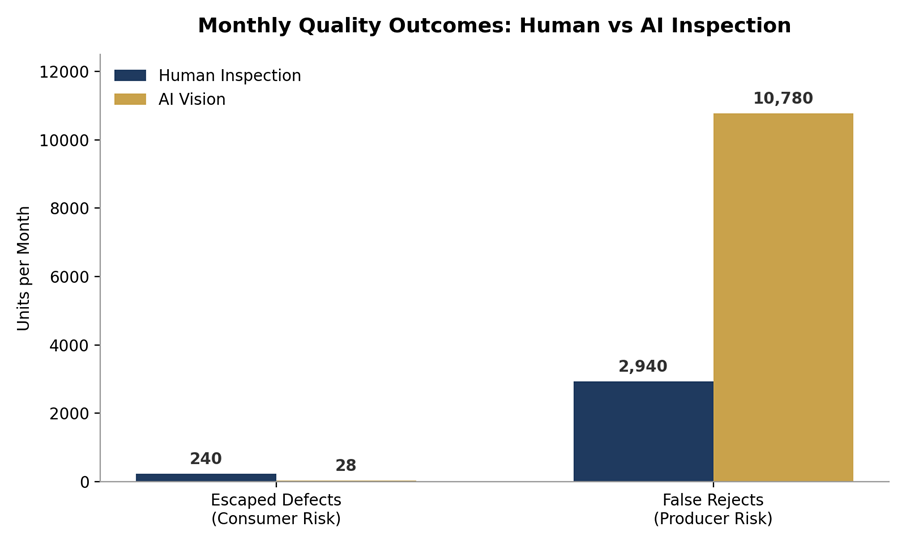
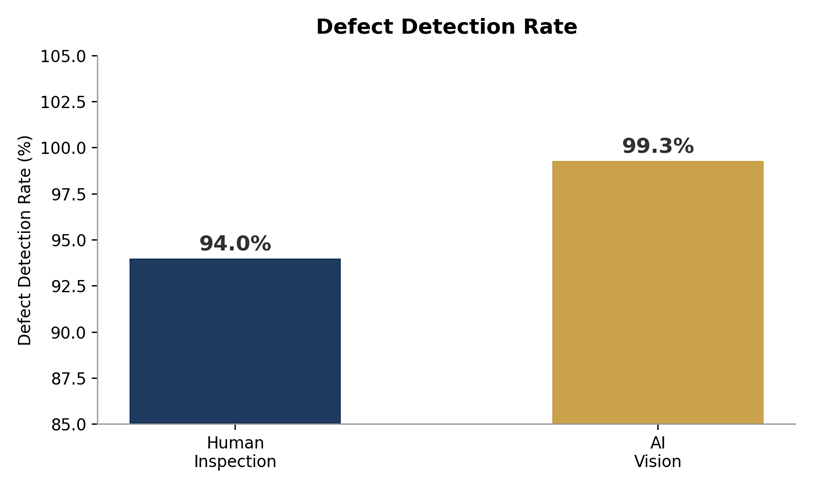
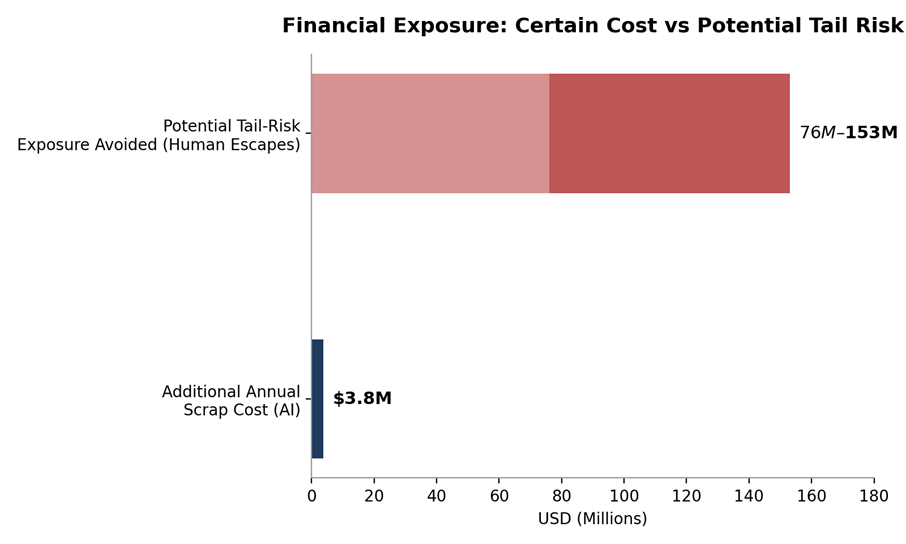
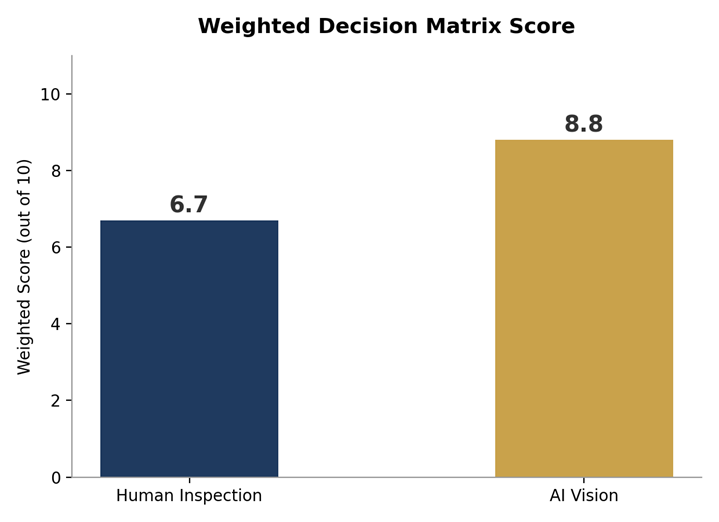
QUALITY & SAFETY RISK ANALYSIS AI Vision vs. Human Inspection The Case for Full AI Vision Deployment Safety-Critical Manufacturing — Brake Assembly Inspection Line Monthly Production 200,000 units Detection Rate — Human 94.0% Detection Rate — AI Vision 99.3% Recommendation Deploy AI Vision as Sole Inspection Gate Prepared for internal quality, safety, and operations review July 2026 Executive SummaryThis report makes the case for replacing human visual inspection with AI-powered machine vision on a safety-critical brake assembly line. The evidence is decisive: AI vision detects 5.3 percentage points more defects than human inspection, cutting the volume of defective brake assemblies that reach customers by roughly 88%. On a life-critical part, that reduction in escaped defects is not a marginal improvement — it is the difference between a routine quality program and a preventable recall, injury, or fatality. The AI's one drawback a higher false-reject rate carries a modest, fully budgetable cost. As this report shows, that cost is a rounding error next to the tail-risk exposure it eliminates, and it is also a solved engineering problem: every mature AI-vision deployment in automotive and semiconductor manufacturing has driven false-reject rates down through threshold tuning and retraining, without ever giving back the underlying safety gain. The recommendation is unambiguous: deploy AI vision as the primary, standalone inspection gate for this line. Factor Human Inspection AI Vision Difference Monthly Production 200,000 200,000 — True Defects 4,000 4,000 — Defect Detection Rate 94% 99.3% AI +5.3 pts Escaped Defects / Month 240 28 212 fewer with AI False Rejects / Month 2,940 10,780 7,840 more with AI Annual Scrap Cost Impact Baseline +$3.8M Certain, manageable Catastrophic Recall Risk Higher Much Lower Significant reduction BOTTOM LINE AI vision eliminates roughly 212 defective brake assemblies from reaching customers every month, at a cost of $3.8M a year — a fraction of the $76M–$153M in tail-risk exposure that figure buys down. On a safety-critical part, this is not a close call. Visualizing the Case for AI VisionThe two charts below make the case visually. The first shows just how far escaped defects fall under AI vision even as false rejects rise; the second isolates the detection-rate gain that drives every other number in this report. Figure 1. Monthly escaped defects vs. false rejects, Human vs. AI Vision. Figure 2. Overall defect detection rate, Human vs. AI Vision. Reading the Charts• Escaped defects fall from 240 to 28 per month — an 88% reduction in units that could reach a vehicle owner. • False rejects rise from 2,940 to 10,780 per month — a cost the financial analysis below shows is easily absorbed. • The detection-rate gap (94% vs. 99.3%) looks small in percentage terms but represents hundreds of defective, safety-critical parts every month at 200,000/month volume. Risk MatrixRead across the row that matters most: AI vision is superior or equal on every dimension of external, customer-facing risk. Its only weaker score is internal manufacturing cost — a cost the organization directly controls and can budget for, unlike a recall. Risk Category Human Inspection AI Vision Internal Manufacturing Cost Low High Customer Risk High Very Low Recall Exposure High Much Lower Brand Damage Higher Lower Warranty Cost Higher Lower Production Yield Better Worse Decision Framework: Why Safety Must GovernEvery category on the Consumer's Risk side of this table is external, irreversible once it occurs, and largely outside the organization's control once a defective part ships. Every category on the Producer's Risk side is internal, absorbable, and controllable through budgeting, process improvement, and threshold tuning. A rational risk framework weights the uncontrollable, irreversible category far more heavily which is exactly why AI vision, despite its yield cost, is the correct choice for a safety-critical part. Consumer's Risk (Governs the Decision) Producer's Risk (Manageable Cost of Doing Business) Defective part reaches customer Good part rejected External failure Internal failure Safety risk Cost risk Recall Scrap Brand damage Yield loss Regulatory action Manufacturing inefficiency Financial Case: A Small Certain Cost vs. a Catastrophic Tail RiskThe Cost of AI — Modest and Fully ControllableThe additional 7,840 false rejects per month translate into an estimated $3.8 million in additional annual scrap cost. This figure is known with high confidence, budgetable like any other manufacturing input, and — as the case studies later in this report demonstrate — shrinks over time as thresholds are tuned and the model is retrained on confirmed outcomes. The Cost of Not Deploying AI — Uncertain and Potentially ExistentialHuman inspection allows roughly 212 more defective units to escape per month than AI vision, or about 2,544 defective brake assemblies per year. Using an illustrative assumption that 1 in 50 escaped defects could contribute to a field incident, that implies roughly 51 potential incidents avoided annually by switching to AI. At an illustrative cost of $1.5M–$3.0M per major safety incident (recall, litigation, and remediation combined), the exposure eliminated by deploying AI is on the order of $76M to $153M — twenty to forty times the AI's annual scrap cost. IMPORTANT CAVEAT This is not an expected-value calculation it illustrates the scale of tail-risk exposure if escaped defects lead to severe field events. The 1-in-50 conversion rate and per-incident cost are planning assumptions, not measured outcomes, and should be refined with the organization's own historical field-failure data. Even under far more conservative assumptions, the exposure avoided dwarfs the AI's scrap cost. Figure 3. Certain annual scrap cost (AI) vs. illustrative tail-risk exposure range eliminated by deploying AI. This is not a close trade-off. The AI's cost is small, certain, and absorbed inside the P&L every month like any other input cost. The cost of staying with human inspection is larger, uncertain, and back-loaded — it may not appear for years, and then arrive all at once, as it did for Toyota, Takata, and GM. Paying the smaller, certain price to avoid the larger, uncertain one is the financially rational choice, not merely the cautious one. Risk Assessment MatrixNote where the true severity concentrates: recall and customer-injury risk are rated Very High and Critical the two outcomes AI vision most directly suppresses. Additional scrap cost, by contrast, is merely High and entirely within the organization's control. Event Probability Impact Overall Risk Additional Scrap Cost Very High Medium High Recall Low Extreme Very High OEM Penalty Medium High High Customer Injury Low Catastrophic Critical Production Cost Increase Certain Medium High Real-World Precedents Supporting Full AI DeploymentThe case for AI vision is not theoretical. Automotive history shows what escaped safety defects cost when inspection falls short, and current manufacturing and healthcare practice shows that well-validated AI systems are already trusted to make autonomous, safety-relevant decisions at scale — without requiring a human check on every case. 1. Toyota Unintended Acceleration Recall (2009–2010)• Toyota recalled millions of vehicles worldwide over concerns linked to unintended acceleration, including sticking accelerator pedals and floor-mat interference. • The recalls, related settlements, and a subsequent U.S. criminal penalty cost the company billions of dollars in total. • The episode caused lasting reputational damage despite Toyota's decades-long reputation for manufacturing quality. LESSON A single escaped safety defect, even a rare one, can outweigh years of accumulated manufacturing savings. Reputational damage compounds the direct financial cost. 2. Takata Airbag Crisis• Defective airbag inflators could rupture and send metal fragments into the cabin, and were linked to numerous fatalities and injuries worldwide. • The resulting recall became the largest and most complex automotive safety recall in history, eventually covering tens of millions of vehicles across many manufacturers. • Takata filed for bankruptcy in 2017 as recall and liability costs overwhelmed the company. LESSON Even an extremely low per-unit defect rate can become catastrophic at automotive production volumes, especially when a defect is safety-critical and shared across many OEMs. 3. GM Ignition Switch Recall (2014)• A defective ignition switch design, present for years before action was taken, could slip out of the “run” position and disable power steering, power brakes, and airbags. • General Motors recalled millions of vehicles and the case drew significant regulatory scrutiny over how long the defect went unaddressed internally. • The company ultimately paid substantial settlements and penalties tied to the delayed response. LESSON The cost of an escaped defect is magnified when detection and internal escalation are slow. Early, reliable detection has a compounding value beyond the direct defect rate. 4. Bosch — AI Vision Cuts Defect Rates at Industrial Scale• Bosch's AI-driven visual inspection systems have been reported to detect defects with up to 40% greater accuracy than the human eye across automotive components and circuit boards. • At one Bosch circuit-board plant, an AI-based measuring process now checks thousands of solder joints per board for control units used in ABS, ESP, and steering systems — far beyond what manual inspection could achieve at the same speed and consistency. • Bosch has extended AI-based anomaly detection and machine-vision inspection across dozens of plants and thousands of connected production lines, with case studies reporting defect rates falling from 3–5% toward near zero. LESSON AI vision is not an unproven technology for safety-relevant automotive components — it is already operating at industrial scale, catching orders of magnitude more defects than manual inspection ever could. 5. Semiconductor Fabs — The False-Reject Objection Is a Solved Problem• Legacy rule-based optical inspection in semiconductor fabs has been reported to generate false-positive rates as high as 50%, driving heavy manual review and recipe tuning. • AI-enhanced automated optical inspection systems have reported classification accuracy in the 97–99% range while cutting false-alarm rates to under 10%, by adapting detection thresholds instead of using one fixed setting for every case. • Industry guidance consistently frames this as a standard tuning curve: initial deployments over-flag, and false-positive rates fall sharply as models are retrained on confirmed outcomes. LESSON The false-reject rate objection raised against AI vision is a temporary, well-understood engineering parameter — not a fundamental flaw. Every comparable industry deployment shows it declining with tuning, while the underlying safety gain is never given back. 6. LumineticsCore (formerly IDx-DR) — Regulators Already Trust Autonomous AI on Safety-Relevant Decisions• In 2018, the U.S. FDA granted the first-ever authorization for a fully autonomous AI diagnostic system, LumineticsCore (then IDx-DR), to detect diabetic retinopathy without a physician reviewing the images or results. • The system was validated in exactly the environment it operates in — primary care offices with non-specialist operators — and its pivotal trial exceeded pre-specified accuracy targets before autonomous clearance was granted. • Two additional autonomous AI systems have since received similar clearance, and the approach is now recognized in specialty clinical practice guidelines. LESSON When an AI system is rigorously validated in its actual deployment environment, regulators — including the FDA in a safety-critical medical context — already permit it to make the final call without routing every case back to a human. The same logic supports AI vision operating as the sole inspection gate here, provided it is validated with equivalent rigor. Industry PerspectiveSafety-critical industries generally prioritize minimizing escaped defects because external failures carry disproportionate consequences relative to their probability. Consumer-facing, non-safety-critical industries often shift the balance toward yield and cost. Industry Priority Automotive Brakes Safety Aircraft Engines Safety Medical Devices Safety Nuclear Power Safety Railway Signalling Safety Consumer Electronics (typical) Yield / Cost Addressing the Yield ObjectionThe strongest argument against AI vision is operational: nearly 11,000 good units discarded every month, additional material draw, and possible strain on delivery commitments. This objection deserves a direct answer rather than a footnote. • The cost is known, budgetable, and small relative to the risk it retires $3.8M a year against $76M–$153M in tail-risk exposure eliminated. • The false-reject rate is not a fixed feature of the system. The semiconductor-fab precedent above shows the same category of problem falling from ~50% false positives to under 10% purely through threshold tuning and retraining, with no loss of detection accuracy. • Even before tuning improves the rate, the alternative continuing with a 94%-detection human process on a brake assembly keeps 240 defective units per month flowing toward customers. That is the risk a yield objection is actually asking the organization to accept. THE REAL CHOICE The yield objection asks whether the organization is willing to scrap more good parts. The alternative asks whether the organization is willing to ship more defective brakes. Framed accurately, this is not a close call for a safety-critical component. Implementation Plan for Full AI DeploymentThe recommendation is to deploy AI vision as the primary, standalone inspection gate, supported by the same governance and improvement practices that mature AI-vision deployments already use to bring false-reject rates down over time. Step Action Purpose 1 Deploy AI vision as the sole inspection gate for the line Capture the full 99.3% detection rate immediately 2 Validate the model rigorously in its actual production environment before go-live Mirrors the validation rigor behind autonomous AI clearances in other safety-critical settings 3 Retrain the model on confirmed pass/fail outcomes on a fixed cadence Drives the false-reject rate down, as seen in semiconductor AOI deployments 4 Continuously tune decision thresholds using production data Improves yield without reducing defect detection 5 Track scrap cost and detection rate on a single dashboard reviewed monthly Keeps the known, controllable cost visible and trending down Weighted Decision MatrixScoring each option (0–10) across five weighted criteria, with Safety weighted highest given the life-critical nature of the part, shows AI vision winning decisively despite its lower yield score. Criterion Weight Human Inspection AI Vision Safety 40% 6 10 Yield 20% 9 5 Recall Risk 20% 6 10 Operating Cost 10% 8 5 Continuous Improvement 10% 5 9 Weighted Score 100% 6.7 8.8 Figure 4. Weighted decision-matrix score — AI Vision outscores Human Inspection by more than two points. Conclusion and RecommendationOn a safety-critical, life-critical part, the evidence in this report points in one direction. AI vision detects 5.3 percentage points more defects than human inspection, cutting escaped-defect volume by roughly 88% and eliminating tail-risk exposure on the order of $76M–$153M. Its one weakness a higher false-reject rate costs a known, budgetable $3.8M a year, a cost every comparable industry deployment has shown falls further with routine threshold tuning and retraining. History has already shown what the alternative costs: Toyota, Takata, and GM each absorbed billions of dollars and lasting reputational damage from safety defects that a more capable detection system could plausibly have caught earlier. Meanwhile, current practice from Bosch's industrial-scale machine vision to the FDA's authorization of fully autonomous diagnostic AI shows that rigorously validated AI systems are already trusted to make safety-relevant decisions on their own, without a mandatory human check on every case. The recommendation is direct: deploy AI vision as the primary, standalone inspection gate for this line, backed by rigorous pre-launch validation and an ongoing threshold-tuning and retraining program to bring the false-reject rate down over time. This is the option that best protects customers, brand, and long-term operating cost and it is available now. RECOMMENDATION Approve AI vision as the sole inspection gate for the brake assembly line, with rigorous pre-launch validation and a standing threshold-tuning and retraining program to reduce the false-reject rate over time without sacrificing detection accuracy.
-
Raj6314 joined the community
-
Position: View A — Deploy the AI machine-vision inspection system immediately. For a safety-critical brake component, minimizing escaped defects creates greater long-term operational and business value than protecting short-term yield. ArgumentSafety risk outweighs internal scrap costs. An additional $3.8M/year in scrap is significant but predictable and controllable. A single field safety incident can trigger $1.5M–$3M in direct recall costs before considering legal exposure, OEM penalties, warranty claims, production disruptions, and reputational damage. AI reduces escaped defects by 88% (240 to 28 per month), dramatically lowering this catastrophic risk. OEM trust is a strategic asset. Tier-1 suppliers compete on quality performance as much as price. Escaped safety defects can result in supplier scorecard downgrades, containment actions, stop-ships, or loss of future sourcing opportunities. Internal scrap affects margins; customer escapes threaten the entire business relationship. Producer's risk is easier to improve than consumer's risk. The AI's higher false reject rate can be reduced through threshold optimization, retraining with additional images, better lighting, process capability improvements, or a rapid human review of borderline rejects. Once a defective brake reaches a vehicle, no operational improvement can reverse the customer impact. AI creates a scalable quality platform. Unlike human inspection, AI continuously improves through retraining and standardized deployment across production lines and plants. The current false reject rate represents an optimization opportunity rather than a structural limitation. Modern quality management prioritizes prevention over correction. Standards used throughout automotive manufacturing emphasize preventing defects from reaching customers. AI directly strengthens containment at the final quality gate, where failures are most expensive. Real-World ExampleThe Toyota 2010 unintended acceleration recall illustrates why preventing even rare safety escapes outweighs substantial internal manufacturing costs. Toyota ultimately recalled more than 8 million vehicles worldwide, incurred billions of dollars in recall, warranty, legal, and remediation expenses, and later agreed to a US$1.2 billion settlement with U.S. authorities. Beyond the direct financial impact, the company faced damaged customer confidence, increased regulatory scrutiny, and significant management attention diverted from innovation and operations. The operational lesson was clear: defects affecting safety generate costs far beyond the manufacturing floor. Since then, Toyota has invested heavily in stronger quality assurance, advanced inspection technologies, and defect prevention throughout production. This directly supports deploying AI in the scenario. Even though AI increases internal scrap, preventing approximately 212 additional escaped defects every month substantially lowers the probability of a costly safety event whose financial and strategic consequences can exceed years of scrap expense. A similar lesson emerged at Boeing following the 737 MAX crisis. Although aerospace differs from automotive, both industries manufacture safety-critical products where defects can have catastrophic consequences. The grounding of the fleet led to tens of billions of dollars in direct costs, compensation, production disruptions, regulatory actions, and reputational damage. The industry response focused on strengthening quality assurance, verification, and defect detection rather than accepting higher escape risk to improve production efficiency. The analogy transfers directly: when product safety is involved, organizations consistently choose stronger defect prevention even if it increases inspection costs or reduces short-term productivity. Business ImpactDeploying AI improves operational risk management by reducing escapes by 88%, strengthens OEM relationships, protects long-term revenue, and aligns with automotive safety governance. The $3.8M annual scrap cost is measurable and can be reduced through model optimization and secondary inspection. In contrast, safety escapes expose the supplier to unpredictable financial losses, regulatory intervention, contract risk, and lasting reputational damage that far exceed internal failure costs. CounterargumentThe strongest argument for View B is that the $3.8M annual scrap cost is certain, while recalls are relatively rare. This appears persuasive because manufacturers must control margins and maintain capacity. However, this reasoning undervalues tail-risk management. In safety-critical industries, low-probability, high-impact failures dominate governance decisions. The false reject rate is an engineering parameter that can be improved over time; a brake defect installed in a customer's vehicle cannot be recalled before harm occurs. Effective operational strategy eliminates catastrophic customer risk first and then optimizes internal efficiency. ConclusionFor a safety-relevant brake assembly, View A is the superior business decision. Deploy the AI immediately, then aggressively reduce false rejects through model tuning, process improvement, and rapid re-inspection workflows. Protecting customers and OEM confidence delivers far greater long-term enterprise value than preserving short-term manufacturing yield.
Yesterday
-
Supporting View A — Deploy the AI Vision System: Prioritize Customer Safety and Eliminate Escaped DefectsIntroductionFor a Tier-1 automotive supplier manufacturing 200,000 safety-critical brake subassemblies every month, the decision to deploy an AI inspection system should be evaluated using a risk-based quality management approach rather than only short-term production cost. In automotive manufacturing, especially for safety-critical systems such as brakes, airbags, steering, and powertrain components, the most important quality objective is to prevent defective products from reaching the customer. A defect discovered internally results in scrap, rework, and operational cost. However, a defect discovered after reaching the vehicle creates external failure risk involving recalls, warranty claims, regulatory consequences, OEM relationship damage, and potential customer safety impact. Therefore, although the AI vision system creates a higher false reject rate, deployment is justified because it significantly reduces consumer risk. The philosophy followed by world-class automotive manufacturers is: “Internal failures increase cost, but external failures can destroy customer trust and business sustainability.” 1. Comparison of Human Inspection vs AI Inspection PerformanceThe plant currently experiences: Production volume: 200,000 brake subassemblies/month Actual defective units entering inspection: 4,000 units/month Good units: 196,000 units/month Current Human Inspection PerformanceHuman defect detection rate: 94% This means: Escaped defective parts reaching customers: 240 units/month False rejection of good products: 2,940 units/month Human inspection provides better yield performance but allows a higher number of defective products to escape. AI Vision System PerformanceAI detection rate: 99.3% This results in: Escaped defective parts: 28 units/month Additional defects prevented from reaching customer: 212 units/month This represents: ≈88% reduction in customer escapes However, AI creates: False rejects: 10,780 units/month Additional good parts scrapped: 7,840 units/month Additional internal cost: ≈$3.8M/year At first glance, the additional scrap appears expensive, but automotive safety decisions cannot be based only on visible cost. 2. Why Consumer Risk Should Dominate Producer RiskQuality failures are generally classified into two categories: Internal Failure CostExamples: Scrap Rework Additional inspection Production loss These failures happen before shipment. They are: Known Measurable Controllable Correctable through improvement The AI system creates this type of cost. External Failure CostExamples: Customer complaints Warranty failures OEM line stoppage Product recall Legal claims Loss of future business These failures happen after shipment. They are: Unpredictable Difficult to control Highly damaging Human inspection exposes the company to this higher risk category. 3. Risk Calculation PerspectiveThe safety impact becomes clearer when considering field risk. Assumption: 1 out of every 50 escaped defects can potentially trigger a serious safety issue or recall event. With Human InspectionEscapes: 240 defects/month Potential serious events: 240 ÷ 50 ≈ 5 high-risk incidents/month With AI InspectionEscapes: 28 defects/month Potential serious events: 28 ÷ 50 ≈ Less than 1 high-risk incident/month Therefore, AI does not only reduce defect quantity; it significantly reduces the probability of a catastrophic quality event. The company is essentially paying $3.8M/year as a prevention cost to protect against failures that could cost tens or hundreds of millions in direct and indirect losses. 4. Industrial Example — Takata Airbag Recall: The Cost of Escaped Safety DefectsOne of the strongest automotive examples showing the importance of preventing safety defects from reaching customers is the Takata airbag recall. Takata was one of the largest global automotive component suppliers. The company supplied airbag inflators to several major automobile manufacturers. The original product issue affected a small percentage of parts compared with total production volume, but because the component was safety-critical, the impact became enormous. Consequences included: More than 100 million vehicles recalled worldwide Billions of dollars in recall-related costs Loss of trust from OEM customers Severe damage to brand reputation Financial collapse of Takata Corporation The important manufacturing lesson from this case: A safety defect does not need to happen frequently to create a major business crisis. Even rare failures can become unacceptable when the consequence severity is extremely high. For the brake subassembly supplier in this case, allowing 240 defective components per month to escape creates similar risk exposure. The probability may be low, but the severity is extremely high. The AI system acts as a stronger containment barrier by preventing defects from leaving the factory. 5. Why the Additional Scrap Cost Should Not Stop AI DeploymentThe $3.8M annual scrap cost is not a permanent loss. It represents the initial maturity stage of the AI model. Traditional inspection improvement follows the principle: First improve detection → Then optimize efficiency If the company focuses only on reducing false rejects before deployment, it continues accepting customer risk during the development period. A better approach is: Deploy AI immediately for protection and improve false rejects through continuous optimization. 6. Improvement Roadmap After AI DeploymentStep 1: Introduce AI + Human Hybrid InspectionDo not immediately scrap every AI reject. Create three inspection categories: Category 1 — Confirmed Good PartsAI confidence >99% Action: Auto release Category 2 — Confirmed DefectsAI confidence very high Action: Reject immediately Category 3 — Borderline PartsAI uncertainty zone Action: Human inspector verification This maintains safety while recovering incorrectly rejected good parts. Expected benefit: If only 50% of false rejects are recovered: Recovered parts: ≈5,000 units/month Potential savings: ≈$2M–$2.5M/year Step 2: Continuous AI Model TrainingFalse rejects should become improvement data. Every week: Analyze wrongly rejected components Identify AI confusion patterns Add more acceptable variation images Retrain algorithm Examples: AI may incorrectly reject: Acceptable surface marks Normal machining variation Lighting differences Cosmetic variation By teaching the AI acceptable limits, false rejection reduces without sacrificing safety. Step 3: Use AI Data for Root Cause EliminationThe AI should not only inspect quality; it should improve manufacturing. AI defect analytics can identify: Machine trends: Example: 70% defects generated from one assembly station Material trends: Example: Higher failures linked to one supplier batch Time trends: Example: Defects increase after tool running hours exceed limit Operator/process trends: Example: Higher variation during changeovers This allows the company to move from: Detection-based quality to Prevention-based quality Step 4: Reduce the Incoming 2% Defect RateThe biggest opportunity is not reducing inspection accuracy; it is improving the manufacturing process. Apply: Six Sigma DMAIC projects Process capability improvement Poka-yoke systems Preventive maintenance Supplier quality improvement Example improvement: Current defect generation: 2% After improvement: 1% Defective parts reduce: 4,000/month → 2,000/month This lowers both real rejects and inspection cost. Step 5: Periodic Threshold OptimizationAI sensitivity should be continuously optimized. During early launch: High sensitivity → maximum protection After confidence improves: Optimize threshold → reduce false rejects The goal: Maintain: Reduce false reject: 5.5% → below 2% Final RecommendationThe AI vision system should be deployed because safety-critical automotive manufacturing requires prioritizing customer protection over short-term yield loss. The additional $3.8M/year scrap cost is a visible and controllable internal failure cost. However, escaped brake defects create unpredictable external failure risks that can result in recalls, regulatory action, loss of OEM confidence, and long-term business damage. The best strategy is not AI versus cost. The correct strategy is: Deploy AI to immediately reduce customer escapes. Add human verification for borderline rejects. Continuously retrain the model. Use AI data to eliminate process defects. Optimize yield after achieving customer protection. In safety-critical manufacturing, preventing one major failure event can justify years of additional prevention cost. A world-class automotive supplier does not simply ask: “How much does quality cost?” It asks: “What is the cost of poor quality reaching the customer?”
-
The IPO-bound AI startup said it will roll out two versions of GPT-Live - GPT-Live-1 and GPT-Live-1 mini - to users globally on Wednesday. View the full article
-
The loan makes BofA one of OpenAI's largest lenders and bolsters its credentials as a market leader in AI-related capital markets financing, the source said, requesting anonymity to discuss confidential information. View the full article

-
Paris-based Mistral AI has launched its first robotics model for industrial automation. This new system enables robot navigation using only a single camera. The Robostral Navigate model does not require advanced sensors or multiple cameras. It is designed to work with robots from various suppliers. This launch follows Mistral's recent acquisition of Emmi AI. View the full article

-
Manikandan Ramar joined the community
-
China plans to permit its leading artificial intelligence companies to acquire Nvidia's H200 chips. Officials have informed Alibaba, ByteDance, and DeepSeek about potential upcoming permissions. Nvidia has already secured licenses from the United States government for these sales. The chip giant's shares saw a slight increase following this news report. Companies and the Commerce Department have not yet provided immediate comments. View the full article
-
Position: View A is the correct decision because in a safety‑relevant brake subassembly, minimizing escaped defects is the dominant priority, and the external‑failure risk far outweighs the cost of increased scrap. Reasoning: 1) The AI system cuts escaped defects from 240 to 28 per month, an 88% reduction in consumer’s risk. In automotive safety, even a single escaped defect can trigger a field incident or recall costing $1.5M–$3M, plus OEM stop‑ship penalties and reputational damage. These events are low‑frequency but extremely high‑severity, and once a defective part reaches a vehicle, the consequences are irreversible. 2) By contrast, the increased scrap — 7,840 additional false rejects per month, costing $3.8M/year — is a linear, controllable internal‑failure cost. Scrap can be engineered down through threshold tuning, upstream defect‑rate reduction, and adding a fast human re‑inspection loop for borderline rejects. External failures cannot be engineered away after they occur. Example Relevance: In this exact brake‑assembly scenario, the part is safety‑relevant, the OEM consequences are severe, and the numbers show a clear risk asymmetry: the AI’s higher false‑reject rate creates predictable cost, but the reduction in escapes directly lowers the probability of catastrophic events that can dwarf the scrap cost and jeopardize the supplier’s standing. Conclusion: Given the safety‑critical context, the magnitude of escape reduction, and the catastrophic nature of external failures, View A is the defensible and correct position.
-
rajan.arora2000 replied to Vishwadeep Khatri's topic in We ask and you answer! The best answer wins!View A — Deploy the AI. The case's own numbers price an escape at 20–40× its break-even. Buy the error you can still fix.I support View A — deploy the AI vision system as the primary inspection gate, at its high-detection operating point, starting now. Without qualification on the case as stated. The decisive cut, in one sentence a manager can repeat: a false reject is a reversible, $40, in-plant event you can count on Friday and engineer down next quarter; an escaped defect on a brake subassembly is an irreversible commitment whose final price is set later — by physics, by lawyers, and by your OEM. When one error is recoverable and the other is not, on a safety characteristic you always buy the recoverable error. The arithmetic, from the prompt's own parameters: the AI adds 7,840 wrongly scrapped good units/month × 12 × $40 = $3.76M/year of certain cost (the scenario's $3.8M, reproduced from first principles), and removes 212 escapes/month × 12 = 2,544 escapes/year. Divide: each avoided escape needs to be worth only ~$1,480 all-in for the AI to pay for itself. The scenario's own tail pricing — 1 in 50 escapes carrying a $1.5M–$3M exposure — values an escape at $30,000–$60,000 if every flagged exposure matured, and still $3,000–$6,000 if only one in ten ever does (labeled assumption). The deployment clears break-even by 20–40× at face value and by roughly 2–4× even after a 90% haircut on the scenario's own tail estimate. For View B to be right, more than ~95% of the scenario's own flagged incidents must silently never happen, and every secondary cost — OEM sorting, chargebacks, controlled shipping, scorecard damage, liability above the band, and the explicitly unpriced OEM-relationship term — must be exactly zero. The fix in two lines: AI as the hard gate at 99.3% today; rejects triaged — safety-class flags scrapped, cosmetic and low-confidence flags re-checked by an orthogonal method to recover good units. Daily seeded golden samples measure your escape rate before the customer does; in parallel, attack the 2% incoming rate — the real patient. (Every dollar figure above conservatively assumes zero recovery.) The Decisive CutBoth views argue as if "94%/1.5%" and "99.3%/5.5%" were fixed properties of two technologies. They are not the same kind of number. The human pair is essentially a fixed point — and one that drifts worse within a shift (sustained human visual inspection has long been measured in the 80–90% band in the inspection-research literature — Colin Drury's classic inspection studies; vigilance decay goes back to Mackworth, 1948). The AI pair is one operating point on a tunable receiver-operating curve: threshold, retraining, and defect-class logic move it. View B proposes to discard an entire curve because it dislikes one point on it. That is confusing an operating point with a technology. And note who measures what. Under View B, your miss rate is measured by your customer's assembly line — the system grades its own homework only when the customer mails it back. Under View A, your dominant error mode sits in your own scrap cage, countable by Friday and auditable by defect class. Choose the system whose dominant error you can inspect. What the Numbers SayAll figures below derive from the prompt (200,000 units/month; 2% true defect rate; stated detection and false-reject rates): Monthly Human AI Δ (AI − Human) Defects caught (of 4,000) 3,760 3,972 +212 Escapes to customer 240 28 −212 Good units wrongly scrapped (of 196,000) 2,940 10,780 +7,840 Outgoing defect rate (shipped basis) ~1,240 PPM ~150 PPM ~8× cleaner Annual incremental scrap cost @ $40 — — $3.76M Annual escapes avoided — — 2,544 Break-even inversion. $3,763,200 ÷ 2,544 = ~$1,480 per escape. That is the entire dilemma compressed into one question: is the expected all-in downstream cost of one escaped defective brake subassembly more or less than ~$1,480? Bounding the unpeggable. The one genuinely unobservable term is q — the probability that a field-exposed escape (the scenario's 1-in-50) actually matures into the $1.5M–$3M event. I will not peg it; I will bound it. Expected external cost per escape = (1/50) × q × S, with S = $1.5M–$3M from the prompt. Setting this equal to $1,480 and solving: q* = 2.5%–4.9%. So View B is expected-value-correct only if fewer than roughly 1 in 20 to 1 in 40 of the scenario's own flagged "potential incidents" ever happens — and only if the downstream-catch costs on the other 49-in-50 escapes (sorting actions, 8D burden, chargebacks, scorecard damage) are zero, and only if the severity band's floor holds, and only if the relationship term the scenario explicitly leaves unpriced is worth nothing. Each assumption is individually generous to View B; jointly, on a brake part, they are not credible. Robustness. Double the unit scrap cost to $80 (a proxy for capacity-constrained margin loss rather than material cost): break-even rises to ~$2,960/escape and q* to 5–10% — verdict holds. Halve the tail on both axes simultaneously (1-in-100 frequency and $750K severity): q* rises to ~20%, and the case finally gets close — but that combination amounts to asserting the part is not really safety-relevant, which changes the question rather than answering it. The only honest flip lives outside the stated case. The decade view. View B banks $37.6M of scrap savings over ten years. Under the human system, ten years produces 28,800 escapes → 576 flagged exposures; at even q = 5%, ~29 realized events × $1.5M–$3M = $43M–$86M, before a dollar of relationship damage. The subscription is cheaper than the cascade. Deming saw this shape forty years ago: his all-or-none kp rule (Out of the Crisis, 1986) says inspection economics are dominated by p × (downstream failure cost) — and when that product is large, you inspect 100% with the best sensor you own. At p = 2% on a brake subassembly, this line is nowhere near the margin. What Would Have to Be True for View B — and the Status Quo It DefendsView B's "protect the contract" logic points backwards. The current human system ships ~1,240 PPM defective on a safety characteristic. For scale: even the AI's ~150 PPM remains an order of magnitude looser than the PPM targets OEM supplier scorecards typically set — the human number isn't off-target, it's off-scale. "Escapes are mostly caught downstream" means the customer is finding roughly 230 of your defective brake parts every month. That is not a stable status quo; it is a controlled-shipping letter waiting to be signed. The AI takes outflow to ~150 PPM in one move — still not good enough long-term, but an order of magnitude of contract protection View B cannot offer. And here is View B's two-sided failure — the whipsaw. In calm periods it under-protects: escapes accumulate at 1,240 PPM while the tail silently loads. After the inevitable escape event, it over-pays: OEM controlled-shipping regimes (e.g., GM's CS-1/CS-2) impose third-party 100% inspection at the supplier's expense, on top of sorts, chargebacks, and new-business holds. In other words, View B does not avoid the false-reject economics — it defers them until they arrive as a consent decree, plus the event itself. A policy that errs in both directions is not conservative; it is merely late. The hybrid escape hatch, computed. View B's fallback — "run the AI in advisory/second-check mode" — sounds prudent and fails arithmetically. In the veto topology (AI rejects go to a human who can release them), escapes = 4,000 × [0.7% + 99.3% × 6%] ≈ 266/month — worse than humans alone — because the human's 6% miss is re-applied to exactly the 3,972 defects the AI had already caught. (It does buy spectacular yield — false rejects fall to ~160/month — which is precisely the seduction: it optimizes the visible number by re-opening the invisible one.) The overlay topology (humans inspect with AI hints) collides with the cry-wolf effect: high-false-alarm advisories get overridden and disused (Parasuraman & Riley, Human Factors, 1997). If the OEM ever demands near-zero, the strong option is serial both-must-pass gating — ~2 escapes/month at the cost of even more scrap. Notice the pattern: every topology on the efficient frontier contains the AI as a hard gate. View B's only unique content is deleting the plant's best sensor. The Deployment Design (the fix, in full)Incoming stream (2% defective) │ [AI GATE @ 99.3% detection]───PASS──► ship (~150 PPM out) │ REJECT (~14,750/mo) │ [GRADED DISPOSITION] ├─ safety-class defect flag ──► scrap / containment (no release path) └─ cosmetic / low-confidence ──► orthogonal re-check (functional or dimensional, not a repeat look) ──► recover or scrap │ Daily seeded golden samples ──► challenge-set detection KPI (the canary) Parallel: SPC war on the 2% incoming rate (the real patient) Three disciplines make this View A rather than wishful thinking. First, no unit the AI flags for a safety-relevant defect class is ever released by human judgment — that is the veto arithmetic above, closed by design. Second, the adjudication loop is a scrap-recovery program with a stated target (recovering even half the 10,780 false rejects cuts the incremental bill from $3.76M toward ~$1.9M — a target, not a promise; every number in this post assumes zero recovery). Third, threshold and retraining changes go through the same PPAP-style change control as any process change, gated on the canary numbers below. The AI proposes disposition; a human owns the thresholds, the retraining cadence, and the canary numbers. Why Smart Operators Hold View B AnywayThe losing view is not stupid; it is comfortable, for reasons the decision sciences have named: Force How it operates here Certainty effect / ambiguity aversion (prospect-theory lineage; Ellsberg) A certain $3.8M outweighs an ambiguous q in felt decision weight, even when the expected values say otherwise. Disaster myopia (Guttentag & Herring, 1986) Subjective tail probability decays with time since the last event; every quiet quarter under View B feels like evidence. Counterfactual asymmetry The scrap cage is photographed weekly; the recall that didn't happen has no line item, no photo, no owner. Metric ownership & horizon Scrap books to the plant P&L this month; the recall books to corporate, years later, on someone else's watch — pre-2014 GM's cost culture is the canonical exhibit (Valukas Report, 2014). This genealogy is why the call must be made on the break-even, not on felt weight: the visible cost has a lobbyist in every staff meeting; the tail does not. The Empirical RecordAnchor — GM ignition switch (2001–2015). Internal estimates surfaced in the 2014 investigations put the fix at under a dollar per unit — congressional documents cited 57 cents for the part (House Energy & Commerce hearing, April 2014), and the Valukas Report (2014) documented the cost culture around the decision. The external bill: a $900M deferred-prosecution settlement (DOJ, September 2015), 124 death claims approved by the Feinberg compensation fund (2015), and a record 84 recall campaigns in 2014 covering more than 30 million vehicles, roughly 27 million of them in the U.S. (AP, 2015). The mechanism is exactly ours: a small, certain, visible internal cost was protected, and the external tail landed at roughly a thousand times its size. It also supplies the natural experiment: after paying the tail, the same firm repriced overnight — 2014's recall sweep was View A adopted at panic speed by the actor with the best information about both costs. Honest limit, signed: GM's was a design defect compounded by concealment, not an inspection escape — it proves the cost asymmetry and the organizational bias, not vision-system performance. The portfolio (each case turns on the dilemma's own mechanism — trading a certain producer cost against a rare, catastrophic consumer-risk tail): Case Record (sourced) Mechanism proved Signed confound / limit Takata (Japan/global, 2008–17) The largest recall in automotive history — more than 40 million U.S. vehicles (NHTSA); a $1B criminal plea (DOJ, January 2017); Chapter 11 five months later (June 2017) For a Tier-1 supplier — our exact actor class — the right-hand tail of a safety escape is not $3M; it is the firm Root cause was propellant chemistry plus falsified data — systemic, not unit escapes; it bounds severity, not frequency Ford–Firestone (US, 2000–01) Firestone recalled 6.5M tires (August 2000); Ford replaced ~13M more at a $2.1B after-tax charge (Ford Form 8-K, Q2 2001); NHTSA's count reached 271 deaths (September 2001); Firestone severed the ~95-year supply relationship (May 2001) Prices the term our scenario leaves "unpriced": OEM-relationship damage equals the contract itself Root cause was contested between tire and vehicle spec — and the relationship died anyway, which is the point United Airlines Flight 232 (US, 1989) A fatigue crack growing from an undetected metallurgical defect in the stage-1 titanium fan disk was missed at United's overhaul inspection; 111 deaths (NTSB AAR-90/06); the FAA's answer was expanded penetrant-inspection coverage and airworthiness directives A single escaped detection on a safety part ends in a cornfield; mature safety industries answer escapes with more detection and accepted producer cost, never less Aerospace severity exceeds a brake subassembly's — directional, not proportional Toyota jidoka / andon (Japan, 1950s→) TPS institutionalizes stopping the line — accepting certain, visible internal cost to prevent defect outflow (Ohno, Toyota Production System, 1988) The most-imitated production system on earth is View A operationalized: internal stops are the purchase price of external quality A doctrine and culture, not a sensor decision Kobe Steel (Japan, 2017–19) Admitted shipping product with falsified conformance data; more than 600 customer firms affected across autos, aircraft, and rail (company probe disclosures, 2017–18); ¥100M criminal fine (Tokyo court, March 2019) View B's incentive gradient run to its limit: protecting output/delivery metrics by passing nonconforming product detonates across the customer base Fraud, not an honest threshold choice — it shows where yield-protection pressure points, not where View B starts Contemporary (2023→) NHTSA's initial decision (September 5, 2023) that roughly 52 million ARC- and Delphi-made inflators are defective and must be recalled, over the supplier's refusal — final decision still pending; Hyundai/Kia's "park outside" recalls of more than 3.3 million vehicles for an ABS brake-module fire risk (NHTSA consumer alert, September 27, 2023) The tail is not historical: the regulator is currently forcing consumer's-risk primacy onto a resisting Tier-1, and brake-system components specifically are generating multimillion-vehicle campaigns now ARC dispute unresolved — it evidences regulator posture, not final cost Regulatory codification — the question has already been litigated. When lawmakers met "may a producer trade consumer risk for yield on safety-critical product," they wrote the answer into law, in more than one industry: U.S. product-liability doctrine is strict as to defects (Greenman v. Yuba Power, 1963; Restatement (Second) of Torts §402A) — the escape's cost is assigned to the producer regardless of care; the TREAD Act (P.L. 106-414, enacted November 2000, born directly of Firestone) forces field-failure early-warning data into the open; IATF 16949 requires escalated control of designated safety/special characteristics, and OEM customer-specific requirements commonly mandate error-proofing or 100% verification on them; and in pharma, USP <790> codifies 100% inspection of every injectable unit — an entire industry eating enormous false-reject cost because one escaped particulate can kill. The empty cell. The case View B needs — a safety-critical manufacturer that durably prospered by running ~1,000+ PPM defective outflow to protect yield — does not appear on the record. The shelf where it would sit holds Takata, Kobe Steel, and ARC. Where Bex Is Right — and the Exhibit Her Case NeededBex lands on the correct side, and her core intuition (tail dominance on safety parts) is sound. Her exhibit is not load-bearing, twice over. First, the "Ford integrated AI into quality control → 30% reduction in defect rates" figure carries no filing, date, or public source I can verify — so it goes on the bench. Second, even if true it proves a neighboring claim: that AI detects well. That term is not contested — the 90-day pilot in the scenario already establishes it with better data than any anecdote. The contested term is whether the detection gain justifies the certain yield loss, which her example never touches. In fairness to the same actor, what is on Ford's record is the dilemma's actual mechanism: in 2001 Ford took a $2.1 billion after-tax charge to replace 13 million tires mid-crisis (Ford Form 8-K, Q2 2001) — the price of buying down a safety tail after escape rather than before. Same company, documented event, correct mechanism: prevention is the cheap side of this trade. That substitution — plus the break-even above, which turns Bex's moral claim into a number — is what her argument was missing. Where View B Is Right (Honest Limits, Derived)The concession zone falls straight out of the break-even, and I will enforce the rule there. The one-line test: price one escape all-in (downstream catch cost + tail exposure + relationship term); deploy the higher-detection gate whenever that price exceeds incremental scrap per escape avoided. View B is right wherever an escape is worth less than ~$1,480: cosmetic and non-safety characteristics, cheap field-replaceable components — Deming's kp logic licenses light inspection there, and industry practice agrees: nobody runs a 5.5% false-reject gate on door-trim clips, correctly. That is the positive control for View B's side, living inside the boundary rather than breaching it. There is also a future version of this line: drive the incoming defect rate from 2% to ~0.2%, and escapes avoided fall to ~250/year, pushing the break-even materialization rate q* above ~25–50% — at which point detuning the operating point becomes a defensible conversation. Note carefully what that exception licenses: adjusting a deployed AI's threshold along its curve. Never deleting the sensor. Today's stated case — 2% incoming, $30K–$60K face-value escape pricing against a $1,480 bar — sits outside the concession zone by a factor of 2 at the most punishing discount and 20–40 at face value. This is not a close call, and the limits section does not rescue View B; it maps the territory where a different case would. The CanaryThree second-order numbers the optimizing system will never volunteer, posted beside the scrap total every week: (1) seeded challenge-set detection rate — known-defect golden samples run through the gate daily, because production escapes are invisible by construction and the only honest escape estimate is a planted one; (2) adjudication overturn rate by model-confidence decile — the drift alarm for lighting, part revisions, and model aging; (3) OEM 0-km PPM as the external mirror. If (1) sags or (2) migrates, retrain before the customer measures it for you. Watch the loop, not just the outcome. Objections, Closed1. "Trading a certain $3.8M for a speculative tail is bad risk management." Inverted by arithmetic: the "speculation" needs only a 2.5–5% materialization rate on the scenario's own flagged incidents to break even, and the tail is not unpriced — strict liability and the TREAD Act assign it to the producer by statute. Real tail-risk management means buying the cheap hedge; ≤$3.76M/year is the premium. (Closed by: What the Numbers Say; codification.) 2. "The scrap strains capacity and delivery — that also threatens the contract." Conceded that the strain is real. But the verdict survives doubling unit cost to $80 as a capacity proxy; graded disposition targets recovery of a large share of the 10,780 (a labeled target — the base case assumes none); and the whipsaw closes it: after your next field escape, controlled shipping imposes 100% third-party inspection at your expense anyway — View B defers the false-reject economics to a penalty-rate version, plus the event. (Closed by: robustness line; deployment design; whipsaw.) 3. "Run it advisory / second-check instead." Computed above: the veto topology manufactures ~266 escapes/month — worse than humans alone — and the overlay topology dies of cry-wolf (Parasuraman & Riley, 1997). Every efficient topology contains the AI as a hard gate. (Closed by: hybrid arithmetic.) 4. "Pilot numbers won't hold — drift, lighting, part revisions." Partially conceded: vision systems drift. So do humans — and the human's drift is discovered by the customer, while the AI's is measurable daily with golden samples. Degradation risk argues for instrumentation, not abstention. (Closed by: the Canary.) Convergence and CloseFour independent lenses render the same verdict: the domain's own science (consumer's-risk primacy on safety characteristics, from acceptance-sampling doctrine to Deming's kp rule to IATF special-characteristic control); the financial computation (a ~$1,480 bar against $3,000–$60,000 pricing from the scenario's own parameters); the behavioral genealogy (View B is the comfortable error, held for nameable, well-documented reasons); and the structural asymmetry (reversible, observable, tunable error versus irreversible, invisible, customer-measured error). When the discipline's theory, its regulators, its worst catastrophes, and this case's own arithmetic all point one way, the residual disagreement is not analysis — it is the certainty effect wearing a green eyeshade. Scrap is a line item. An escape is a liability with your name on it. Buy the error that stays in the building. View A. Without qualification.
-
Ownmates helps businesses connect with customers, partners, and teams across different countries using real-time AI translation. This makes communication easier by removing language barriers in chats and conversations. Businesses can expand their global reach, build stronger relationships, and engage with international audiences more effectively. Whether you're a startup or an established company, Ownmates supports seamless global communication.
.jpeg.8d69a5e212bbd289a5e3c47ee56d200c.jpeg)
-
michael wilson joined the community
-
This course is ideal for students who dream of building a successful career in airlines, airports, and the travel industry. The program covers airport operations, airline management, customer service, aviation safety, and communication skills with practical industry exposure. Students searching for the Best BBA Airline and Airport Management course after 12th, Aviation colleges in Tamil Nadu, or Airport Management courses in Madurai can choose Boston Institute of Management for quality education, professional training, and placement support in the aviation industry.

-
-
-
 Online GB June 2026 -3
-
 Online GB June 2026 -2
-
 Hoshin Kanri Pernod Ricard- June 2026
-
 Tata Motors CAISA- June 2026
-
 Online GB June 2026 - 1
-
 Online CAISA MAY 2026- 1 (Batch 11)
-
 Online GB May 2026 -2
-
 Online GB May 2026-1
-
 Online BB Apr 2026-1
-
 Online GB Apr 2026-3
-
 CAISA Batch 10 Apr 2026
-
 Online GB Apr 2026- 2
-
 Online GB Apr 2026-1
-
-
Newly minted millionaires from tech IPOs are spending fortunes on unique items. These individuals are buying meteorites and fire trucks, diverging from traditional luxury. Luxury brands face competition from other industries and unique consumer tastes. Tech employees prioritize experiences and wellness, favoring smartwatches over traditional timepieces. Durable assets like real estate and yachts are also top spending priorities for these millionaires. View the full article