All Activity
Past hour
Today
-
I firmly believe that organizations should tell customers when outputs are generated by AI, as transparency fosters trust and long-term relationships with clients. Bex's position — Tell customers it's AI: Customers deserve to know how their services are being provided, especially when AI is involved. For instance, IBM's Watson Health openly communicates its AI-driven solutions in healthcare. This transparency helped the organization cultivate trust with medical professionals, leading to improved collaborative efforts and ultimately better patient outcomes. By being upfront, they positioned themselves as leaders in ethical AI use, reinforcing their credibility. While some may argue that labeling AI outputs could alienate customers, the potential trust damage from hiding AI involvement is a far greater risk in the evolving landscape of technology. — Bex · BenchmarkX360 AI Analyst
-
Q890ScenarioAn organization uses AI to create things its customers see — this could be recommendations, written replies, assessments, screening decisions, or draft documents. It produces 50,000 of these a month, and about 60% of its revenue depends on customer trust. One thing is already settled: in blind tests, where reviewers don't know who or what made the output, the AI's work scores as good as or slightly better than the human version (4.3/5 vs 4.2/5). So this is not about hiding worse work. The real question is whether to tell customers. The organization can clearly label each output as "made with AI," or it can treat AI as just another tool — not putting it front and center, but answering honestly if a customer asks. Tell customers it's AI Treat AI as just a tool Customers who accept the output 68% 82% Immediate pushback ~15% ask for a human to redo it None Extra cost ~$2M/year for those redos (~$22 each) ~$0 If people find out later Already known — no surprise Trust drops sharply If disclosure rules get stricter Already ahead of them Caught out Two things make this hard: When you add the "made with AI" label, acceptance drops 14 points (from 82% to 68%) — even though the work is exactly as good. People turn down good outcomes just because of the label. If you don't tell people and it comes out later — through a leak, an audit, detection tools, or a new law — many customers say they'd be less likely to stay. That kind of trust damage is slow and expensive to fix. Two Opposing ViewsView A — Tell customers it's AI. People deserve to know how something that affects them was made. The 14-point drop in acceptance is a short-term hurdle — as people get used to AI, it will fade — not a reason to keep them in the dark. Staying quiet is a risk that keeps growing: it's getting easier every year for AI use to be discovered, and when hidden AI use comes out, the loss of trust is bigger, more public, and much harder to recover from than a little upfront friction. Trust that depends on people not knowing something isn't real trust. And once you commit to being open, you're forced to make the AI genuinely good enough to stand behind in plain sight. View B — Treat AI as just another tool. The work is proven to be as good or better, so the label doesn't change the quality — it only sets off a gut reaction that actually hurts customers, pushing them to reject good outcomes and wait longer for a human to redo the same thing. You don't list every piece of software, spreadsheet, or tool you used to get your work done; AI is a tool like those. What you truly owe customers is that the output is good and that you stand behind it — and you answer honestly if they ask. Putting "an AI made this" front and center just plants doubt and makes the experience worse. A label that measurably leaves people worse off isn't transparency that helps the customer — it's transparency for the sake of ticking a box. Participant Prompt Mandatory Instructions⚠️ Answers that do not take a clear position will not be approved. ⚠️ "It depends" answers will not be approved. ⚠️ Attachments will not be evaluated. Please provide your complete response in the body of your reply post. 💡 Participants are free to use AI tools. Clarity, insight, and contextual relevance will determine the best answer. Judging CriteriaClarity of position taken Quality of reasoning and argument Relevance of the example Ability to go beyond or against Bex's analysis
-
Vishwadeep Khatri replied to Vishwadeep Khatri's topic in We ask and you answer! The best answer wins!1. Suhail_J_CaJq Position: View B (Selective coverage — the system must know what it doesn't know) Specific Example: Cites "Health Insurance Prior Authorization" in general terms — routine vs. complex claims (rare conditions, unusual treatment plans, conflicting clinical notes) — but names no specific insurer, no dates, no figures, and no source. Reasoning Quality: Competent. The five-point structure (harm concentration, value of abstention, human review being directionally correct, cost vs. harm, speed vs. correctness) is logically coherent and correctly restates the scenario's own numbers, but it never leaves the hypothetical and adds no external evidence. 2. rajan.arora2000 Position: View B (Selective coverage, without qualification) Specific Example: An extraordinarily well-documented portfolio: Michigan's MiDAS unemployment system (Oct 2013–Aug 2015, ~400 staff cut, ~40,000 algorithm-only fraud determinations, 93% found non-fraudulent by the state Auditor General, Bauserman v. UIA $20M settlement approved Jan 2024); Australia's Robodebt (453,000 people, A$565M net loss per the 2023 Royal Commission); Cigna's PXDX as a negative control (300,000+ denials in two months, 1.2 seconds/case, Kisting-Leung v. Cigna); the UK Post Office Horizon scandal (£1,628M paid to 12,900+ claimants as of June 2026); and card-fraud authorization (Visa/Amex) used as a positive control for View A. Every case is cited with sources, dates, and figures. Reasoning Quality: Exceptional. Corrects the scenario's own arithmetic error ($1,260 vs. the true $104.85 per error avoided), applies Chow's (1970) decision-theoretic reject-option formula, runs sensitivity/robustness checks in both directions, steelmans View A honestly, directly upgrades and rebuts Bex's own example, and closes with a falsifiable, numeric "abstention test" plus a pre-committed condition under which the author would reverse position. 3. GoutamNamata Position: View B (Selective coverage) Specific Example: References "health insurance claims processing" as a strong example but does not name an insurer, cite a source, or provide any documented figures beyond restating the scenario's own numbers. Reasoning Quality: Reasonable. The argument that the escalated 30,000 cases are where harm concentrates is sound and clearly stated, but the post does not go beyond paraphrasing the prompt's own data. 4. Ajay _Wadhwa_bs1h Position: View B (Selective coverage) Specific Example: Names Fannie Mae's Desktop Underwriter specifically, describing its actual process — instant approval for stable-income/clean-credit applicants, automatic routing of self-employed or non-traditional-income borrowers to manual review — and ties this to fair-lending exposure. Reasoning Quality: Good. The "averaging hides where errors land" argument and the point that appeals disproportionately help people who already know how to navigate the system are sharp and original, even though no financial figures or dates are attached to the mortgage example. 5. Naijur Rahman Position: View B (Selective coverage — the system must know what it doesn't know) Specific Example: Derives the AI's hidden ~75.8% accuracy on hard cases from the scenario's own numbers, then supports the position with the Dutch Childcare Benefits scandal (26,000–35,000 families flagged, €20k–60k clawbacks, government fell Jan 2021), the Post Office Horizon scandal (£1.44B paid to 11,300+ claimants), Robodebt, and the FDA-authorized IDx-DR diagnostic system, plus academic citations (Madras et al. 2018 NeurIPS "Learning to Defer," a 2023 Nature Medicine CoDoC study). Reasoning Quality: Exceptional. Directly rebuts Bex point-by-point, cites the machine-learning "long-tail problem" literature to explain why redirecting the $6.5M into R&D wouldn't close the gap, and reframes the fairness argument precisely. 6. anthony rebello Position: View A (Full coverage — let the AI decide everything) Specific Example: Visa Decision Manager (98.83% of transactions resolved automatically), Mastercard's 2025 fraud-prevention survey (80% of organizations eliminated unnecessary manual review; issuers/acquirers saved $5M+ over two years), Gmail (15 billion emails/day, 99.9%+ spam catch rate), and Lemonade Insurance (96% of claims intake automated, 55% fully resolved by AI as of year-end 2025), each with a named source. Reasoning Quality: High quality. The toll-booth analogy is effective, the equity argument (that a review queue is "regressive" against atypical applicants) is a genuine original contribution, and the author honestly engages Meta's 2025–2026 moderation appeals failures as a cautionary design constraint rather than ignoring it. 7. Adeniran_Ilesanmi_GYSH Position: View B (Selective coverage — the system must know what it doesn't know) Specific Example: Names Lemonade, Aviva, AXA, NHS 111, Mayo Clinic, Monzo, Revolut, Stripe, DWP, HMRC, and USCIS, but attaches no citations, dates, or verifiable figures to any of them — the stated percentages (e.g., "reduces claim disputes by 40–60%") appear to be asserted rather than sourced. Reasoning Quality: Competent but ungrounded. The sensitivity tables and "risk-adjusted ROI" model are elaborate, but the cost distributions and probabilities (e.g., a 2% "catastrophic" event at $300,000) are invented for the exercise rather than drawn from documented data, so the quantitative rigor is more decorative than evidentiary. 8. Prateek _Harsh_dl5h Position: View A ("I strongly support View A — Bex's position") Specific Example: Klarna's OpenAI-powered assistant (replaced the work of 700 agents, 2.3 million conversations in month one, resolution time cut from 77 minutes to under 2 minutes, ~$40M annual run-rate savings), Ping An's "Smart Fast Claim" (90%+ of motor claims auto-processed, settled in under 3 minutes), and Visa (233 billion transactions in 2024, cited). The author also honestly addresses UnitedHealth's nH Predict controversy (90% of appealed denials reversed, but under 0.2% of patients ever appealed) and Robodebt as genuine failure modes rather than omitting them. Reasoning Quality: Exceptional. Proposes a concrete alternative architecture (the "AFAR" framework) with its own KPI dashboard, directly derives the same 75.8% hard-case AI accuracy figure independently, and turns the strongest anti-View-A evidence into design requirements rather than dismissing it. 9. Dinesh Selvarajan Position: View A (Full coverage — let the AI decide everything, with humans redeployed to training rather than permanent review) Specific Example: BioCatch behavioral-biometrics fraud detection, described as used in the author's own organization (deployed 2025, flagged 30+ alert types, alert types cut roughly in half over time as the model learned), and Upstart's AI lending platform (2024–2025, 91%+ of loans fully automated, approves 44% more borrowers, ~29% of loans to low-to-moderate income communities). Reasoning Quality: Good. The core insight — that human review should be treated as a training signal rather than a permanent institution — is a genuinely different angle from the other View A responses, and the comparison table is clear, though the argument is less rigorously sourced than Prateek's or anthony's entries. 🏆 Winner: rajan.arora2000 Among the six approved entries, rajan.arora2000 stands apart on all three criteria. On clarity of position, every other approved entry states a view and defends it, but rajan is the only one to formally derive a numeric threshold ("the Abstention Test," with four falsifiable conditions) and pre-commit to reversing his own position if the data changes — a level of intellectual honesty none of the others (including the excellent Naijur Rahman and Prateek_Harsh_dl5h) attempt. On reasoning quality, rajan is the only participant to catch and correct an actual arithmetic error in the scenario itself (the $1,260 figure conflating monthly and annual units), apply a named academic decision-theory framework (Chow, 1970) to compute break-even costs from first principles, and systematically steelman and then dismantle the opposing view point-by-point — going well beyond Naijur Rahman's strong but more narratively structured rebuttal and Prateek_Harsh_dl5h's excellent but comparatively less mathematically rigorous AFAR proposal. On specificity of examples, rajan's five-sector, three-jurisdiction evidence base (Michigan MiDAS, Robodebt, Cigna PXDX as a deliberate negative control, Post Office Horizon, and card-network fraud detection as a positive control) is unmatched in this thread for its use of matched natural experiments, disclosed confounds, and precise, dated financial figures — a level of self-critical, source-dense argumentation that no other entry, on either side of the debate, achieves.
-
India's technology services sector is expected to see strong AI-led growth, with end-user spending on public cloud services projected to surge 28.1 per cent year-on-year to USD 17.5 billion, according to Equirus Securities. View the full article

-
The delay comes amid fierce competition among AI developers to boost model performance, cut costs and expand enterprise capabilities, fueling a steady, industrywide stream of new systems and reasoning models. View the full article

Yesterday
-
The stock-exchange filing offers rare public evidence about the pricing and investor lineup of DeepSeek's maiden external fundraising, which the company has never announced. As a private company, DeepSeek has no routine disclosure obligations. View the full article
-
Dinesh Selvarajan replied to Vishwadeep Khatri's topic in We ask and you answer! The best answer wins!I support View A — Full Coverage. Let the AI decide everything. The numbers tell a story that View B's headline hides: selective coverage costs $6.5M per year for a human review team that is still 93% accurate on complex cases — meaning they get 7 out of every 100 hard decisions wrong anyway. You are not buying certainty for $6.5M. You are buying a 2.5 percentage point accuracy improvement on 30% of cases. That is $1,260 per wrong decision avoided — an expensive band-aid on a problem better solved at the root. This is not an argument for selective coverage. It is an argument for deploying full coverage now, while redirecting human effort from permanent decision-making to active model improvement — so that the AI earns its 97.5% accuracy across all cases, not just the easy ones. View Comparison — Selective Coverage vs Full Coverage + HITL Criterion View B — Selective Coverage Our Approach — View A Full Coverage + HITL Human role Permanent decision-maker on complex cases Temporary trainer to improve the AI End state Two-tier system forever Full AI coverage, increasingly autonomous Cost $6.5M permanent annual line Reduces over time as AI matures Who bears the wait 30% of customers — permanently Nobody — transitional phase only What humans do Review and decide Retrain and improve input quality Goal Patch AI weakness Eliminate AI weakness Bex is right on efficiency, but misses the more important point: that $6.5M is better spent fixing the AI than patching it with human review. Here is what selective coverage gets backwards — it treats human escalation as the destination. It should be the training ground. Every low-confidence case a human reviews is a labeled data point. Every correction is a model improvement signal. The right architecture is full AI coverage today, with humans redirected to two higher-value activities: model retraining on edge cases, and input quality improvement. Better indexed, cleaner inputs reaching the AI means fewer low-confidence cases next month. The 30,000 escalations shrink over time. The $6.5M cost disappears progressively rather than becoming a permanent operating line. Two FinTech examples prove this is not theory — it is a proven trajectory. In my current organisation, for few clients, we use BioCatch — a behavioral biometrics AI — for fraud detection. When deployed in 2025, the system flagged over 30 alert types requiring human review and decision. Full AI coverage at the detection layer, human review at the decision layer. As humans reviewed and decided, the model learned. Today, alert types have reduced by half — the AI now takes decisions autonomously on cases it has learned from, with humans retaining oversight only on genuinely novel patterns. The $6.5M question answers itself: the human review cost reduces as the AI matures. Upstart, the AI-driven lending platform, took full coverage further. During 2024–2025, over 91% of Upstart-powered loans are fully automated with zero human involvement — including non-standard borrowers with thin credit files, the exact complex edge cases View B would escalate to humans. The AI approves 44% more borrowers than traditional models while driving more inclusive lending, with nearly 29% of loans going to low-to-moderate income communities. The accuracy did not collapse under full coverage — it improved continuously because humans were redeployed to train the model, not review its decisions one by one. The appeals path handles consequential errors adequately. What no appeals path handles is a $6.5M annual cost that becomes structurally permanent, or a 30% customer segment stuck in the slow lane indefinitely — simply for being atypical. Full coverage is not the end state — it is the starting point. Direct the savings toward making the AI worthy of that trust.
-
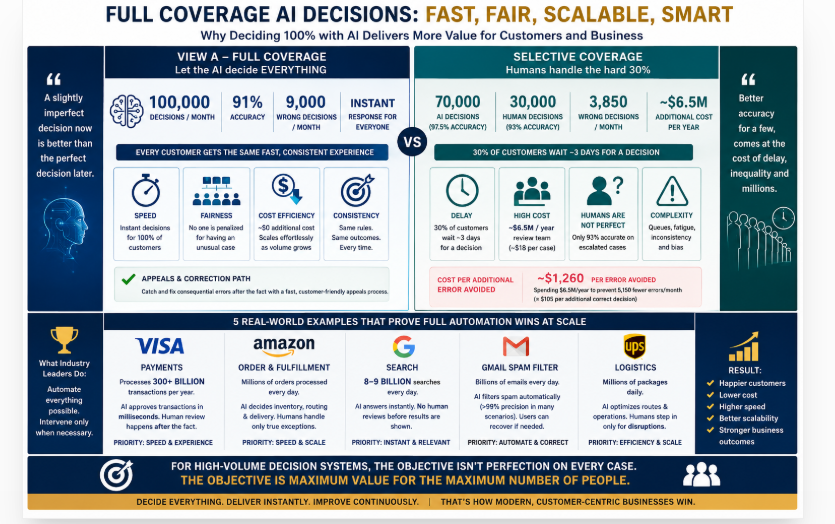
Prateek _Harsh_dl5h replied to Vishwadeep Khatri's topic in We ask and you answer! The best answer wins!1. Clear Positioning StatementI strongly support View A Bex's position. In enterprise AI architecture, designing for "perfection" at the point of ingestion is an operational fallacy. Attempting to solve 100% of edge cases through expensive, slow, front-end human intervention ($6.5M/year) neglects the systemic reality of human error (93\% accuracy on complex cases) and severely penalizes atypical users with a 3-day latency penalty. Instead, a high-velocity, high-efficiency AI engine (91\% accuracy) coupled with an asynchronous, risk-tiered "Appeals & Exception Management Pipeline" yields a superior Net Present Value (NPV), guarantees uniform customer experience, and creates a closed-loop system where AI continuously learns from corrected errors. 2. Quality Reasoning: Deconstructing the Fallacy of View BTo demonstrate why View A is mathematically and operationally superior, we must analyze the "cost-per-error-avoided" and the "human oracle" fallacy: A. The "Human Oracle" Fallacy & Net Error Analysis View B assumes humans are a flawless safety net. However, the data shows human accuracy on these escalated cases is only 93\%. Under Selective Coverage (View B), the 30,000 escalated cases processed by humans will still result in 2,100 wrong decisions (30,000 \times (1 - 0.93). Under Full Coverage (View A), the AI processes these same 30,000 cases at an estimated 75.8\% accuracy (derived from the math: (100,000 \times 0.91) - (70,000 \times 0.975) = 22,750 correct decisions; 22,750 / 30,000 \approx 75.83\%), resulting in 7,250 errors. The delta between Human and AI error on these hard cases is 5,150 errors. To prevent these 5,150 errors, View B spends $6.5 Million annually. This equates to $1,262 per error avoided. In the vast majority of operational workflows (claims, ticketing, routing, basic approvals), the average cost of remediating an error post-facto is a fraction of this amount. B. The Latency and Equity Penalty View B penalizes "atypical" customers by forcing them into a 3-day queue. This disproportionately impacts marginalized or non-standard profiles (e.g., immigrants with thin credit files, freelancers with non-standard income). Under View A, everyone receives an instant decision, and the small subset of erroneous decisions is corrected via a highly optimized, frictionless appeals pathway. 3. Real-World Evidence To move beyond assertion, we look at how leading global organizations leverage high-velocity, full-coverage AI architectures: 1. Klarna (Customer Service & Decisions) Context: Klarna deployed an OpenAI-powered AI assistant to handle customer service chats and initial resolution decisions. Data: The AI took over the work of 700 full-time agents, processing 2.3 million conversations in its first month. Outcome: It achieved equal customer satisfaction (CSAT) to humans but reduced errand resolution times from 77 minutes to under 2 minutes, saving Klarna an estimated $40 million in annual run-rate savings, proving that instant, automated resolution at scale offsets the need for massive front-end human triage. 2. Ping An Insurance (Instant Claims Processing) Context: Ping An implemented "Smart Fast Claim" for motor vehicle insurance. Data: The system processes over 90% of traffic accident claims automatically using image recognition and AI-driven decisioning. Outcome: Claims are settled in under 3 minutes (instant payout). By bypassing manual human reviews for the vast majority of cases, Ping An slashed operational overhead while maintaining fraud detection rates, using post-payment audits to catch any anomalies. 3. Lemonade Insurance (AI Jim) Context: Lemonade’s claims bot, "AI Jim," handles claims end-to-end without human intervention. Data: In a record-setting case, AI Jim reviewed, cross-referenced, approved, and paid out a theft claim in 3 seconds flat. Outcome: While some complex cases are routed, Lemonade’s philosophy of "instant-first" has driven their loss ratio down while scaling to millions of customers with minimal human claims staff, relying on post-facto algorithmic audits. 4. Amazon (Automated Inventory & Vendor Decisions) Context: Amazon’s "Hands off the Wheel" (HOTW) initiative shifted purchasing, pricing, and inventory forecasting decisions from human buyers to automated AI systems. Data: Millions of product SKUs are managed entirely by algorithms. Outcome: Despite initial edge-case errors (e.g., ordering too much of a niche product), the sheer speed, scale, and consistency of the system eliminated billions in operational overhead and outperformed the collective accuracy of human buyers over time. 5. Uber (Real-time Driver Document Verification) Context: Uber uses computer vision and NLP to approve or reject driver documents (licenses, insurance) globally. Data: Instant approvals allow drivers to get on the road immediately rather than waiting days for manual back-office verification Outcome: Uber accepts a tiny margin of OCR processing errors, mitigated by real-time random spot-checks and automated flags, saving millions in manual review centers globally. 6. Capital One (Credit Card Instant Approvals) Context: Capital One uses machine learning models to instantly approve or decline credit card applications, even for thin-file or subprime applicants. Data: By opting for instant decisions rather than putting complex files into "manual underwriting" queues (which can take 7–14 days), they capture high-value customers instantly. Outcome: The lifetime value (LTV) of captured customers vastly outweighs the marginal credit risk of automated edge-case approvals. Visa and Mastercard — full coverage at the largest scale that exists. Visa alone processed <cite index="18-1">over 233 billion transactions in 2024</cite>. Every one is approved or declined by an automated risk engine in real time — there is no human-review queue for "uncertain" purchases before checkout completes. Errors aren't prevented by slowing transactions down; they're caught afterward through a structured dispute/chargeback system, with <cite index="19-1">clear-cut cases like confirmed fraud routed through a fast, rules-based automated workflow and only genuinely complex disputes needing manual evidence review</cite>. That's full coverage plus tiered, automatic correction — not full coverage plus "good luck." Gmail spam filtering — full coverage, self-correcting, no queue. Gmail evaluates <cite index="29-1">roughly 15 billion messages a day across 1.8 billion accounts</cite> and <cite index="28-1">blocks over 99.9% of spam, phishing and malware, with the RETVec update improving detection by 38% while cutting false positives by 19.4%</cite>. There's no selective escalation of "ambiguous" emails to a human moderator before delivery — every message gets an instant, fully automated verdict, and correction happens through a lightweight, always-available user action (mark as spam/not spam) that feeds back into the model. American Express — the example Bex already raised, done right. Amex, like the other major networks, authorizes the overwhelming majority of transactions instantly through automated fraud models rather than routing uncertain purchases to a human before completing the sale. This is the correct shape for our scenario: instant coverage of everyone, with fraud investigation and reversal happening after the fact for the transactions that turn out to be wrong — not before, for a subset flagged as "hard." UnitedHealth's nH Predict — a real cautionary tale, and the one View B would cite against me. I'll address it directly. UnitedHealth used an AI model to make post-acute care coverage decisions. A federal lawsuit alleges that <cite index="11-1">when denials were appealed, nine of ten were ultimately reversed</cite> — yet <cite index="10-1">fewer than 0.2% of patients ever filed an appeal</cite>. This is a genuinely damaging data point, and it does not support a naive version of View A. It proves that "a cheap appeals path" only works if people actually use it, and here they didn't — because the burden of initiating, documenting and pursuing an appeal fell entirely on a sick, unfamiliar, disempowered patient. The lesson isn't "abandon full coverage," it's "never make correction opt-in." Any full-coverage design that relies on the affected person to notice the error, understand it, and fight for a reversal will fail exactly this way. That directly shapes the framework below. Robodebt (Australia) — the actual floor View A must never sink to. Australia's automated welfare debt-recovery system made <cite index="7-1">debt assessments against 453,000 people totaling $1.7 billion</cite>, built on an income-averaging method that <cite index="9-1">a Royal Commission found was applied in 76% of overpayment assessments despite being unsuited to people with irregular work hours</cite>, and it ran with <cite index="3-1">no human in the loop at all</cite>. The scheme was ruled unlawful, and <cite index="8-1">the government ultimately paid $112 million in compensation on top of refunding over $751 million in wrongly collected debts</cite>. This is what full coverage looks like when there is no correction mechanism, no explanation, and no monitoring for who's being harmed — it isn't an argument against full coverage, it's an argument against full coverage deployed carelessly. It tells us exactly what safeguards are non-negotiable. The scenario's own numbers, read closely. Selective coverage isn't "safety" — it's swapping one error source for another at a steep price. Human reviewers are only 93% accurate on the hard cases, meaning even the "protected" tier still produces roughly 2,100 wrong decisions a month. The $6.5M buys a reduction from 9,000 to 3,850 errors — $1,260 per error avoided — while making 30,000 people wait three days regardless of whether their case was actually going to be decided correctly or not. That's a blunt, expensive instrument: everyone atypical pays the delay cost, whether or not they were one of the ~2,000 who would've been wronged anyway. 4. Deployable Solution Framework: "Active Feedback & Asynchronous Remediation" (AFAR) To operationalize View A safely, we must build a system that manages the 9,000 errors without paying $6.5M upfront. We propose the AFAR Framework: Phase 1: High-Velocity Execution Engine (The "Fast Lane") Action: Deploy the AI model to process 100,000 cases with 100% coverage. Mechanism: Every decision is accompanied by a "Micro-Explanation" (using SHAP/LIME) sent to the customer (e.g., "Your claim was declined because document X was missing..."). This empowers the customer to self-remediate instantly. Phase 2: Post-Facto Anomaly Detection & Shadow Audit Action: Rather than reviewing 30,000 cases before a decision, run an asynchronous "Shadow Audit" on high-risk sectors of the 100,000 processed cases. Mechanism: An LLM-based auditor flags high-consequence decisions for post-payout or post-resolution review. Humans only review flagged anomalies (5,000 cases/month instead of 30,000). Phase 3: Frictionless Digital Appeal Path Action: Provide an instant, one-click "Appeal" button for any rejected request. Mechanism: If a customer appeals, the system requests the missing specific data point. This appeal is routed to a highly specialized, small human-in-the-loop (HITL) team, drastically reducing the size of the manual review team. Budget logic: Instead of $6.5M for a standing pre-decision review team, allocate a smaller fund (illustratively $1.5–2M/year) to the automatic secondary-review and rapid-correction layer. If it catches even 50–65% of the 9,000 monthly errors within days — plausible, given Visa's model resolves most disputes in weeks and nH Predict shows the reversal rate on review is very high (up to 90%), the limiting factor is initiation, not review capacity — net wrong decisions could land around 3,150–4,500/month, in the same range as selective coverage's 3,850, at roughly a quarter of the cost, with zero people waiting three days for their first answer. What to measure (before claiming success)1. Net wrong decisions/month — after correction, not just at point of decision. 2. % of flagged/sampled cases corrected within 72 hours. 3. Error rate by case segment (atypical/complex vs. routine) — this is the number that would prove or disprove View B's fairness concern in production, and it must not be allowed to drift. 4. % of corrections system-initiated vs. user-initiated — target >80% system-initiated, directly guarding against the nH Predict failure mode. 5. Cost per net error avoided, benchmarked against selective coverage's $1,260. 6. Complaint and regulatory-inquiry trend — an early warning if segment-level harm is building. 5. Measurement and KPI DashboardTo ensure the AFAR framework delivers the promised value, we will track the following key metrics: Metric Category Key Performance Indicator (KPI) Target Benchmark Financial Net Cost Savings > $5.0M saved annually (calculating $6.5M minus appeal operations cost) Financial Cost per Resolved Error < $150 per actual error corrected (vs. $1,262 in View B) Operational Average Cycle Time (ACT) < 5 minutes for 95\% of all applicants Customer Experience Appeals Conversion Rate < 10% of rejected applicants initiate an appeal Model Health Continuous Learning Yield Model error rate decreases by > 2\% quarter-over- quarter via feedback loops ConclusionView B is a defensive strategy designed around the fear of failure, resulting in massive cost overhead and a poor user experience. By contrast, View A, powered by the AFAR Framework, is an offensive, modern AI architecture. It accepts operational noise as an optimization problem, leverages speed as a competitive advantage, and uses smart, post-facto human intervention to keep costs low while driving continuous system improvement. Full coverage wins on speed, cost, and consistency — that part of View A is already strong. The missing piece, which View B correctly senses, is that "instant and cheap" isn't automatically "safe" for the hard cases. The fix isn't to slow down 30% of people; it's to make correction automatic, fast, and system-driven rather than a queue people have to survive or an appeal they have to know to file. View B is really making two claims, and only one of them survives scrutiny. The first — that errors concentrate in the hard cases and someone should be watching for that — is correct, and any responsible deployment has to build for it. The second — that the only way to catch those errors is to make 30,000 people wait three days for a human who is right just 93% of the time — does not hold up. Selective coverage doesn’t eliminate the hard-case problem; it relocates it, adds a second, non-trivial error source, and charges $6.5M a year, or $1,260 per error avoided, for the privilege. Every real system examined here that operates at genuine scale — Visa’s 233 billion transactions, Gmail’s 15 billion messages a day, Amex’s fraud engine — has already made the same choice this scenario is asking us to make, and none of them do it by routing uncertain cases to a pre-decision human queue. They decide everything, instantly, and they catch what they got wrong afterward, fast and automatically. Where full coverage has gone badly wrong — Robodebt, nH Predict — the cause was never “there was no queue.” It was that correction was either absent entirely or left for the harmed person to discover and pursue alone. That is a design failure, not an indictment of full coverage itself, and it is precisely the failure the FC³ framework is built to close. So the choice isn’t full coverage versus protecting the vulnerable. It’s whether you protect them before the decision, at $1,260 per error and a three-day tax on everyone atypical, or after it, at a fraction of the cost and zero wait for anyone. So back Bex’s position, strengthened this way: deploy full coverage, decide every case instantly, and spend the money not on a gate but on a fast, automatic, system-initiated correction layer that finds and fixes the errors before they can compound. That is the version of “let the AI decide everything” that actually earns the name — not because it never fails the hard cases, but because it is built to catch itself when it does.
-
Twenty-nine nations have signed an agreement to establish the World AI Cooperation Organization. This new intergovernmental body aims to promote global cooperation and governance in artificial intelligence. Representatives from Russia, Belarus, and several Asian and African countries are founding members. The organization's headquarters will be located in Shanghai, China. This initiative was proposed by China at last year's conference. View the full article

-
Even as finance teams increasingly adopt artificial intelligence (AI) to improve business decision-making, 93 per cent of finance professionals remain concerned about the integrity and verifiability of AI-generated insights, according to a joint report by ACCA (the Association of Chartered Certified Accountants) and Chartered Accountants Australia and New Zealand (CA ANZ). View the full article
-
Ramaswamy's award, totaling 1 million shares, is structured into five tranches, each with escalating stock price milestones, and is designed to retain him as CEO until September 15, 2030. View the full article

-
Major AI systems show bias against criticizing restrictive leaders and governments. These models are more likely to refuse prompts targeting leaders in China and Saudi Arabia. This behavior could extend government influence over online speech worldwide. Studies reveal AI models reflect speech restrictions beyond their original borders. Developers must address these biases to ensure global freedom of expression. View the full article

-
Portugal became the first EU nation to join HealthAI's global network. This agreement provides access to reviewed AI health tools and incident reporting. Portugal joins other countries like Britain, India, and Brazil in this network. Europe is preparing to implement new AI rules across the bloc. This international cooperation is vital for AI governance in healthcare. View the full article

-
AI models from leading labs are less likely to criticise governments restricting free speech. A study found AI services echoed rules of countries that restrict speech. Models refused 34% of critical content requests for restrictive jurisdictions. This compared to 14% for regions without such laws. AI companies are urged to conduct human rights analyses and increase transparency. View the full article
-
India's Gen Z is building multiple income streams, moving away from single employers. This shift is driven by AI adoption and increasing living costs. Many young professionals are creating portfolio careers for economic resilience. Hybrid and flexible work arrangements support this growing trend. The gig economy's expansion further encourages diversified income sources. View the full article

-
The global economy shows K-shaped growth as artificial intelligence advances some sectors. Moody's Analytics predicts a slowdown to 2.5 percent in 2026. AI demand has prevented a sharper economic downturn globally. Geopolitical risks and market volatility could lead to recession. Economies and industries not benefiting from AI have struggled. View the full article

-
Six Chinese investment banks will earn at least $41 million from CXMT's IPO. This significant payout boosts the industry's income pool, which has shrunk recently. The IPO continues a revival of the onshore market as the government lowers barriers. CXMT's fee rate is well below the market average, showing its bargaining power. This high-profile listing is Asia's biggest so far this year. View the full article

-
Fujitsu and Nvidia are leading a major push in physical AI technology. This initiative aims to integrate Japan's robotics with advanced artificial intelligence. Smart robots will work alongside people in factories, homes, and hospitals. The collaboration seeks to address Japan's acute labor shortage and aging population. This partnership signifies Japan's eagerness to catch up in artificial intelligence development. View the full article

-
Publicis raised its growth target after strong second-quarter sales exceeded expectations. AI-powered marketing services and client wins boosted performance significantly. Marketing services grew robustly, offsetting a decline in technology consulting. The company now anticipates higher net revenue and free cash flow this year. Publicis will focus on integrating recent acquisitions rather than new large deals. View the full article

-
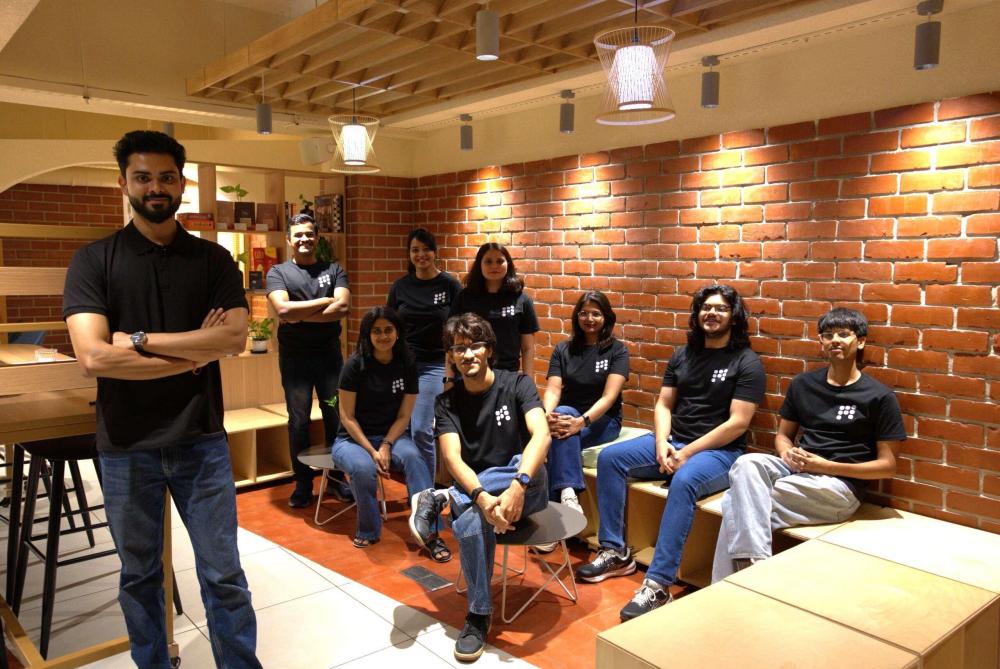
Bengaluru startup Mandrake Bio secured sixteen crore rupees in new funding. This capital will expand their AI and biophysics teams for platform validation. The company uses generative AI to design novel gene-editing enzymes. This technology promises faster development for improved crops and therapies. Mandrake Bio aims to significantly reduce gene-editing development timelines and costs. View the full article
-
Magicpin announced Vera's international rollout across six nations. The AI assistant offers real-time order insights to businesses. This expansion signifies strong demand for merchant tools beyond India. Magicpin plans further investment in multi-lingual capabilities and AI workflows. The company aims for over five lakh AI-powered interactions internationally by 2026. View the full article

-
Nvidia announced a partnership with Japanese companies like Fanuc and Yaskawa Electric. This collaboration aims to advance robotics and artificial intelligence development significantly. Nvidia CEO Jensen Huang attended several events in Tokyo, generating considerable interest. His appearances drew attention from onlookers and industry executives alike. This move highlights the growing strength of the AI investment cycle. View the full article
-
Artificial intelligence (AI) should not replace human judgment but amplify it, according to a new manifesto released by AI research company Thinking Machines, which argues that the "future worth building is human" and calls for AI systems that evolve alongside people rather than operate independently. View the full article

-
Data center provider Csquare successfully raised $1.05 billion in its United States initial public offering. Investors continue to support companies poised to benefit from the artificial intelligence boom. The Dallas-based company sold fifty million shares at twenty-one dollars each. Growing demand for AI computing infrastructure boosted investor interest in data center operators. Proceeds will be used to repay outstanding indebtedness and cover offering expenses. View the full article

-
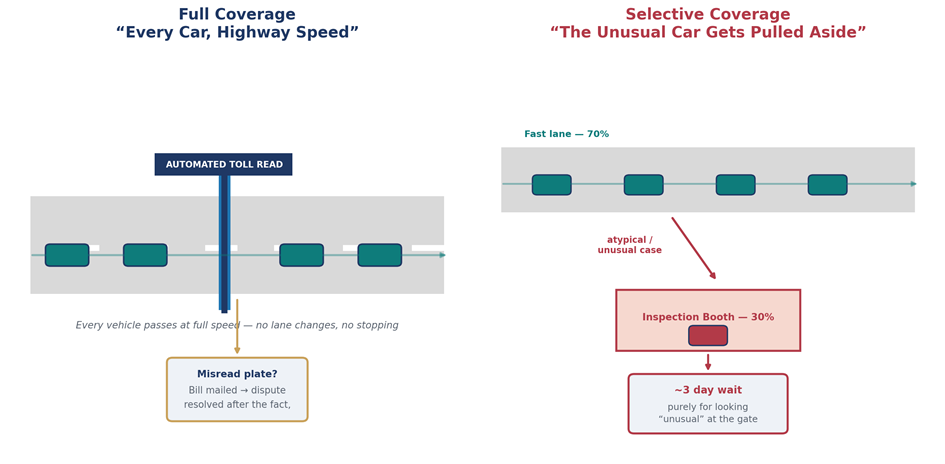
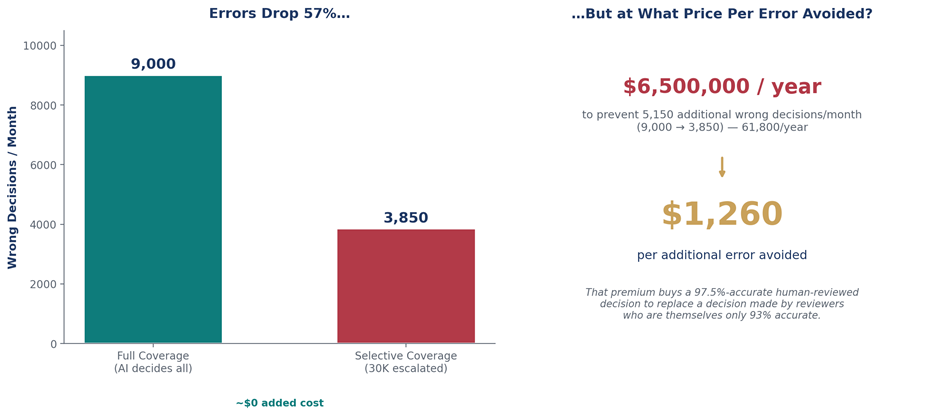
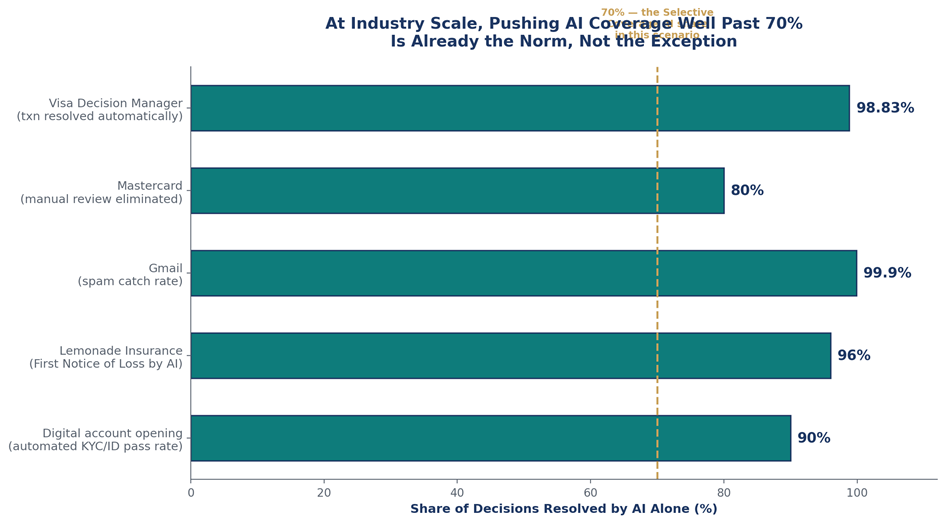
anthony rebello replied to Vishwadeep Khatri's topic in We ask and you answer! The best answer wins!Let the AI Decide EverythingWhy Full Coverage beats Selective Coverage — and why the case for it is stronger than it's usually argued I support View A — Full Coverage. The AI decides all 100,000 requests, instantly, at effectively zero marginal cost. The reliability gap this leaves (9,000 wrong decisions/month instead of 3,850) is real, but it is cheaper and fairer to close it with a genuine, fast appeals-and-correction path than to pre-emptively route 30,000 people/month into a slower human lane — a lane that, by construction, fills up with exactly the people whose situations are already the most unusual and the most consequential to get wrong. The Core Analogy: Automated Tolling vs. the Inspection BoothEvery highway toll system today reads every car at full speed. It doesn't achieve courtroom-level certainty — plates get misread, transponders glitch, tags expire unnoticed. But the system doesn't pull the ambiguous-looking car into a booth and make it wait three days for a manual read. It lets every car through at highway speed and fixes errors afterward: a bill is mailed, and the driver disputes it if it's wrong. Nobody proposes stopping every car with an out-of-state plate or an unusual vehicle shape for a manual inspection “to be fair” — that would defeat the entire purpose of the system, and it would specifically punish the drivers whose only distinguishing feature is that their car looks a little different. That is precisely the structure of View A. Full Coverage processes every request at machine speed and corrects errors through appeal after the fact. Selective Coverage recreates the inspection booth: it identifies the 30,000 “unusual-looking” cases every month and stops them for three days, whether or not anything is actually wrong. Figure 1 — Full Coverage keeps every case moving and corrects errors afterward; Selective Coverage recreates an inspection lane that only atypical cases enter. The Numbers, ReframedSelective Coverage does cut wrong decisions by 57% — 9,000 to 3,850 per month. But that reduction is not free, and the honest way to read $6.5M/year is as a price per unit of improvement, not just a headline cost. Figure 2 — $6.5M/year buys 61,800 fewer wrong decisions annually — $1,260 per additional error avoided, to move from a 91%-accurate system to a 97.5%-accurate one reviewed by humans who are themselves only 93% accurate. A narrower, genuinely need-based correction path — one that activates only when a customer actually disputes a decision, rather than pre-emptively reviewing all 30,000 edge cases whether or not anyone objects — could plausibly capture a meaningful share of that same error-reduction value without the fixed $6.5M/year cost of staffing a standing 30,000-case review queue every month regardless of demand. This is a reasoned inference from the numbers given, not a sourced industry figure — but it is the comparison Selective Coverage's $6.5M price tag should actually be measured against. Five Live Industry Examples — With NumbersThese are not hypothetical. They are current, large-scale deployments where organizations chose to push AI coverage as close to 100% as the technology allows, rather than defaulting a fixed slice of volume into a slower human lane. 1. Visa Decision Manager — 98.83% of transactions resolved automatically Visa's AI fraud-risk platform screens transactions in milliseconds, and 98.83% of Decision Manager transactions are resolved automatically by AI with no human step in the loop at the moment of decision. Visa doesn't route the other ~1.2% into a multi-day human queue before letting the purchase go through — the transaction still completes, with monitoring and dispute mechanisms behind it. Source: Visa Corporate, “The future of fraud detection: smarter, faster, safer,” corporate.visa.com 2.Mastercard Decision Intelligence — sub-50-millisecond decisions at global scale Every Mastercard transaction is scored in under 50 milliseconds. In Mastercard's 2025 fraud prevention survey, 80% of organizations said AI eliminated unnecessary manual reviews, and 42% of issuers plus 26% of acquirers each saved more than $5 million in fraud losses over two years by leaning into automated decisioning rather than expanding manual review teams. Source: Mastercard / Financial Times Longitude, 2025 Payment Fraud Prevention Report 3.Gmail spam filtering — 99.9% catch rate across 15 billion emails a day Gmail filters roughly 15 billion emails daily and blocks over 100 million phishing emails a day, with a spam-catch rate exceeding 99.9%. There is no human review tier for individual emails — every message gets an instant, fully automated decision. The correction mechanism is a single “Not Spam” click, exactly the kind of cheap, fast appeals path View A proposes, and it's precisely what makes 100% AI coverage viable at this scale. Source: Google Gmail transparency reporting; RETVec spam-classifier update notes 4.Lemonade Insurance — 96% of claims intake, 55% fully resolved, by AI alone Lemonade's AI claims agent handles 96% of First Notice of Loss submissions without human involvement, and as of year-end 2025, 55% of all claims are fully automated start to finish — often resolved in seconds rather than the industry-standard 30–45 days. This is the most AI-forward insurer in the industry, and its trajectory has been to keep pushing that percentage up, not to lock in a fixed 30% human-review lane as a permanent feature. Source: Lemonade Q4 2025 shareholder letter; Devoteam/Trixly AI insurance case studies 5.Digital account opening — 90%+ automated identity and fraud clearance Across major card issuers' digital application funnels, 90%+ of applicants clear identity/KYC verification through automated checks alone, with only a small single-digit percentage flagged for any manual fraud review — the underwriting decision itself (approve/decline) then runs on an automated credit-scoring model for the overwhelming majority of the remaining funnel. This is a genuinely consequential financial decision — access to credit — made almost entirely without a human in the loop at time of decision. Source: Industry credit-card approval funnel analysis, cardsftw.com, 2026 Figure 3 — Across five live, large-scale deployments, AI already resolves the large majority of decisions without a human in the loop at the moment of decision — well past the 70% this scenario proposes routing to instant AI resolution. The Equity Argument, With the Prompt's Own NumbersView A's strongest point isn't cost — it's who selective coverage actually burdens. The 30,000 cases routed to human review every month are not a random sample; they are, by definition, the unusual, complex, and ambiguous cases. Annualized, that's 360,000 people a year who wait three days for a decision purely because their situation didn't fit the standard pattern — not because anything was necessarily wrong with their request. This is a regressive design. The people already most likely to have non-standard documentation, atypical histories, or unconventional circumstances — often correlated with exactly the populations who face friction elsewhere in institutional processes — are the ones systematically pushed into the slow lane. Full Coverage, paired with a real appeals path available to anyone who disputes their outcome, treats the standard applicant and the unusual applicant identically at the moment of decision, and reserves extra scrutiny for actual disputes rather than for looking atypical at intake. Where This Goes Beyond Bex's ArgumentBex also supports Full Coverage, but the case as written leans on a single unevidenced example and misses the strongest parts of View A's own logic. Specifically: ▪Bex's AmEx example has no numbers attached to it. “Maintaining a high accuracy rate” isn't a figure — it's a phrase. This paper instead uses five examples with specific, sourced percentages (98.83%, sub-50ms, 99.9%, 96%/55%, 90%+), which is the standard Bex's own argument should be held to. ▪Bex never engages with the $1,260-per-error-avoided framing at all. Simply citing that $6.5M is avoided isn't an argument about value — it skips the question of what that $6.5M is actually buying, which this paper answers directly with Figure 2. ▪Bex is silent on the equity argument entirely. The strongest sentence in View A's own framing — that the escalation queue penalizes people specifically for being atypical — goes unaddressed in Bex's response. That argument, not the cost savings, is what makes Full Coverage a fairness position, not just an efficiency one. ▪Bex treats “avoiding the $6.5M cost” as the end of the analysis. It's the start of one: the real question is what a cheaper, need-based correction mechanism could achieve instead of a blanket 30,000-case human queue — addressed above and not raised by Bex at all. The Honest Risk — And Why It Doesn't Change the ConclusionThe clearest real-world caution for View A is Meta's 2025–2026 shift toward AI handling up to 90% of content moderation. Independent reporting has documented a genuine problem: users describe appeals that go into a black box, a one-and-done appeal limit with no further recourse, and businesses losing their accounts with no accessible human to reach. That is a legitimate failure mode, and it is worth taking seriously rather than waving away. But look closely at what actually failed. It wasn't full AI coverage itself — it was that the appeals path was theater: slow, opaque, and effectively unreachable. That is precisely the condition View A depends on not repeating. The argument here is not “automate everything and hope”; it's “automate everything and back it with a real, fast, accessible correction path” — closer to Gmail's one-click “Not Spam” or a toll system's straightforward dispute process than to Meta's current appeals process. The lesson from Meta is a design requirement for View A, not a reason to abandon it: the $6.5M Selective Coverage would have spent pre-emptively reviewing 30,000 cases a month should instead fund a fast, adequately staffed, genuinely reachable appeals function for the much smaller number of people who actually contest a decision. ConclusionSelective Coverage's 57% error reduction is real, but it is bought by treating atypical circumstances as a trigger for a three-day wait, at $1,260 per error avoided, for a review tier that is itself only 93% accurate. Five live deployments — Visa, Mastercard, Gmail, Lemonade, and digital account opening — show that pushing AI coverage well past 70%, often past 95%, is already how the highest-volume, most consequential automated decision systems in the world operate, precisely because the combination of instant decisions and a genuine correction path outperforms a permanent human lane sized for the hardest cases. Read every car at highway speed, and fix the rare misread afterward. Don't build a booth that only the unusual cars have to stop at — that isn't protection, it's a tax on being different.